

 Ask Perplexity

To get cited by AI engines, make your pages reachable, put direct answers at the top, back claims with sources, and earn mentions on other sites. These six steps are the order we’d do it in, and they sit on top of your SEO rather than replacing it.
Answer Engine Optimization (AEO), also called Generative Engine Optimization (GEO), is the work of becoming a source AI answers draw on. Our look at what gets a page cited covers the evidence in more depth. This post is the plan.
Contents
- The Plan at a Glance
- Step 1: Measure Where You Stand
- Step 2: Restructure Your Content for Extraction
- Step 3: Add Schema Where It Describes Real Facts
- Step 4: Cover Your Topic in Depth
- Step 5: Earn Mentions on Other Sites
- Step 6: Speed Up Discovery and Monitor Monthly
- What Not to Do
- Start This Week
- FAQ
The Plan at a Glance
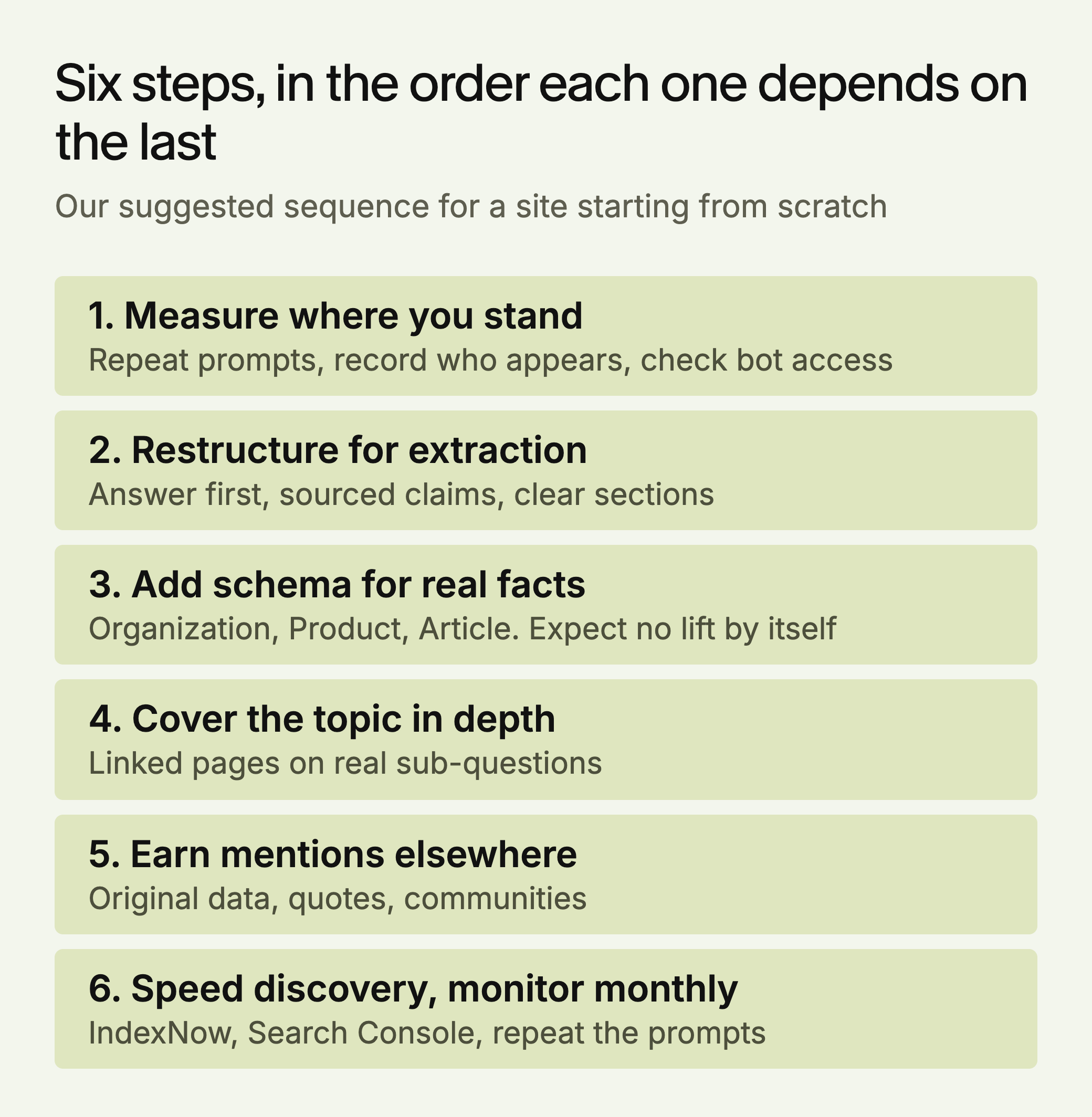
The order is deliberate. Rewriting a page bots can’t reach is wasted, and earning mentions for a site with nothing worth citing brings little back. If you’ve already done a step well, skip it, but don’t skip the measurement. Without a baseline you won’t know whether anything worked.
Step 1: Measure Where You Stand
Open ChatGPT, Perplexity, Claude and Gemini and ask the questions your customers ask:
- “What’s the best [your product category] for [use case]?”
- “How do I solve [problem your business solves]?”
- “Compare [your brand] vs [competitor]”
- “Is [your brand] a good choice for [use case]?”
Run each prompt several times and record how often you appear, and who appears instead. One run proves little: SparkToro’s research (not peer reviewed) found less than a 1-in-100 chance that ChatGPT or Google’s AI would give the same list of brands in any two responses. Share of appearances across repeated runs is the number to track.
Record five things per run: the prompt, the engine, whether you were named, whether your URL was cited, and who else appeared. Named and cited are different results. Named without a link means the engine knows you but didn’t use your page.
Be honest about what a small test can show. SparkToro’s authors ran each prompt 60 to 100 times, say that’s usually the minimum for sound figures, and call the exact number an open question. Three runs by hand tells you whether you’re absent or present. It can’t tell you a five-point rise is real.
Here’s how a first scorecard might read. The company and figures below are made up for illustration: ten prompts, three runs each, so 30 runs per engine.
| Engine | Tessel appears | Top competitor appears | What it suggests |
|---|---|---|---|
| ChatGPT | 3 of 30 | 21 of 30 | Biggest gap. Check crawler access and indexing in Bing |
| Perplexity | 11 of 30 | 14 of 30 | Close already. Passage-level edits may be enough |
| Gemini | 6 of 30 | 20 of 30 | Check Search Console for indexing problems |
| Claude | 2 of 30 | 18 of 30 | Treat as a brand-mention gap, and revisit after Step 5 |
While you’re there, check access. OpenAI says OAI-SearchBot controls whether you appear in ChatGPT search answers, and Perplexity recommends allowing PerplexityBot. Make sure neither robots.txt nor your CDN blocks them.
To confirm it worked, search your server logs for OAI-SearchBot and PerplexityBot and check that they get 200 responses. A 403 or a challenge page means a block your robots file won’t show. Allow a day for changes: OpenAI says about 24 hours and Perplexity says up to 24 hours. Perplexity also warns that Cloudflare’s Bot Fight Mode can still challenge its crawler when a custom rule allows it, and that its IP ranges change, so check the logs again after any security update.
One common mistake: blocking GPTBot does not remove you from ChatGPT search, and allowing it doesn’t put you there. GPTBot is for model training. OAI-SearchBot decides search visibility.
Step 2: Restructure Your Content for Extraction
Perplexity says it scores results at both the document and sub-document level, so each section has to work on its own. Four changes we’d make first:
- Put the answer first. State it in the first one or two sentences of the section.
- Use headings that say what the section answers. “How pricing works for teams over 50” tells a reader and a machine more than “Overview”. A question form is optional: SE Ranking’s ChatGPT study (vendor data) found question-style titles and H1s averaged 3.4 citations against 4.3 for plain ones, and its authors call the format context-dependent.
- Attribute your data. In the Princeton GEO study, adding statistics gained about 31% and adding quotations about 41% on its word-count measure. Those are tests on a benchmark, with only a 200-query check on Perplexity, so they aren’t proof for live engines, but sourced claims also help your readers.
- Answer real follow-up questions. Add an FAQ only where people actually ask those questions. SE Ranking found pages with FAQ sections averaged about the same citations as pages without (3.8 against 4.1), so don’t add one for its own sake.
Don’t overdo the splitting. Google says you don’t need to chunk content into small pieces, and SE Ranking’s data on section length (a correlation) points the same way.
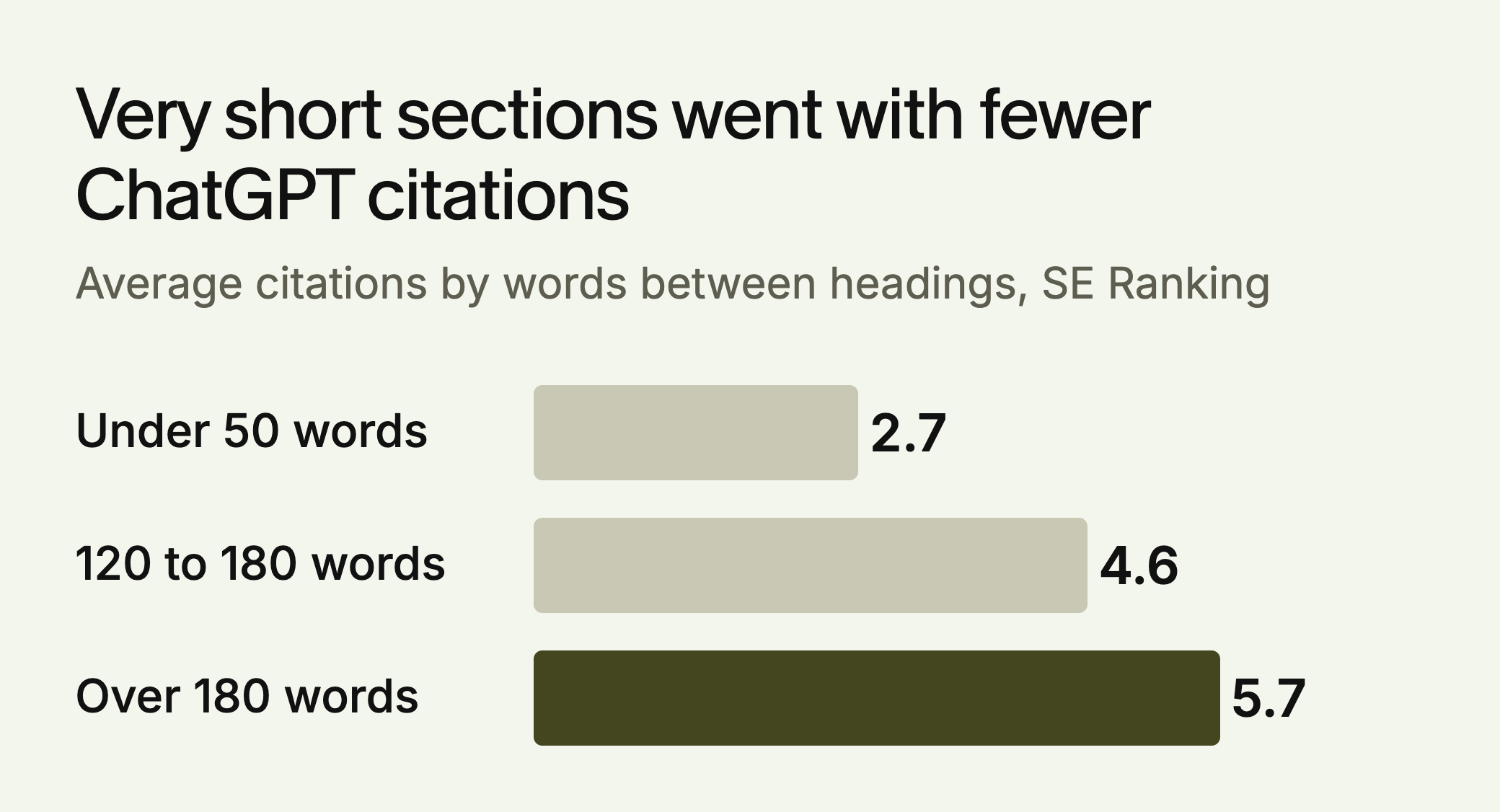
SE Ranking cautions that the over-180 result may reflect thorough coverage rather than readability. The safe reading is narrow: sections of a sentence or two give an engine little to work with. Write a section as long as its answer needs, with the answer at the top.
There’s experimental support for restructuring. In GEO-SFE, a March 2026 preprint, restructuring 200 benchmark articles raised the citation rate across six engines from 45.0% to 52.8%. The authors credit document structure with about 45% of the gain, chunking 40% and emphasis 15%.
Here’s what the rewrite looks like. The company and figures are made up for illustration.
| Before | After |
|---|---|
| Overview. Modern teams need flexible tools. Tessel helps you get more from your schedule with smart features that grow with you. | How shift scheduling works for teams of 20 to 200. Tessel builds a weekly rota from staff availability and labor rules, then texts it to each employee. In our 2026 survey of 140 retail managers, rota building fell from 5.1 hours a week to 1.4. Pricing starts at $3 per employee per month. |
Work through your pages in revenue order, and within that, start where you aren’t already winning. In the Princeton benchmark, with every source in an answer edited at once, adding citations raised visibility by 115.1% at rank 5 and cut it by 30.3% at rank 1, so test edits on pages behind the leaders first.
Step 3: Add Schema Where It Describes Real Facts
Evidence on schema is mixed and depends on the schema type and the engine. Google says no special schema.org markup is needed for its AI features. Add structured data because it describes your business accurately and earns rich results where they’re available, and use JSON-LD so it’s easy to maintain.
Ahrefs’ May 2026 test (vendor data) is the closest thing to a controlled result. Across 1,885 pages that added JSON-LD and 4,000 controls, AI Mode (+2.4%) and ChatGPT (+2.2%) were indistinguishable from zero, and AI Overviews fell 4.6%. Ahrefs can’t say schema caused that decline, and it tested only pages AI already cited. Don’t schedule schema work expecting more citations.
- Organization: your name, logo and social profiles, on the homepage.
- Product: price, availability and reviews, if you sell anything.
- Article: author and dates on editorial content.
Start with Organization. Google’s documentation lists no required properties, recommends the home page or a single page that describes your organization, and suggests leading with name, address or telephone, and url or logo. Use sameAs to link your profiles on other sites. The details below are made up:
<script type="application/ld+json">
{
  "@context": "https://schema.org",
  "@type": "Organization",
  "name": "Tessel",
  "url": "https://www.example.com",
  "logo": "https://www.example.com/logo.png",
  "sameAs": ["https://www.linkedin.com/company/example"]
}
</script>
Check it with the Rich Results Test, then use URL Inspection to see what Google sees.
Don’t add FAQ or HowTo markup expecting search features. Google limited FAQ rich results to well-known government and health sites and deprecated HowTo results in 2023. Make sure markup matches the visible text. Our review of the schema studies goes through the conflicting results.
Step 4: Cover Your Topic in Depth
Engines split one question into several searches. In AirOps’ March 2026 report (vendor data), 95% of ChatGPT’s fan-out queries had no monthly search volume by traditional metrics, so a keyword list will miss them. Depth is our best guess at how to show up for the ones you can’t see.
Match the format to the intent. AirOps found comparison queries split into sub-queries 38.4% of the time, and it recommends depth on the core topic for informational queries and modular coverage (pricing, features, alternatives, comparisons) for commercial ones.
If you sell project management software, one post about project management won’t cover it. Write a main page on the topic, then separate pages for task delegation, Gantt charts, agile, remote teams and templates, and link them together. Start with the questions you hear on sales calls.
Google draws a limit here. Its guide says creating pages for every query variation or fan-out query to manipulate rankings can violate the scaled content abuse policy, and that more pages don’t make a site higher quality. Use a simple rule: a new page needs a different answer, a different reader, or enough material that it would crowd out the main page. Otherwise add a section.
| Business | Build first | Skip |
|---|---|---|
| B2B software | Pricing, integrations, security, alternatives, comparisons | A page for each keyword variant |
| Ecommerce | Buying guides, full specs, accurate Merchant Center feed | Copied manufacturer descriptions |
| Local services | Complete Business Profile, one strong page per service | Near-identical pages for each town |
| Small sites | One narrow topic, finished before starting another | Broad topics dominated by large sites |
A good sign is pages other than your main one starting to appear in your Step 1 runs.
Step 5: Earn Mentions on Other Sites
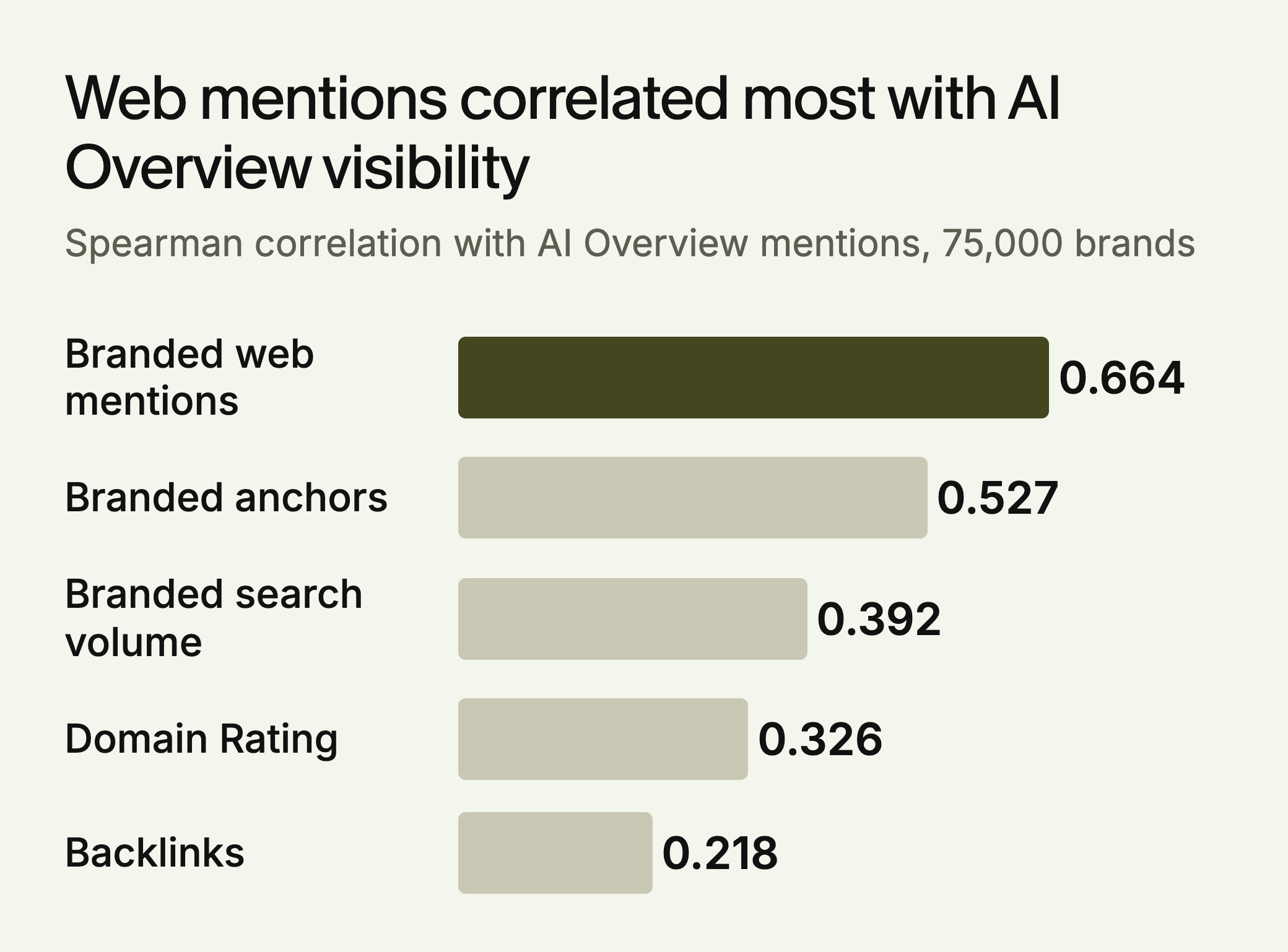
In Ahrefs’ study of 75,000 brands (vendor data), branded web mentions correlated with Google AI Overview visibility at 0.664, against 0.218 for backlinks. That’s correlation, and big brands get more of everything, but it’s the strongest correlation in the study. Google also warns that manufactured mentions don’t help much, so the mentions have to be real.
- Publish original data from your customers or product.
- Offer quotes to journalists who cover your industry.
- Write for publications your buyers already read.
- Take part in the forums and communities where your category gets discussed.
We think original data is the most durable of these, because other writers need a source to cite when they use the number.
We’d budget one person and a month. Pick one number nobody else has, such as a median from your product data. Publish it on its own page with the sample, the date and how you calculated it. Then send it to five writers who covered the topic in the last year, with one sentence on why it changes what they wrote.
Where you earn mentions depends on the engine and the buyer. In Profound’s data on 680 million citations (vendor data, August 2024 to June 2025), G2 and Forbes were among ChatGPT’s most cited sources, Reddit and YouTube led Google AI Overviews, and Yelp and TripAdvisor made Perplexity’s top 10. SE Ranking found domains with profiles on several review platforms averaged 4.6 to 6.3 ChatGPT citations, against 1.8 without. Both are observations, not proof that a profile causes citations, but a complete profile is cheap.
Step 6: Speed Up Discovery and Monitor Monthly
IndexNow tells participating engines that a page changed. They include Amazon, Bing, Naver, Seznam, Yandex and Yep. Google isn’t listed, and IndexNow doesn’t guarantee indexing. We think it’s worth enabling because ChatGPT search has used Bing as a provider, as TechTarget reported. Check whether your CMS or CDN supports it.
If yours doesn’t, setup is short: generate a key, save it as a text file named after the key at your site root, and POST changed URLs to api.indexnow.org/indexnow. IndexNow’s documentation says a 200 means the URL was received, and a 202 means it was received but the key check is still pending.
Repeat your Step 1 prompts every month. Google’s Generative AI performance report in Search Console shows impressions from AI Overviews and AI Mode by page, country and device. LLMagnet measures AI visibility across seven engines, and its agent prepares fixes for your approval. Google Alerts on your brand and competitors will show who is earning mentions.
| Measure | Where | What to look for |
|---|---|---|
| Share of appearances | Your Step 1 prompts, by engine | A rise larger than the swing between repeat runs |
| Named against cited | The same runs | More linked citations, not only mentions |
| AI impressions by page | Search Console | Important pages that show none |
| Citations by page | Bing’s AI Performance report | Copilot, Bing summaries and select partners only. Don’t read it as ChatGPT data |
| Crawler status codes | Server logs | New 403s after a security change |
| AI referrals | Analytics | Landing pages and conversions. Clicks undercount exposure |
What Not to Do
Don’t expect citations from llms.txt. SE Ranking’s study of nearly 300,000 domains found no measurable link to citations, and Google Search doesn’t use the file. It may still give agents a useful map, so it can be worth a few minutes, as our llms.txt breakdown explains. Do the work above first.
Don’t abandon SEO. In AirOps’ data, pages ranking first on Google were cited at a 43.2% rate, 3.5 times the rate for pages beyond the top 20. Google also says its AI features run on its core ranking systems.
Don’t change everything at once. If you rewrite pages, add schema and start outreach in the same month, you won’t know which one moved the number. Stagger the work, and note the date of each change.
Don’t judge a result from one chat. Answers vary too much. Use the same prompts, the same number of runs and the same engines each month.
Start This Week
- Check that robots.txt and your CDN allow Googlebot, OAI-SearchBot and PerplexityBot.
- Run ten customer questions through four engines, three times each, and record the results.
- Rewrite your main product page so the first two sentences say what it is and who it’s for.
- Add Organization schema to your homepage.
- Add one sourced number or attributed quote to each of your top five pages.


 Ask Claude

 Ask Gemini



 30-day free trial · no credit card