

Advertise
Where paid could help,
and where it can’t
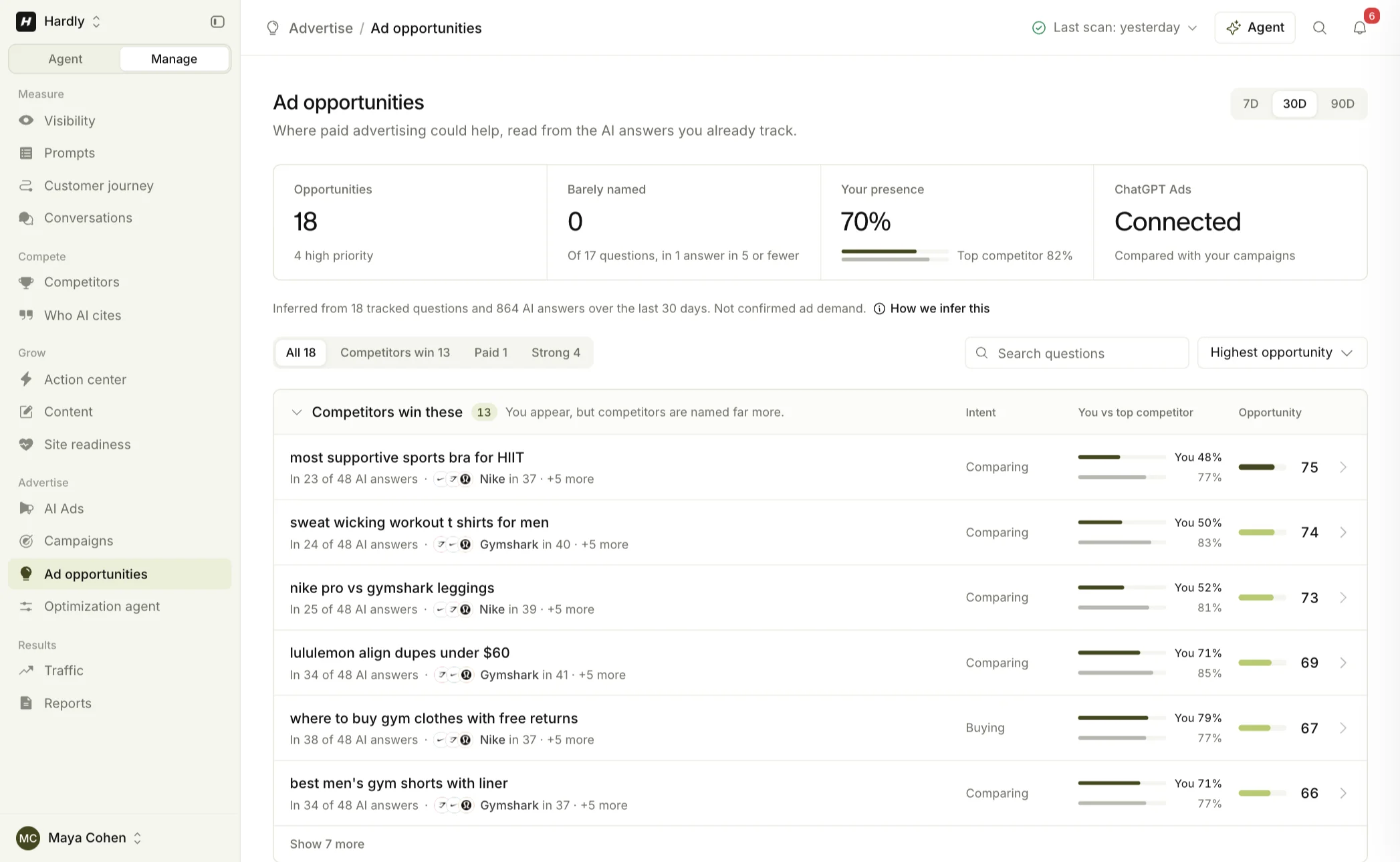
LLMagnet reads the answers it already tracks for you and lists the questions where paid might be worth a test, with the evidence behind each one and a label saying how far that evidence goes.
Book a demoSee what it’s inferred from
30-day free trial · no credit card
The problem
The worst ad budget is the one buying something you already had
A ChatGPT Ads account can tell you what a campaign spent. It can’t tell you that the question you just bought was one AI already named you for, unpaid, in six answers out of seven. That’s money spent to stand where you were already standing, and there’s no line item for it.
Keyword plannersquat proof leggings
KeywordAvg. monthly searches
squat proof leggings—
high waisted gym leggings—
best leggings for squats—
Not available for chat answers
 Lululemon namedHardly —
 Lululemon namedHardly —
 Lululemon namedHardly —
 Lululemon namedHardly —
 Lululemon namedHardly —
 Lululemon namedHardly —
 Lululemon namedHardly —
You0 of 7
Score80
Inferred · high confidenceThere’s no keyword tool for this
The planners you’ve used for twenty years rest on counted searches. Nobody counts the questions inside a chat for you, so the starting point has to be something you can actually see.
A question you lost, with the answers that prove it
Each opportunity opens onto the prompt it came from, how often you were named, how often a competitor was, and a next step you can read before you spend anything. Hover the numbers; open the answers.
Visibility gapHigh priority“best squat proof leggings”1The heading is a prompt we tracked for you, not a keyword with a volume figure behind it.
Visibility gap score80High confidence
You appear in 0 of 7 tracked answers to this question20 of 7 is countable. The seven answers are below; open any of them.
You appear in0%
Competitor presence3The other half of the same answers. Somebody was named, and it wasn’t you.100%Lululemon · 7 of 7
Suggested next step4It ends in a review, not a launch. Nothing here spends.Draft a paused ad group with a small test budget and conversion tracking, then review it before anything goes live.
Inferred from last 7 days of tracked answers.5The footer names the window. Change the window and the list changes.
The seven answers“best squat proof leggings” · Oct 26 – Nov 1
For squats, most lifters point to Lululemon’s Align: opaque at full depth, and high enough to stay put.
Lululemon namedHardly not named
These are inferred opportunities. A tracked prompt shows how an AI engine answered it for you. It does not prove how often anyone asks it inside ChatGPT, that ad inventory exists for it, or that an ad can be aimed at that exact question. Treat each one as a test worth running, not as confirmed demand.

Five types
Five things worth knowing before you spend
Every opportunity is one of five types, and the type tells you what kind of decision you’re being handed.
- 01Visibility gap
A question you’re tracking where you’re barely named, or not named at all.
Your tracked answers - 02Competitor dominance
A rival is named across the answers to a question, and you aren’t.
Your tracked answers - 03Paid performance gap
A campaign has spent real money and the account reports zero conversions.
Your ads account - 04Organic strength
You’re already named here, for free. Paying for it buys nothing new.
Your tracked answers - 05Unmeasured spend
A campaign is spending and nothing is measured, so there’s nothing to judge it by.
Your ads account
Each one carries a score from 0 to 100, a priority, a confidence level, the prompt it came from, your organic visibility, the competitor presence, and evidence rows naming where every number came from.
We won’t judge a campaign that has barely run
Neither of the two spend-based types appears until a campaign has spent at least 50 in your account’s currency. Below that there isn’t enough to say anything, and a confident verdict drawn from a handful of impressions is worse than no verdict at all.
- Rep Seamless · Leggings£0.00No verdict yet
- Holiday prep£61.67Unmeasured spend
- Shorts · Prospecting£209.28Unmeasured spend
- Spring training · Brand£371.05Unmeasured spend
Organic strength
Sometimes the finding
is: don’t buy this
Organic strength is a type of its own. It marks the questions where AI already names you without a budget, so if a campaign is pointed at one of them, you’re paying for an answer you were getting anyway.
It’s the least exciting card in the list and the most useful one. Paid and organic teams rarely share a screen, which is how a brand ends up bidding against its own best answer. Here they’re two columns of the same card.

Organic strengthMedium priority
“best gym wear brands uk”You appear in86%6 of 7 answers
Competitor presence29%Nike · 2 of 7
You’re named here without a budget. Check that no campaign is paying to stand where you already are.
Inferred from last 7 days of tracked answers · high confidence
Found it. Now fix it.
This page shows where paid might help. The optimization agent turns a decision into a prepared change, and waits for your approval.
Optimization agent
From a card to a change
The proposal carries the same prompt, its evidence rows, a confidence label and a date it expires. Dismiss weighs as much as Approve.
 Optimization agentExpires Nov 8
From: Visibility gap · “best squat proof leggings”
Create a paused test campaign, £10.00/day
Named in answers0 of 7LLMagnet
Lululemon named7 of 7LLMagnet
Spend on this topic£0.00ChatGPT Ads
Medium confidenceCreated paused · you activate it
What it’s allowed to do
Four changes, and no others
Pause a campaign, activate one, move a budget, or create one. It reads the campaign back from your account before it reports anything as applied.
- Pause a campaign
- Activate a campaign
- Move a budget
- Create a campaign
The score is a sort order, not a measurement
It ranks the list. It doesn’t estimate return, volume or cost.
Weights are a product hypothesis, not a measurement.
- What it’s built from. Your organic visibility on the prompt, how present a competitor is in the same answers and, once you have spend, what the ads account reports. Those inputs are weighted, and we chose the weights.
- What the confidence label is for. Low, medium or high, moving with how much the underlying answers agreed. One answer and a pattern held across a week aren’t the same finding, and they aren’t labeled as one.
- What you can do instead of trusting it. Open the evidence. Every card lists its rows and the prompt behind them, so the order can be checked rather than taken on faith. How we measure
EvidenceOrganic strength · “best gym wear brands uk” · 45
| Metric | Baseline | Current | Period | Source |
|---|---|---|---|---|
| Named in answers | 5 of 7 | 6 of 7 | 7 days | LLMagnet |
| Nike named | 3 of 7 | 2 of 7 | 7 days | LLMagnet |
| Spend · Spring training | £318.40 | £371.05 | 7 days | ChatGPT Ads |
| Conversions | Not measured | Not measured | 7 days | ChatGPT Ads |
1.7%of the time, four AI models cited the same domain for the same question
Answers move between days, too: run again two days later, Claude kept only 30% of the URLs it had cited, and Perplexity, the steadiest, 65%. A score read off one day’s answers would have no shelf life, which is why every card states its window.
Why every card says “inferred”. We haven’t seen evidence, from anyone, that a gap in AI visibility predicts how an ad will perform. So we don’t imply it. The word stays on the card, and the evidence rows do the rest.
So this is keyword research for ChatGPT?
No, and we’d rather lose the comparison than make it. Keyword research starts from counted demand. This starts from answers we ran and stored for you, which proves absence, not appetite. It can’t tell you how often anyone asks the question, whether inventory exists for it, or that an ad can be aimed at it. Each card is a test worth running, and that’s the whole claim.
Opportunities are where you decide
What it proposes from theseOptimization agent
Create a paused test campaignMedium confidence · expires Nov 8
DismissApprove change
The account these are compared againstChatGPT Ads
£642.00Spend · Oct 26 – Nov 1 · Hardly UK
Cost per conversion · not measured
AI Visibility · the organic half every opportunity is read fromIntegrations · the ads account, and the store or CMS the agent writes to
Frequently asked questions
Want to see the product before you start? Take the product tour, or start a 30-day free trial.
No. An opportunity names the question an answer came from; it doesn’t mean an ad can be aimed at that question. Ad groups take context hints, which are hints about where an ad fits and guarantee nothing about any particular question.

See where you’re absent
before you buy it.
The list reads from tracked answers, so it has something to say before you’ve spent anything.
Book a demo
 30-day free trial · no credit card