

ChatGPT cites only a small share of the pages it retrieves. In AirOps’ vendor study, 85% of 548,534 retrieved pages went uncited, so getting cited means passing several filters, not just ranking first.
This article keeps only the figures we could check at the original source. Most come from companies that sell SEO or AI-visibility tools, and nearly all are correlations. Treat them as clues about what to test, not as proof of what causes a citation.
Contents
- A page has to pass four filters
- A controlled test favors evidence over keywords
- Brand mentions correlate with citation more than backlinks do
- Top-ranked pages get cited more, but rank is not the whole story
- Titles: two studies that seem to disagree
- Each engine leans on different sources
- How to find which filter is stopping you
- A worked example: one page through the four filters
- What changes for B2B, ecommerce and small sites
- Where to spend less time
- What to change this week
- What to measure
- Being cited is not the same as being read
- FAQ
A page has to pass four filters
Citation works like a funnel. A page that fails an early filter never reaches the later ones, which is why polishing the writing on a page blocked at the CDN does nothing.
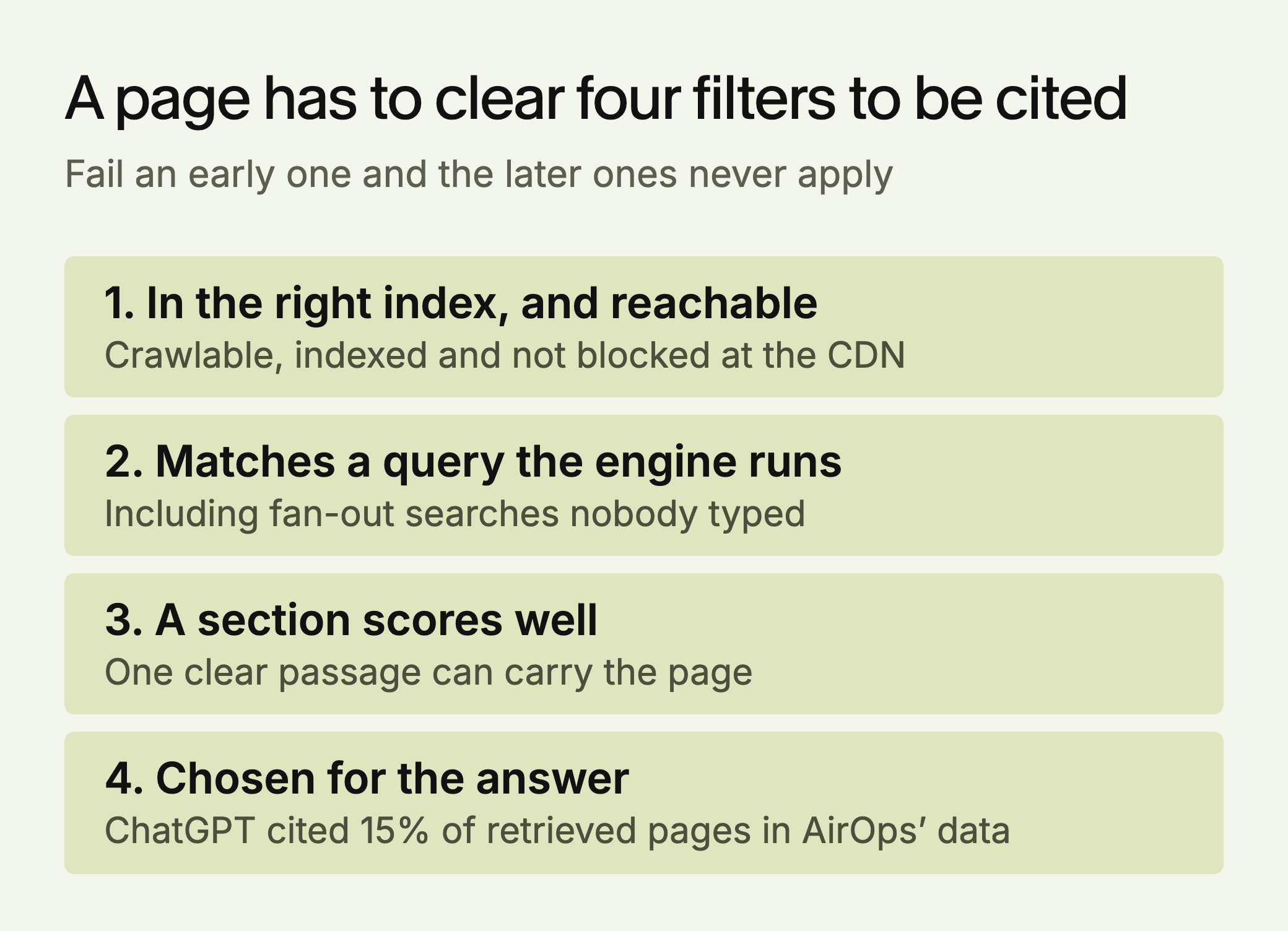
1. It has to be in the right index, and reachable. Each engine draws on a different pool. Google says its AI features use its core ranking systems to retrieve pages from the Search index, and a page must be indexed and eligible to show with a snippet. Perplexity says it runs its own index of over 200 billion URLs. ChatGPT search uses third-party providers, including Microsoft Bing, as TechTarget reported in December 2024.
Access decides this filter too. OpenAI’s crawler documentation says OAI-SearchBot controls whether a site appears in ChatGPT search answers, while GPTBot is for model training and is controlled separately. Perplexity recommends allowing PerplexityBot if you want to appear in its results. Your CDN can also block AI crawlers: in July 2025 Cloudflare said it would block AI crawlers by default and ask every new domain whether to allow them.
Robots.txt isn’t the last word. OpenAI and Perplexity say changes can take about a day to apply, and Perplexity warns that Cloudflare’s Bot Fight Mode can still challenge its crawler when a custom rule allows it. Confirm in your server logs that OAI-SearchBot and PerplexityBot get 200s, not 403s.
2. It has to match a query the engine actually runs. Engines split one question into several related searches. Google calls this query fan-out. In AirOps’ March 2026 report (vendor data, 15,000 prompts), 95% of ChatGPT’s fan-out queries had no monthly search volume by traditional metrics, so a keyword tool won’t show them to you. Among cited pages that appeared in a Google top 20, 32.9% were found only through a fan-out query.
Fan-out was the norm: 89.6% of the 15,000 prompts generated two or more fan-out queries. Comparison queries split into sub-queries 38.4% of the time, so a comparison page has to hold up against narrower searches, such as pricing.
3. A section of it has to score well. Perplexity says it scores results at both the document and sub-document level. One clear section can be what gets picked, and one good page can lose if the useful passage is hard to separate from the rest.
Perplexity’s parser splits documents into self-contained spans that are ranked on their own, and it searches both by keyword and by meaning. So a passage needs the words someone would search and a clear meaning without the paragraph above it.
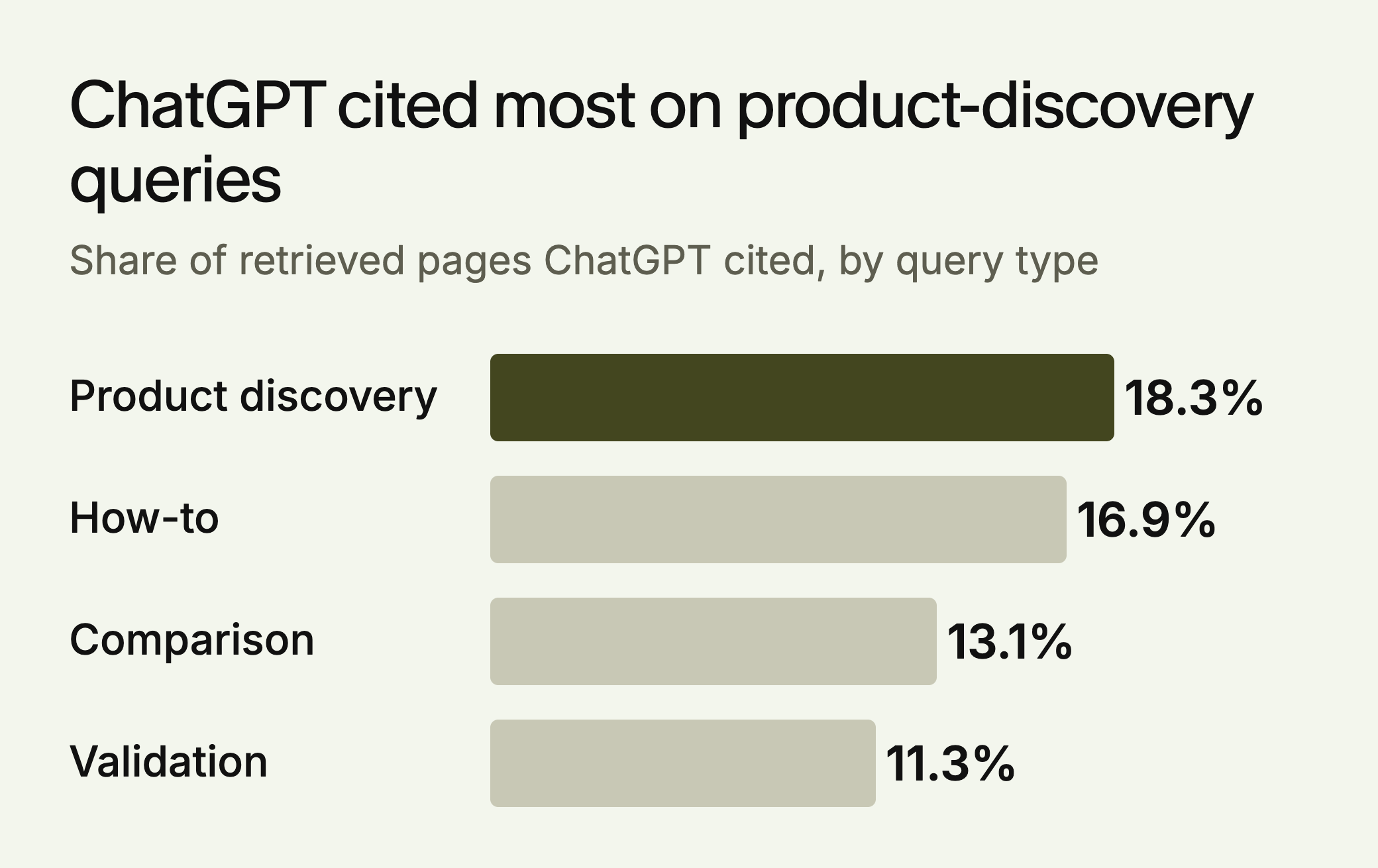
4. It has to be chosen for the answer. This is where AirOps’ 85% applies. Retrieval is necessary, but most retrieved pages still don’t appear in the final response. The study covers ChatGPT only, and it can’t tell us why any one page was passed over.
How hard this step is depends on the question. Among the four query types AirOps gives rates for, ChatGPT cited 18.3% of retrieved pages on product-discovery queries and 11.3% on validation queries.
A controlled test favors evidence over keywords
The Princeton GEO study (Aggarwal et al., KDD 2024) tested nine methods on the 1,000-query test split of a 10,000-query benchmark. On its Position-Adjusted Word Count measure, against the baseline:
- Adding quotations: about +41%
- Adding statistics: about +31%
- Improving fluency: about +28%
- Citing sources: about +28%
- Keyword stuffing: about -8%
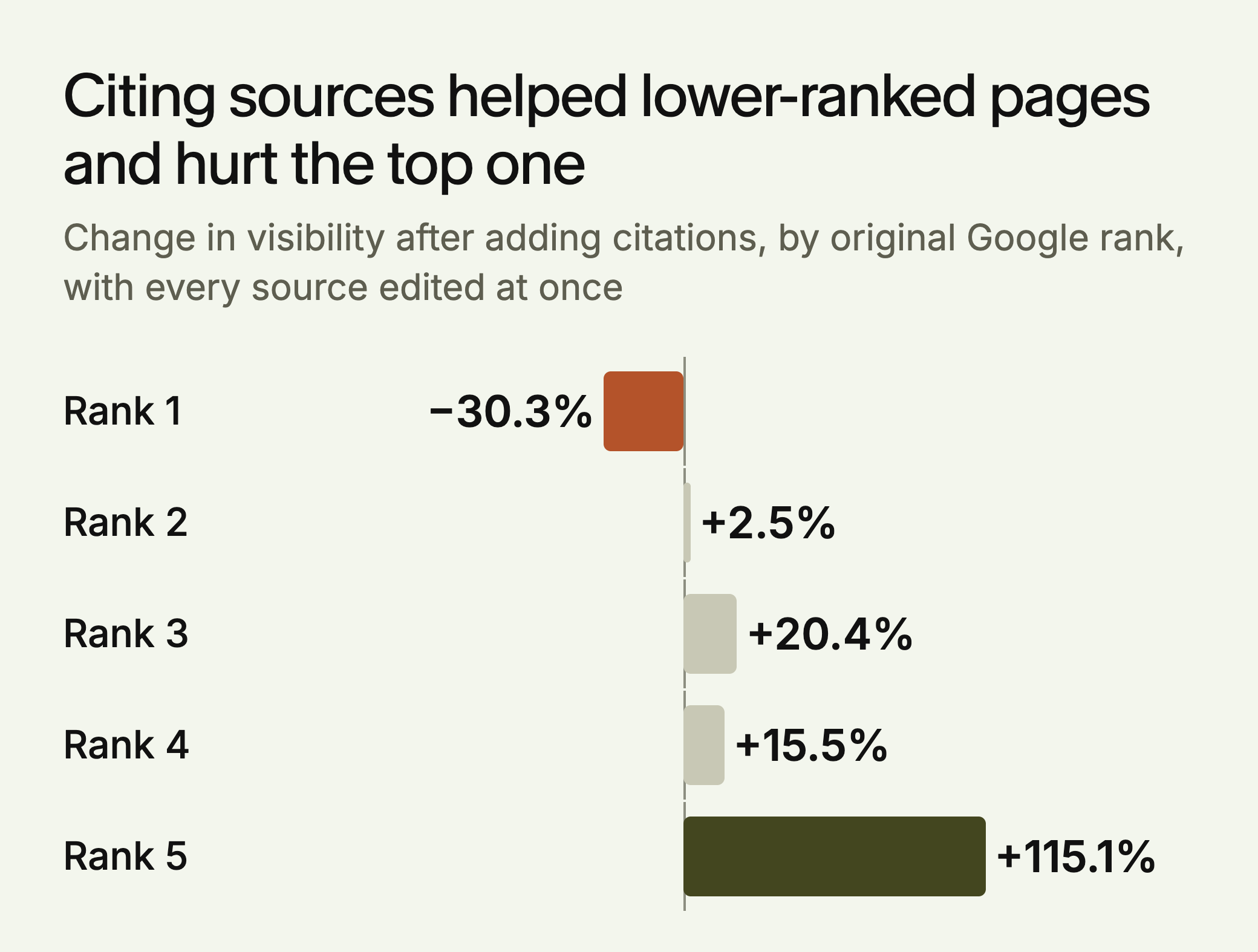
Rank changed the result when every source in an answer was edited at once. Citing sources lifted pages at rank 5 by 115.1% and cut pages at rank 1 by 30.3%. The percentages per method are calculated from the paper’s Table 1, and the rank figures are its Table 2.
Quotations and statistics followed the same pattern. Adding quotations cut visibility at rank 1 by 22.9% and raised it at rank 5 by 99.7%. Statistics went from a 20.6% loss to a 97.9% gain.
The best edit also depended on the topic. Statistics did best on Law and Government, Debate and Opinion queries. Quotations did best on People and Society, Explanation and History. About 80% of the benchmark’s queries were informational, so it says less about buying questions.
How we’d apply it: start with pages that sit behind stronger sources. A page that already leads may not gain, so change a few pages and measure before rolling an edit out.
These are tests on a benchmark, with only a 200-query check on Perplexity, so they aren’t proof for live engines. In that check, quotations moved the word-count measure from 24.1 to 29.1, and keyword stuffing dropped it to 21.9. They are still the best reason to add sourced numbers and attributed quotes, because that also makes a page more useful to the person reading it.
Brand mentions correlate with citation more than backlinks do
Ahrefs’ May 2025 study of 75,000 brands (vendor data) measured how often brands appeared in Google AI Overviews. Branded web mentions had a Spearman correlation of 0.664. Branded search volume was 0.392, Domain Rating 0.326, referring domains 0.295 and backlinks 0.218. Brands in the top 25% for web mentions had a median of 169 AI Overview mentions, against 14 for the next quartile.
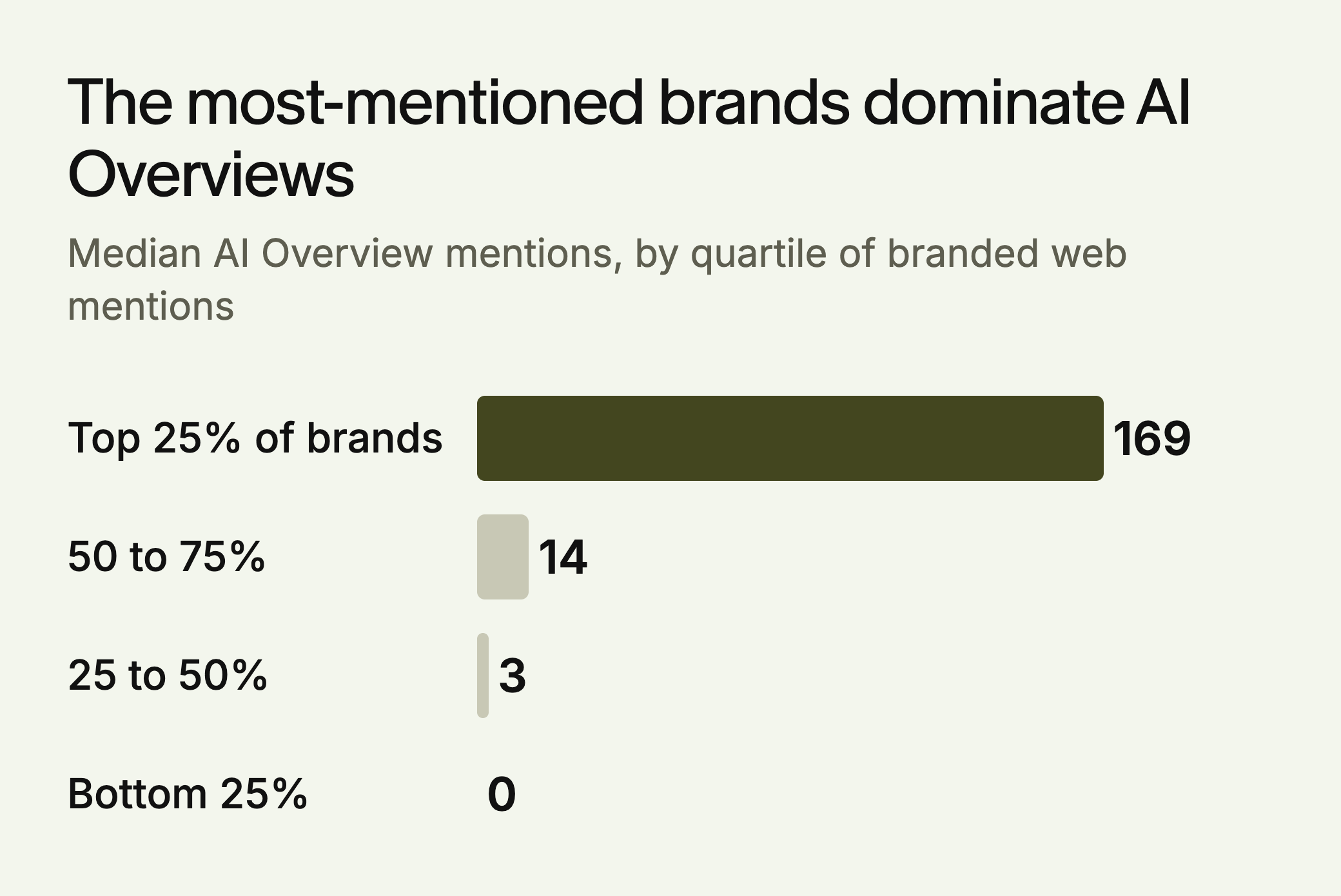
That is correlation, as Ahrefs itself notes, and big brands tend to have more of everything. The sample also only kept domains with a Domain Rating above 40 and dropped the 26% of brands with no mentions, so it says little about small sites.
Links are not irrelevant. In SE Ranking’s study of 129,000 domains (vendor data, ChatGPT only), sites with up to 2,500 referring domains averaged 1.6 to 1.8 citations and sites above 350,000 averaged 8.4. The two studies measure different engines and different outcomes, which is why one can favor mentions while the other shows a strong link pattern.
Top-ranked pages get cited more, but rank is not the whole story
In AirOps’ data, pages ranking first on Google were cited at a 43.2% rate, 3.5 times the rate for pages beyond the top 20, and 55.8% of cited pages ranked in the top 20 for at least one query. Once a page was retrieved, high domain authority went with a lower citation rate: sites rated DA 80 to 100 were cited from 15.0% of retrieved pages, while every lower tier landed between 21.5% and 23.6%. About 74% of citations went to sites under DA 80.
Those tier rates run higher than the report’s overall 15%, and AirOps doesn’t explain why, so read them as a comparison between tiers, not as absolute odds. Smaller sites do get cited: DA 20 to 40 earned 26.0% of citations, about the same as DA 80 to 100 at 25.4%.
Ahrefs’ test of 15,000 long-tail prompts (vendor data, published August 2025, with ChatGPT results collected in early July) looks like a contradiction: an average of about 12% of AI-cited URLs ranked in Google’s top 10. Perplexity was the outlier at 28.6%, and ChatGPT’s in-text citations were at 8.0%. One likely difference is the query. Ahrefs checked top-10 rank for the original prompt, while AirOps counted top-20 rank for any query, including fan-out queries. Pages can rank for what the engine searched without ranking for what the user typed.
Ahrefs adds that assistants may favor pages that rank steadily across several variants, so a page around position 6 for many versions of a query can beat one at position 1 for a single version. That’s Ahrefs’ reasoning, not a published description of any engine.
Titles: two studies that seem to disagree
AirOps found pages whose titles overlapped the query by 50% or more were cited at 20.1%, against 9.3% for pages under 10% overlap. SE Ranking’s ChatGPT data points the other way: titles with low relevance scores (0.00 to 0.59) averaged 5.9 citations, against 2.8 for high scores (0.84 to 1.00).
They measure different things. AirOps reports overlap between a title and the query, and doesn’t define how it calculated that. SE Ranking scores similarity between a keyword and the page’s topic, without naming its method. Its authors read the result as ChatGPT preferring titles that describe a topic over titles tuned to one keyword.
The advice that fits both: write a title that says plainly what the page answers, in the words a person would use, and don’t stack keyword variants into it.
Each engine leans on different sources
In a July 2025 Profound analysis of 100,000 prompts (vendor data), only 11.0% of domain citations appeared in both ChatGPT and Perplexity. Another 37.4% were ChatGPT-only and 51.6% Perplexity-only. Profound doesn’t explain how it calculated the overlap, so take it as a rough size.
Profound’s larger dataset of 680 million citations (August 2024 to June 2025) shows the same split in what each engine favors. Wikipedia was ChatGPT’s most cited source, at 7.8% of total citations. Reddit led Perplexity at 6.6%. In Google AI Overviews, Reddit led at 2.2%, just ahead of YouTube at 1.9%.
A result on one engine tells you little about another. Measure them separately.
How to find which filter is stopping you
No engine says which filter a page failed, so work from the symptoms, starting at the top. The checks below are our own suggestions.
| Filter | What you see | How to check | What to do |
|---|---|---|---|
| 1. Index and access | Absent from an engine even on prompts that name your brand | Search server logs for OAI-SearchBot, PerplexityBot and Googlebot. Check index status in Search Console and Bing Webmaster Tools | Allow the bots, remove 403s and challenges, submit missing pages |
| 2. Query match | Named on broad questions, absent on specific ones | Write out the sub-questions a buyer would ask, and compare them with your headings | Answer the missing sub-questions on the page or a linked page |
| 3. Section score | A competitor is cited for a fact your page also states | Read your section alone. Does it make sense without the one above? | Put the answer first and name the subject instead of “it” or “this” |
| 4. Selection | You rank for the topic, but similar pages get cited instead | List what the cited pages have and yours lacks: figures, quotes, dates, a comparison table | Add evidence, update stale claims, earn mentions |
A worked example: one page through the four filters
The company and figures below are made up for illustration. Fennick sells invoice approval software, and its page on automating invoice approvals never appears when buyers ask ChatGPT or Perplexity for options.
- Index and access. Logs show PerplexityBot getting 403s from a CDN bot rule, while OAI-SearchBot gets 200s. The team adds an allow rule and confirms 200s the next day.
- Query match. “Best invoice approval software for a 50-person finance team” implies narrower questions: NetSuite integration, approval limits by amount, pricing per invoice, audit trail. The page covers none of them, so the team adds four sections.
- Section score. The pricing section opened with two sentences of company history. It now opens: “Fennick charges $0.40 per approved invoice with no seat fees and a 5,000-invoice annual minimum.”
- Selection. The team adds a figure from its own customers, median approval time down from 6 days to 2 across 180 accounts, states how it was calculated, and quotes a named controller.
The team runs 20 prompts ten times per engine, in two batches before the changes. Perplexity shows Fennick in 9 and 14 of 200 runs, ChatGPT in 6 and 9. Eight weeks later Perplexity is at 41 and ChatGPT at 13. The Perplexity gain is far larger than the gap between baseline batches, so it’s likely real. The ChatGPT change is too close to that noise to claim.
What changes for B2B, ecommerce and small sites
- B2B software and services. AirOps suggests modular coverage for commercial queries: separate material on pricing, features, alternatives and comparisons. In SE Ranking’s data, domains with profiles on several review platforms averaged 4.6 to 6.3 ChatGPT citations, against 1.8 without. That’s a correlation.
- Ecommerce. Google says Merchant Center feeds can help products appear in AI responses, so keep price and availability accurate there. Google names Business Profiles as the route for local businesses.
- Small sites. AirOps says the clearest opportunities often sit in longer-tail topics, and that sites rated DA 40 to 80 already earn a meaningful share of citations.
Where to spend less time
Schema markup. Google says no special schema.org markup is needed for its AI features, though structured data still matters for rich results. SE Ranking found pages with FAQ schema averaged slightly fewer ChatGPT citations (3.6 against 4.2 without). Ahrefs’ May 2026 test (vendor data) of 1,885 pages that added JSON-LD found no significant change in AI Mode or ChatGPT and a small decline in AI Overviews, on pages already heavily cited. Overall the evidence is mixed and depends on schema type and engine, as our review of the schema studies explains. Add it where it describes real facts, and don’t expect a universal lift.
llms.txt. SE Ranking’s study of nearly 300,000 domains found no measurable link to citations, and Google Search doesn’t use the file. Don’t expect citations from it. It may still give agents a useful map, as we explain in our llms.txt breakdown.
Splitting pages into tiny chunks. Google says you don’t need to, and that its systems can handle several topics on one page.
A page for every fan-out query. Google says creating pages for each query variation or fan-out query to manipulate rankings can violate its scaled content abuse policy, and that more pages don’t make a site higher quality. Add the missing answer to an existing page first.
What to change this week
- Check access. Confirm robots.txt and your CDN’s bot settings allow Googlebot, OAI-SearchBot and PerplexityBot on pages you want cited.
- Check Bing as well as Google. Open Bing Webmaster Tools and fix pages that aren’t indexed.
- Write down the sub-questions. For your five most important pages, list the follow-ups a buyer would ask. Answer the missing ones on the page or on a linked page.
- Put the answer first in each section. Make the opening sentences make sense without the rest of the page.
- Add evidence. Replace vague claims with a sourced number or an attributed quote.
- Update what is stale. SE Ranking found pages updated in the past three months averaged 6.0 ChatGPT citations, against 3.6 for outdated pages. It also found longer articles (over 2,900 words) averaged 5.1 citations against 3.2 for those under 800, and pages with a First Contentful Paint under 0.4 seconds averaged 6.7 against 2.1 for those above 1.1 seconds. All three are correlations, and better-resourced sites tend to do all of them.
- Earn real mentions. Pick three publications or communities your buyers read and give them something worth citing, such as your own data.
What to measure
| Measure | Where it comes from | How to read it |
|---|---|---|
| Share of appearances, by engine | Repeated runs of a fixed prompt set | Your main number. Compare with your closest competitors |
| Named against cited | The same runs, recorded separately | Named without a link means the engine knows you but didn’t use your page |
| AI impressions by page | Search Console’s Generative AI report | Google only, and impressions only |
| Citations and grounding queries | Bing’s AI Performance report | Copilot, Bing summaries and partners only. Queries are a sample |
Being cited is not the same as being read
Clicks are scarce. Pew’s analysis of 900 US adults’ browsing in March 2025 found users clicked a link inside an AI summary in 1% of visits to pages with one. They clicked a regular result in 8% of those visits, against 15% when no summary appeared.
Answers vary from run to run. SparkToro’s January 2026 research (2,961 runs of 12 prompts, not peer reviewed) found less than a 1-in-100 chance that ChatGPT or Google’s AI would give the same list of brands in any two responses. Rank in an AI answer means little. Share of appearances across many runs of many prompts is a better measure.
Citations are often wrong. In a Nature Communications study of medical questions, between 50% and 90% of LLM responses were not fully supported by the sources they cited. Most of those answers were collected in early 2024, so newer models may differ. Don’t assume a citation means the engine represented you correctly. Read what it says about you.
LLMagnet measures AI visibility across seven engines and has an agent that prepares fixes for your approval. The free audit is a quick way to see where you stand.





 Gemini


 30-day free trial · no credit card