

 Ask Claude

There is no single best Semrush alternative for AI optimization. If you need keyword and backlink data too, stay with Semrush or Ahrefs, since both now sell AI visibility tracking; if AI answers are the main job, trial a dedicated tool such as Profound, IGEO or LLMagnet. Your platform and team size narrow it from there.
Contents
- Why people look for a Semrush alternative
- What to look for in an AI optimization tool
- The main options compared
- What the entry plans include
- Why two tools show different numbers
- Where LLMagnet fits
- How to choose: a quick decision guide
- How to run a fair evaluation
- A worked scorecard
- Mistakes that skew the comparison
- Next step
- FAQ
Why people look for a Semrush alternative
Semrush is a broad SEO suite. The newer question is different: when someone asks ChatGPT, Gemini, Claude, Perplexity or Copilot about your category, does your brand appear in the answer?
That is a separate measurement problem from keyword rankings. Semrush now has an AI Visibility toolkit for it, so a move only makes sense for a specific reason:
- You want a tool built around AI answers rather than a general SEO suite.
- You need per-engine visibility, not one blended number.
- You want someone or something to prepare the fixes, not only report the gap.
- You need a lighter setup for a WordPress or Shopify site.
What to look for in an AI optimization tool
- Engine coverage. Does it track the assistants your audience uses? Ask for the list, because some vendor pages don’t give one. Insist on results by engine too: in TJ Digital’s agency study of 193,507 answers, AI Mode and AI Overviews shared 12% of cited pages, and ChatGPT shared about 5% with either.
- Prompt tracking. Can you define the questions customers ask and monitor them over time?
- Competitor benchmarking. Can you see who is named in the answers instead of you?
- Sentiment and mentions. Are you named, and how are you described?
- Actionability. Does it tell you what to fix, or only report numbers?
- Technical readiness. Does it check whether AI crawlers can read your pages? Treat
llms.txtas a minor extra: SE Ranking’s study of about 300,000 domains found no measurable link to citations, though the file may still give agents a useful map. - Platform fit. Is there a plugin or workflow for your CMS?
In our reading, products differ most on the fifth criterion.
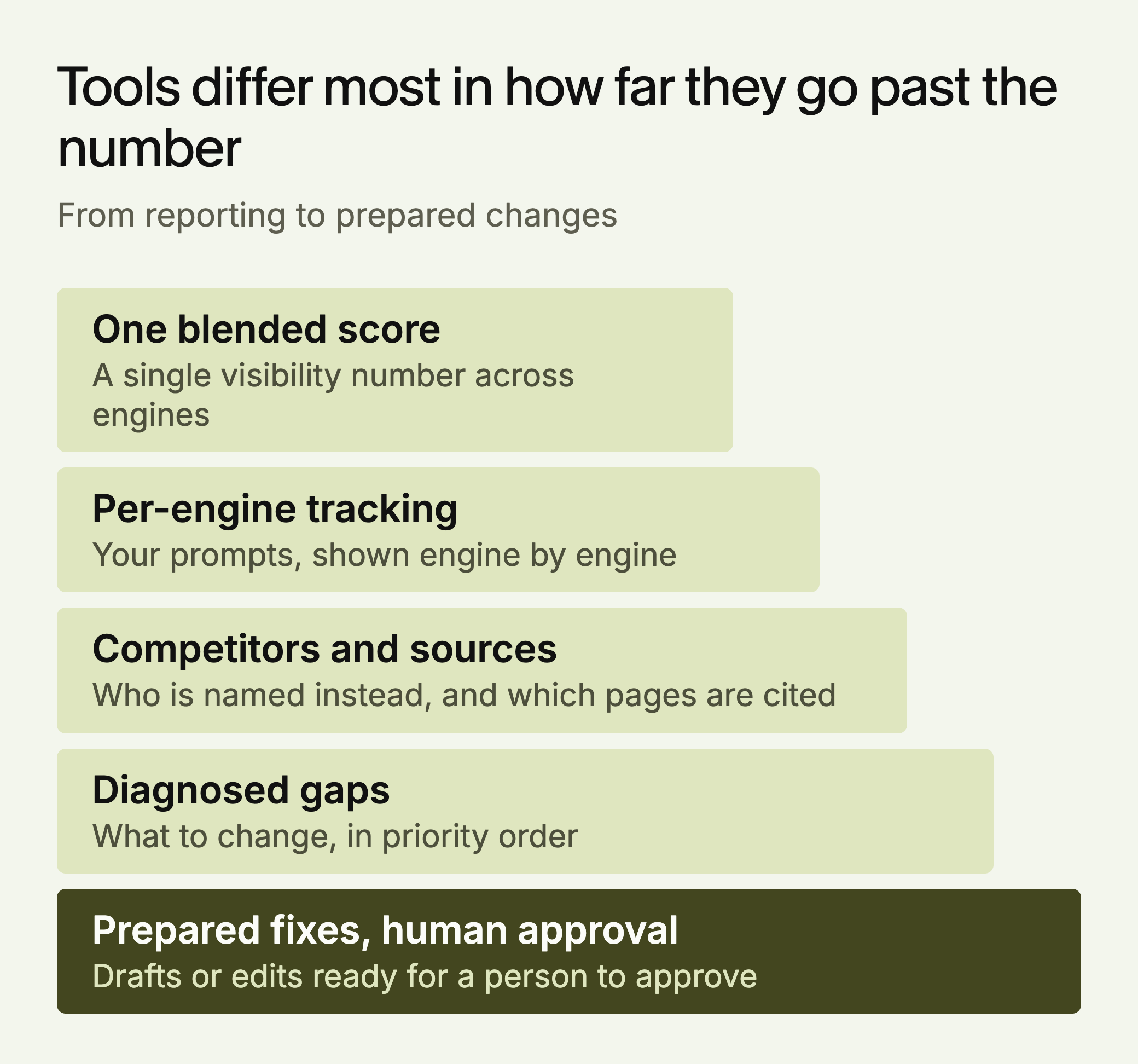
A team with a content lead may only need the third level, because it already knows how to act on a list of sources. A team of one gets more from prepared fixes, as long as a person still approves them.
The main options compared
| Tool | What it does, by its own description | Consider it if |
|---|---|---|
| Semrush | SEO suite with an AI Visibility toolkit: visibility overview, prompt tracking, competitor research and brand perception. Its knowledge base gives ChatGPT and Google AI Mode as examples of platforms covered. | You want broad SEO and AI tracking in one account |
| Ahrefs | SEO suite plus Brand Radar, which reports mentions, citations and AI share of voice across AI Overviews, AI Mode, ChatGPT, Perplexity, Gemini, Copilot and Claude. | Backlink and search research are your priority and you want AI data beside them |
| Profound | An “AI marketing platform” with an AI agent trained on prompt and citation data. Lists ChatGPT, Perplexity, Claude, Gemini, Copilot, DeepSeek and AI Overviews. | You want a platform built around AI search for a marketing team |
| AIOSEO | WordPress SEO plugin: titles, schema, sitemaps, redirects, AI writing tools and an LLMs.txt generator. Its homepage lists no tracking of AI answers. | You work inside WordPress and want on-site SEO tooling, not AI-answer measurement |
| IGEO | Finds gaps in how AI answers represent a brand, then drafts content and actions for human approval. Lists ChatGPT, Gemini, Perplexity, Claude, Copilot and AI Overviews. | You want drafted actions with a person approving them |
| LovedByAI | WordPress plugin that adds structured data, summaries and Q&A formatting to pages so AI tools can read them. Its dashboard tracks AI mentions and AI visitors. | You run WordPress and want on-page changes without a redesign |
| Limy | Shows how AI agents discover and recommend a brand, and measures the traffic, pipeline and revenue that follow. The page doesn’t name the engines covered. | Connecting AI visibility to revenue is the main question |
| LLMagnet | Measures AI visibility across seven engines, with an agent that prepares fixes for you to approve. Started as a WordPress plugin. | You want measurement and prepared fixes in one place |
Descriptions come from each vendor’s own website, checked on 10 November 2026. They are the vendors’ claims, not test results, and features and plans change, so confirm before you buy.
What the entry plans include
Vendors publish these limits, checked on 10 November 2026.
| Product | Published price | What that buys |
|---|---|---|
| Semrush AI Visibility toolkit | $99 a month | One domain and 25 tracked prompts. Extra domains are $99 each and 50 more prompts are $60 a month. No free trial. |
| Ahrefs Brand Radar | Add-on, from $50 a month for Custom Prompts, from $199 for the AI Visibility Index | Your own prompts refreshed daily, or Ahrefs’ index of 551 million-plus prompts. |
| Profound | Free trial, then custom Enterprise pricing | Trial: 50 prompts, daily for 7 days, on ChatGPT, Gemini and AI Overviews. Enterprise: up to 9 engines. |
Ask how a prompt is counted. If one prompt tracked on five engines uses five units, 25 prompts cover five questions. Then check scope. Semrush prices the toolkit per domain, so an agency with 10 client domains would pay $990 a month at the listed rate, before extra prompts (our arithmetic).
Why two tools show different numbers
Expect tools to disagree on the same brand, for three reasons.
- Whose questions. An index built from a keyword database shows a whole market. A list you write shows your buyers’ questions. Their share-of-voice figures won’t match, and neither is wrong.
- How answers are collected. Some tools record the consumer app and others call an API. In an October 2026 preprint that recorded ChatGPT’s web app, Google results and OpenAI’s API combined found only 28.3% of the pages and 50.3% of the sites ChatGPT cited on GPT-5.3 Instant. It tested no AI visibility product. Ask each one which method it uses.
- Answers change by themselves. In TJ Digital’s data, the same question asked on the same day produced 23% to 25% overlap in cited pages.
SparkToro’s authors, after 2,961 runs, conclude that a visibility percentage across many repeated runs is a reasonable metric, and they dismiss tools that report a ranking position in AI answers. So favor a tool that reports how often you appear and lets you open the answers behind the number.
Where LLMagnet fits
LLMagnet is our product, so weigh this section accordingly. It is a platform that measures how brands appear across seven AI engines: ChatGPT, Claude, Gemini, Google AI Overviews, Perplexity, Copilot and Grok. It includes:
- Tracked prompts, so you monitor the questions your customers ask.
- Competitor comparison, including share of voice and sentiment.
- An agent that prepares fixes for you to approve before anything goes live.
llms.txtgeneration in the WordPress plugin and Shopify app.- A WordPress plugin and a Shopify app, for teams on those platforms.
What LLMagnet is not: a replacement for a full SEO suite’s keyword database or backlink index. If those are your main needs, keep your current tool.
How to choose: a quick decision guide
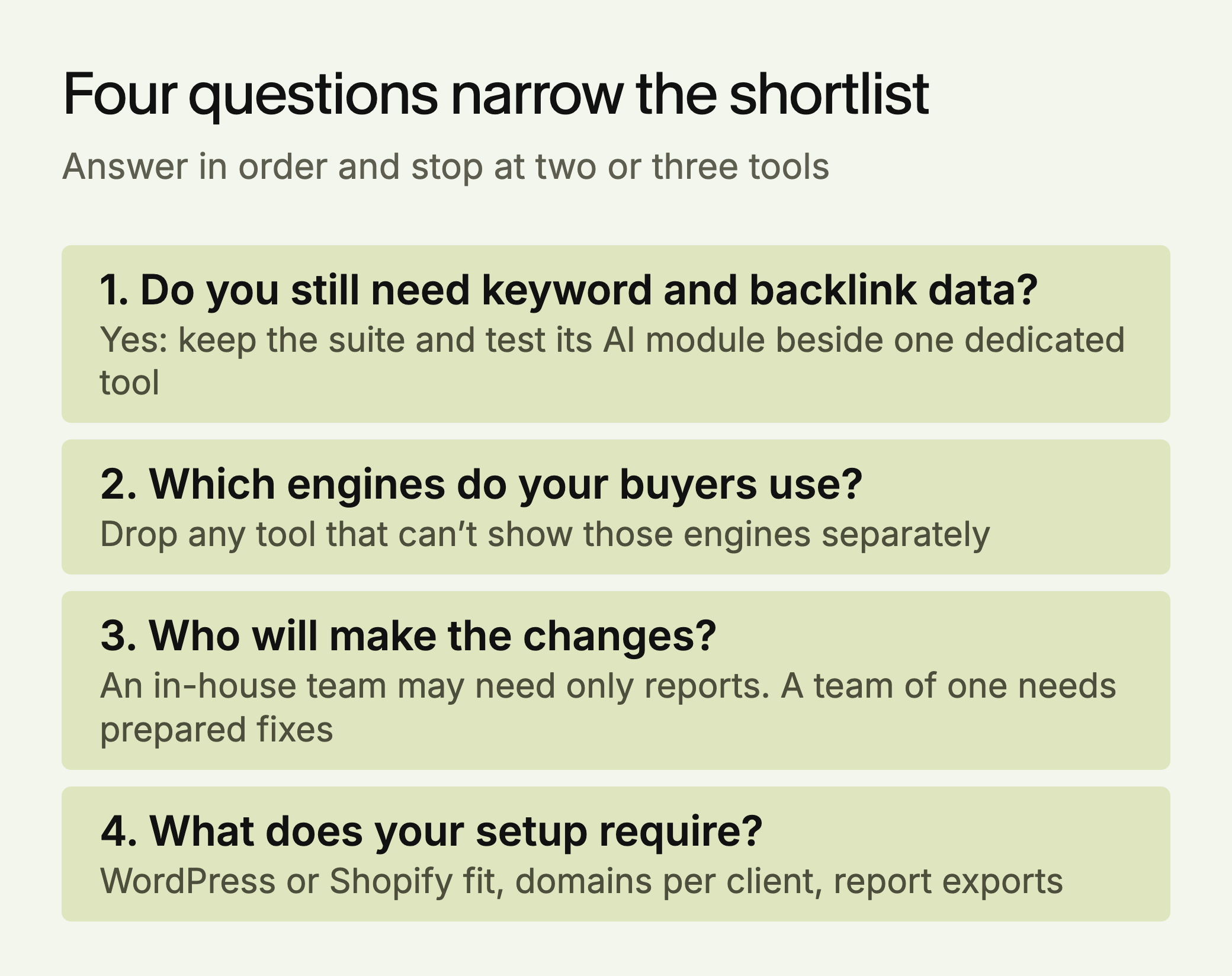
- You need a full SEO suite plus AI tracking: stay with Semrush or Ahrefs and test the Semrush AI Visibility toolkit or Ahrefs Brand Radar.
- You want a tool focused on AI answers: shortlist two or three of Profound, IGEO, Limy and LLMagnet, then compare engine coverage and what each does after it finds a gap.
- You run WordPress or Shopify: check plugin and app availability first. AIOSEO works on the page itself. LovedByAI pairs page changes with a dashboard of AI mentions and visitors, so check what it tracks before you skip a separate tool.
- You are an agency: ask each vendor how it handles multiple clients and client-ready reports, and see a sample export.
Your business model changes the weighting. In TJ Digital’s agency data, covering 78 client businesses, company websites earned 52% of citations in consumer products and ecommerce, and 87% in B2B industrial and distribution.
- Ecommerce: much of the citation pool sits on sites you don’t own, so favor a tool that shows which outside sources get cited.
- B2B: citations cluster on company sites, yours and your rivals’, so page-level diagnosis counts for more.
- Small sites: one domain and 10 to 20 prompts fit an entry plan. Don’t pay for market-wide index data you won’t open.
How to run a fair evaluation
- Write 10 to 20 prompts your customers really ask, across awareness, consideration and decision stages.
- Run the same prompts in each tool you are testing, in the same week.
- Compare which engines are covered, how often each brand appears, and which competitors are named.
- Spot-check a few results by asking the assistant yourself. AI answers vary, so look for broad agreement, not an exact match.
- Check whether the tool gives you concrete next steps, not just dashboards.
- Re-check after 30 days. One snapshot is not enough.
A worked scorecard
The company and figures below are made up for illustration. Northpine, a 40-person B2B software company, trials two tools for 30 days on the same 15 prompts. It sets the weights first, so it can’t justify the tool it already liked.
| Criterion (weight) | Tool A | Tool B |
|---|---|---|
| Covers the four engines buyers use (30) | 4 of 4: 30 points | 3 of 4: 22 points |
| Shows the answers behind the score (25) | Yes: 25 | Score only: 5 |
| Agrees with 12 hand checks (20) | 9 of 12: 15 | 10 of 12: 17 |
| Next steps usable as written (15) | 5 of 8: 9 | 2 of 8: 4 |
| Allowance covers the prompt list (10) | Yes: 10 | Yes: 10 |
| Total (100) | 89 | 58 |
Tool B’s slightly better hand-check result doesn’t rescue it. When a score moves and you can’t see the answers, nobody can explain why.
Mistakes that skew the comparison
- Testing branded prompts. “What does Northpine do?” names Northpine in almost any tool. Use questions that don’t name a brand.
- Treating a short trial as a trend. Seven days can test the workflow. It can’t show direction.
Next step
Write your prompt list first, because it is the part every tool needs and only you can supply. Then get a baseline from the LLMagnet free audit and compare it with the other tools above.


 Ask Gemini





 30-day free trial · no credit card