

 Ask Gemini

The evidence on named authors and AI citations is mixed, so don’t expect a byline alone to earn citations. Small tests found gains tied to real author pages, while an agency study of cited and passed-over pages found 28% lower odds for pages with a byline. A clear author setup is still cheap and useful, as long as you treat any citation gain as unproven.
Contents
- What the studies found
- Why the results disagree
- Where author work pays, and where it doesn’t
- What to do: build a real author page
- Author markup: what it needs
- A worked example: one author, before and after
- Common mistakes
- Audit your attribution in an afternoon
- Run your own test
- FAQ
What the studies found
We looked for the original data behind the common claims about authors and AI citations. None of the four studies below is peer reviewed, and each comes from an agency or a research brand tied to one.
| Study | Sample | Finding |
|---|---|---|
| TJ Digital | 21,874 cited and 4,507 passed-over pages, from 193,507 answers on ChatGPT, AI Mode and AI Overviews. Collected August 27 to October 21, 2026. | Pages with a byline had 28% lower odds of being cited, adjusted for Domain Rating and page type. |
| Machine Relations Research | 706 pairs, each a cited page and another page on the same site (not guaranteed uncited), five engines. Citation runs July 6 to November 7, 2026. | Author named in markup or meta tags on 67.0% of cited pages against 57.9%. Visible byline on 40.1% against 34.4%. |
| Seer Interactive | Detailed bylines added to 123 of its own blog pages, with a control group. | Bing citations up 109% against about 34% for control. No significant difference in AI Overviews. Retrieval crawling flat. |
| Ranko | 22 client sites, 60 queries each, 30 days, AI Overviews. April 2026. | An author page within two clicks was cited 2.6x as often as plain-text or archive-only bylines. A sameAs graph with no broken links, 1.9x. |
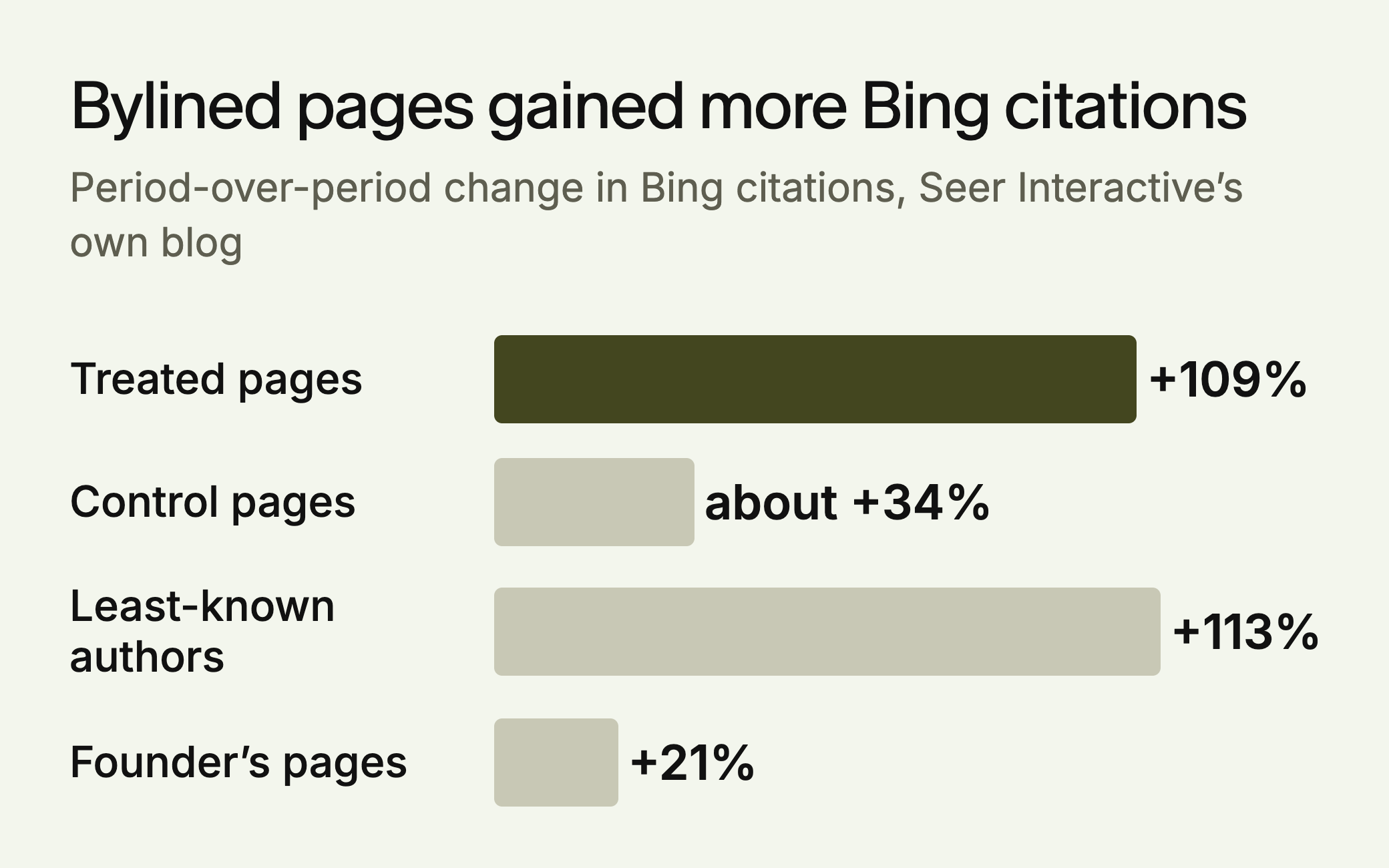
Seer’s is the only test here that changed pages and kept a control group. It added a mix of six elements: a name with headshot and profile link, title and company, named focus areas, outside credentials, years of experience, and Person schema. It doesn’t say which pages got which. Of treated pages with earlier citations, 44% improved, against 27% of control pages. Googlebot crawled treated pages 11.7 percentage points harder for about two weeks, and the adjusted effect on AI retrieval crawling was −1.3%, which the authors call statistically zero.
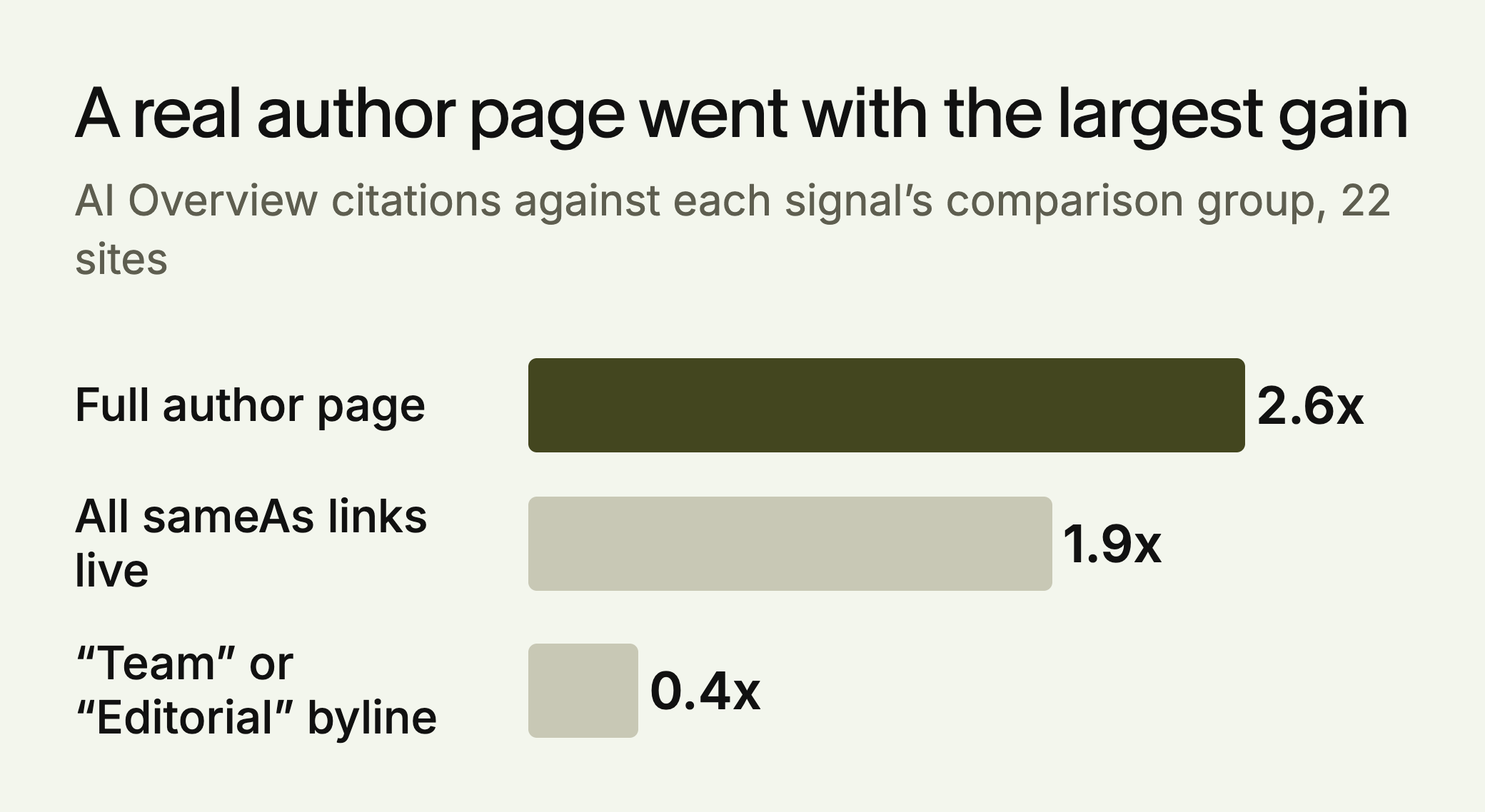
Ranko also found that photo cards, certification badges and credential strings had no measurable effect, and that “Editorial” or “Team” bylines were cited 0.4x as often as a named person. It reports no sample sizes per signal and no significance tests.
Why the results disagree
The studies measure different things. TJ Digital compares cited pages with Google top-10 pages the AI passed over. Machine Relations compares pages on the same site, and its comparison pages include things like product pages and listings, which may lack bylines for other reasons. Seer changed real pages, but the authors call the signals inconclusive, and warn that a few high-volume URLs drive the Bing totals and that the report is still in beta. Machine Relations also says its rule for detecting authors wasn’t retained, so its two author figures can’t be stated precisely until a rerun planned for 22 November 2026.
Three of the four are associations. TJ Digital says it can’t explain its byline result and advises against removing bylines because of it. That’s the right response. No study here shows that adding an author line, alone, earns citations.
Where author work pays, and where it doesn’t
Bylines only apply to pages that have authors. In TJ Digital’s data, product pages took 28% of citations, homepages 12% and articles 25%. Articles made up 17% of ChatGPT citations and 28% of AI Overview citations. Check which of your page types get cited before you start a byline project.
| Page type | What to do | Our reasoning |
|---|---|---|
| Health, finance, expert advice | Named person, with a full author page | Readers most need to know who is speaking |
| Blog posts and research | Named person, linked to an author page | Ranko’s “Team” bylines were cited 0.4x as often |
| Product, pricing and homepage | No personal byline needed | Fix product facts and clarity first. No study above isolates these pages |
| Documentation | A team owner and a date can be enough | Accuracy and freshness are what a reader checks |
A B2B company with a research blog has the most to work with. An ecommerce site whose citations land on product and category pages should fix product data first. Small sites need patience: Ranko says sites with fewer than about 50 indexed articles lack the data to read a signal in 30 days, so treat the setup as basic hygiene and measure over a longer window.
What to do: build a real author page
The setup below is cheap, helps readers, and matches Google’s guidance on author markup. The citation benefit is a possible bonus.
- Use a person’s name on articles where a person’s judgment is the point. Replace “Editorial” or “Team”.
- Link the byline to a page with that person’s bio, role and the articles they wrote, at a stable URL.
- Keep external profiles live. Check that each linked profile loads and shows the same name. In Ranko’s data, three to five maintained links beat ten links with two dead, so keep the list short.
- Skip the decoration. Badges and strings of credentials didn’t register in the one test that looked, so spend the time on the bio.
Author markup: what it needs
Google recommends using the right type for an author (Person or Organization), putting only the name in name, and including url or sameAs so it can tell authors apart. Give each author a separate entry. Job titles belong in jobTitle.
{
  "@context": "https://schema.org",
  "@type": "Article",
  "author": {
    "@type": "Person",
    "name": "Jane Example",
    "jobTitle": "Head of Research",
    "url": "https://example.com/authors/jane-example/",
    "sameAs": ["https://www.linkedin.com/in/jane-example"]
  }
}
Keep expectations in check: Seer’s test bundled Person schema with up to five other byline changes, so it can’t show what the schema did alone.
A worked example: one author, before and after
The company and person below are made up for illustration.
| Element | Before | After |
|---|---|---|
| Byline | By the Harborline Team | By Maya Ortiz, linked to her author page |
| Author page | None | Stable URL, a bio, her role, and her 14 articles linked |
Markup name | Maya Ortiz, CPA, Head of Compliance | Maya Ortiz |
Markup jobTitle | Missing | Head of Compliance |
sameAs | 12 profiles, 2 dead | 4 live profiles that show her name |
Every change above comes from Google’s guidance or Ranko’s thresholds (a bio, a stable URL and 10 or more cross-linked articles). None of it guarantees a citation. It makes the page accurate and easy to attribute.
Common mistakes
- Removing bylines because of the 28% figure. The study’s author says he wouldn’t, and can’t explain the result.
- Reading Seer’s Bing number as an AI-wide result. AI Overviews showed no significant difference in the same test.
- Adding a “verified by an expert” box. Ranko reports lower citation rates for sidebars with a separate expert byline, with no figure given.
- Inventing an expert. A made-up author misleads readers and fails the first profile check.
- Changing every author at once. You lose the untouched group you need for comparison.
Audit your attribution in an afternoon
- List your 20 most important articles.
- Mark each one: no named author, a name with no author page, or a name linked to a full author page.
- Check the page source for
authormarkup, and test that eachurlandsameAslink loads. - Fix the 10 pages that matter most, starting with health, finance and expert advice, where readers most need to know who is speaking.
- Record which of those 20 pages are cited for your tracked prompts before the change, and check again after 60 days alongside a set of untouched pages.
Run your own test
Compare the share of pages that improved as well as total citations. Seer warns that a few high-volume URLs drove its Bing totals, and the 44% against 27% split is harder for one page to distort. Keep topics and publish dates balanced between the two groups, since Seer says both may have influenced its results.
The last step above matters most, because published results disagree. A before-and-after comparison on your own pages, with an untouched group, tells you more than another industry average. To set the baseline, LLMagnet measures AI visibility across seven engines, and its free audit is one place to start.




 Ask Claude


 30-day free trial · no credit card