

 Ask Gemini

ACP and UCP define how AI agents get product data and start a purchase, but they don’t decide which brand gets the sale. The overviews and merchant documentation we read for both protocols describe no ranking method, so selection stays with each agent. The practical job is to keep your product data accurate and to apply only where the programs fit your market.
Contents
- What the Agentic Commerce Protocol (ACP) Is
- What the Universal Commerce Protocol (UCP) Is
- How Selection Actually Works
- Content Work and Protocol Work Are Different Jobs
- What Enrollment Requires
- Should You Apply Now?
- What to Audit Before You Apply
- FAQ
What the Agentic Commerce Protocol (ACP) Is
ACP is an open standard under Apache 2.0 for how businesses and agents complete purchases. Stripe and OpenAI launched it with Instant Checkout on September 29, 2025, starting with US buyers and US-based Etsy sellers. Stripe’s documentation lists checkout, cart and feed, delegated payment, delegated authentication, and orders and webhooks, and it links to specifications dated 2026-04-17. The same page now names Meta alongside Stripe and OpenAI as a creator of the standard.
The product built on top of it has changed. In March 2026, an OpenAI spokesperson told Digital Commerce 360 that “Instant Checkout is moving to Apps,” with ACP remaining as the infrastructure connecting users and merchants. Purchases made directly from product listings were reported to be going away. Check OpenAI’s current documentation before you plan around a specific buying flow.
The purchase itself is split between the two sides. This is the sequence in OpenAI’s key concepts guide.
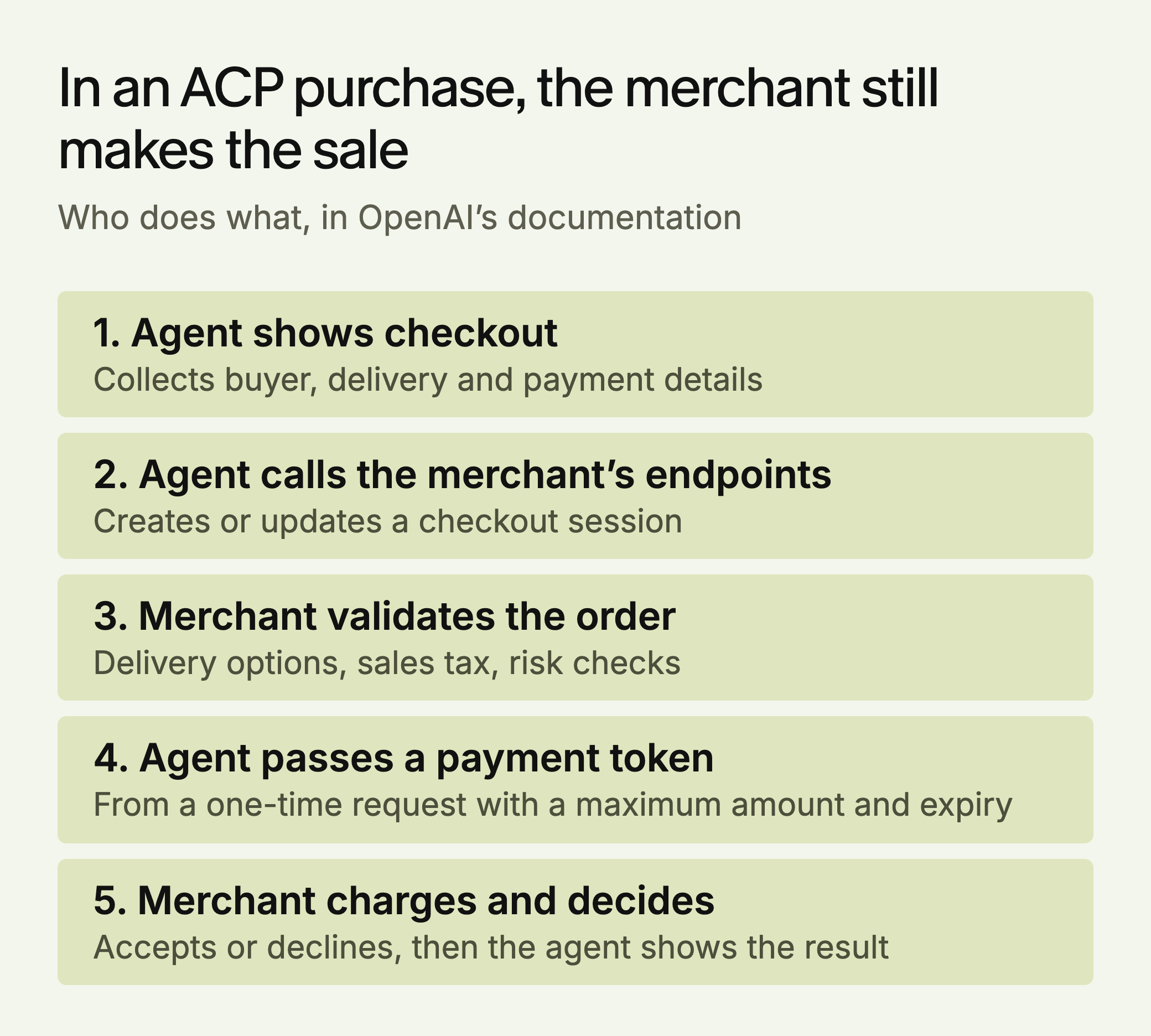
The key point is who keeps responsibility. The merchant decides which delivery options to offer, calculates and collects sales tax, runs its own payment and risk checks, and accepts or declines the order. OpenAI says it “is not the merchant of record.” The payment request behind the token is one-time, with a maximum amount and an expiry.
What the Universal Commerce Protocol (UCP) Is
Google announced UCP on January 11, 2026, co-developed with Shopify, Etsy, Wayfair, Target and Walmart, and endorsed by more than 20 other companies including Stripe, Visa and Mastercard. UCP’s site lists catalog, cart, checkout, identity linking and order capabilities, with lodging as a draft.
PYMNTS reported on February 11, 2026, that US shoppers could buy from Etsy and Wayfair through UCP checkout in AI Mode and the Gemini app. At the January announcement, Google said shoppers would pay with Google Pay and that PayPal was coming soon. According to Google’s documentation, you remain the merchant of record. That documentation lists AI Mode and Gemini web, with the app “coming soon.”
Here is how the two compare, from each project’s own documentation.
| ACP | UCP | |
|---|---|---|
| Started by | Stripe and OpenAI | Google, with Shopify, Etsy, Wayfair, Target and Walmart |
| Main surface today | ChatGPT (check OpenAI’s current flow) | AI Mode and Gemini |
| Product data | OpenAI product feed, over SFTP | Merchant Center feeds |
| Access | Approved partners | Interest form, select merchants |
| Merchant of record | You | You |
| Market | Launched with US buyers; check current terms | Products sold in the United States |
How Selection Actually Works
The honest answer is that it isn’t published in detail. UCP’s site and Google’s UCP page say nothing about how products are ranked. The ACP overview and OpenAI’s feed specification set out data formats, not a selection formula.
The closest thing to a statement comes from OpenAI’s commerce documentation. It says required fields ensure correct display of price and availability, and that recommended attributes such as rich media, reviews and performance signals “improve ranking, relevance, and user trust.”
So be careful with two popular claims. We found no documentation saying agents never read product pages, and OpenAI’s feed requires a product URL. We also found none saying that enrolling early earns a lasting ranking advantage. Treat both as unproven.
What you can act on is narrow but real. A rejected row can’t be shown, and OpenAI’s spec rejects rows with a missing or unrecognized availability value. Recommended attributes such as rich media and reviews are the only ones OpenAI links to ranking. Everything else, including how an agent weighs price against brand, is unknown from the outside.
Content Work and Protocol Work Are Different Jobs
Content work helps when a buyer is researching and an AI engine is deciding what to mention. Protocol work helps when a buyer is ready to purchase and the agent needs a price, stock level and checkout path it can act on.
We’d put the first before the second for most brands, because a buyer has to hear of you. But a recommended product with a wrong price or dead stock status still loses the sale. Fix the data either way, because it also serves your site, your shopping ads and your customers.
What Enrollment Requires
For ChatGPT product feeds: OpenAI’s onboarding is limited to approved partners, who apply at chatgpt.com/merchants. Partners upload a catalog over SFTP, and OpenAI recommends a full snapshot at least once a day. The feed spec requires item_id, title, description, url, brand, seller_name, image_url, availability and price. Checkout is a separate integration, disabled by default, and setting the eligibility flag doesn’t complete onboarding.
A record looks like this. The product is made up for illustration, and the fields follow OpenAI’s spec.
{
  "item_id": "LK-156-16",
  "title": "Larkfield 15.6-inch Laptop, 16GB RAM",
  "description": "15.6-inch laptop with 16GB RAM and a 512GB SSD.",
  "url": "https://example.com/larkfield-156",
  "brand": "Larkfield",
  "seller_name": "Example Store",
  "image_url": "https://example.com/larkfield.jpg",
  "availability": "in_stock",
  "price": "749.00 USD"
}
The format rules are strict. Price must be an amount and an uppercase currency code, with no thousands separators. Availability must be one of in_stock, out_of_stock, pre_order, backorder or unknown. Leave unknown optional fields empty instead of writing “n/a”. Keep item_id stable when prices change, never reuse it for a different item, and keep the price out of any offer_id. A GTIN, if you send one, must have a valid check digit. To enable checkout you also need is_eligible_checkout, plus seller_privacy_policy and seller_tos.
For UCP checkout on Google: Google’s documentation says existing Merchant Center feeds can be used for discovery. It makes native checkout the default and limits embedded checkout to approved merchants. Its Merchant Center guide says merchants join through an interest form, that only listings with the native_commerce checkout-eligibility attribute show the Buy now button, and that this applies to products sold in the United States.
If you use a platform: Ask Shopify, or your commerce provider, what it already handles. Google’s guide tells merchants on third-party platforms to contact the provider about its UCP plans.
Should You Apply Now?
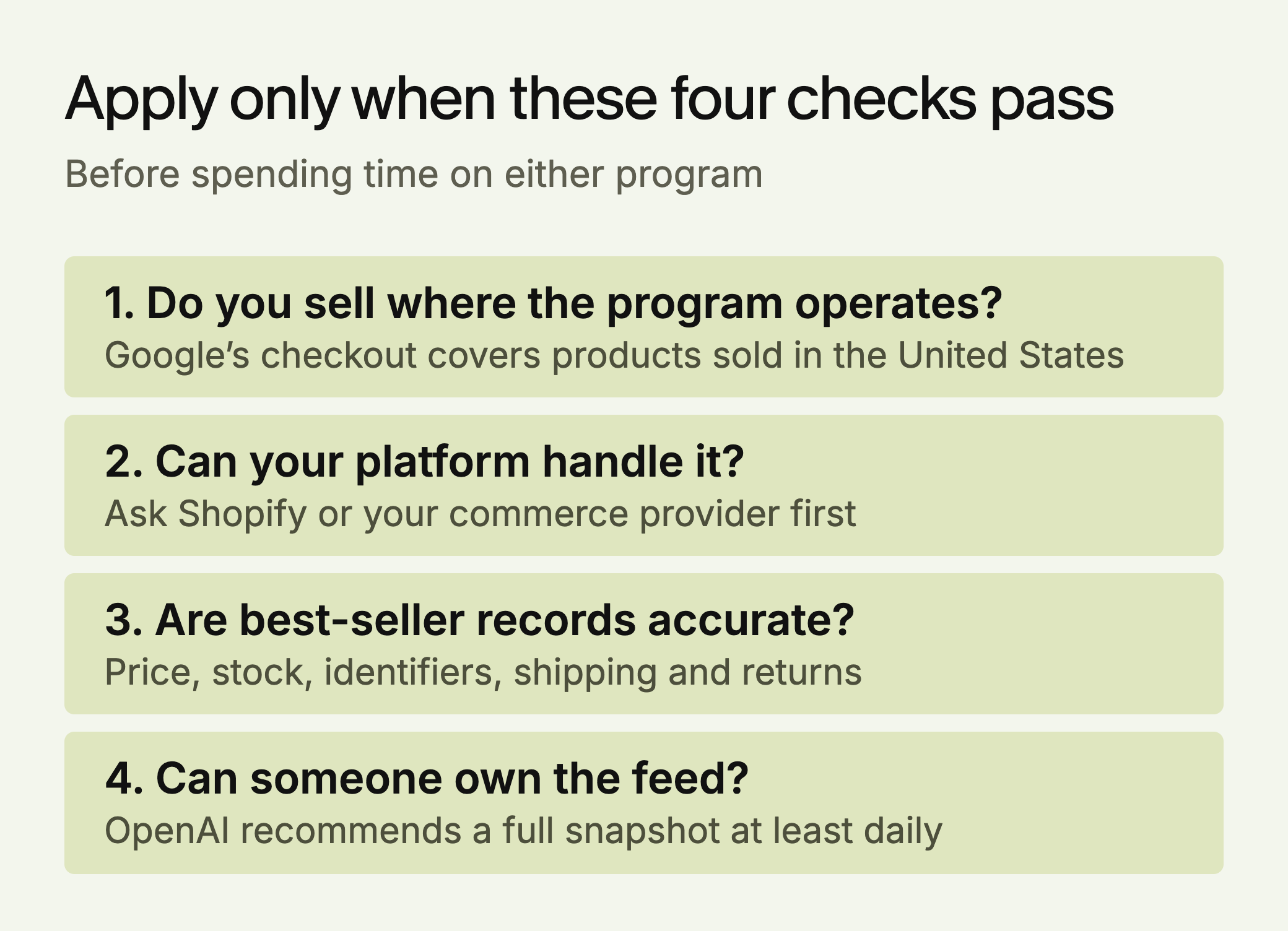
The answer differs by business, and this is our reading of the documents above. A US store on a major platform has the shortest path, so ask the provider first. A store outside the US can’t use Google’s checkout yet, so feed quality is the useful work. A B2B seller with quote-based pricing has little to gain until prices can be stated in a feed, because both protocols assume a price an agent can act on. A small catalog can be maintained by hand, while a large one needs an automated feed before it can meet a daily snapshot.
What to Audit Before You Apply
Check these against your actual systems, not against what the feed says:
- Price: Does the feed show what the buyer actually pays at checkout, including active promotions? OpenAI’s sale and expiration dates don’t schedule changes, so the feed has to be updated when a sale starts or ends.
- Availability: How long does a stock change take to reach the feed? OpenAI says to update availability when stock changes.
- Identifiers: Are GTINs valid on the products that have them? OpenAI lists GTIN as optional and says not to invent an MPN to replace one. Google recommends GTINs in its merchant listing markup.
- Shipping and returns: Can you state delivery time, shipping cost and return terms for each market?
- Variants: Is each size and color its own record, grouped correctly under a parent product? In OpenAI’s feed, that means a shared
group_idthat differs from eachitem_id. - Market: Do you sell in the United States? Google’s checkout currently applies only to products sold there.
Fix errors on a small set of best sellers first, then extend. Apply to a program once those records are right.
Measure the data, since the outcome can’t yet be seen from the outside. Track the share of feed rows rejected, the number of products where the feed price differs from the checkout price, and the minutes between a stock change and the next feed update. If those improve and the program brings no orders, you still have better data for your site and your shopping ads.
The most common mistake is treating enrollment as the goal. Being eligible only means an agent can buy from you. Whether it recommends you depends on signals neither protocol documents in any detail, which is why the research stage still needs its own work.
LLMagnet measures AI visibility across seven engines and has an agent that prepares fixes for you to approve. Its free audit shows how AI engines describe your brand during the research stage.





 Ask Perplexity


 30-day free trial · no credit card