


In the evidence we could trace, only two kinds of GEO tactic have held up in experiments, both on research benchmarks: adding verifiable substance to a page, and restructuring it for extraction. Brand mentions have the strongest correlation with AI visibility, while schema, llms.txt and word count show little or no effect. We graded 12 common claims by the strength of the evidence behind them.
Contents
- How We Graded the Evidence
- The Scorecard
- What Has Held Up in Tests
- What Correlates Strongly, but Is Unproven
- Where Google Rankings Help, and Where They Don’t
- What Doesn’t Earn Its Reputation
- Where Studies Conflict: Named Authors
- Why Every Result Carries a Warning
- A Worked Example: Rewriting One Paragraph
- What to Do First
- How to Test a Tactic on Your Own Site
How We Graded the Evidence
The trouble with GEO advice is that a good claim and a weak one look identical in a blog post. A number from a controlled experiment and a number from one vendor’s customer base get the same bold type. So before grading any tactic, we sorted the evidence itself.
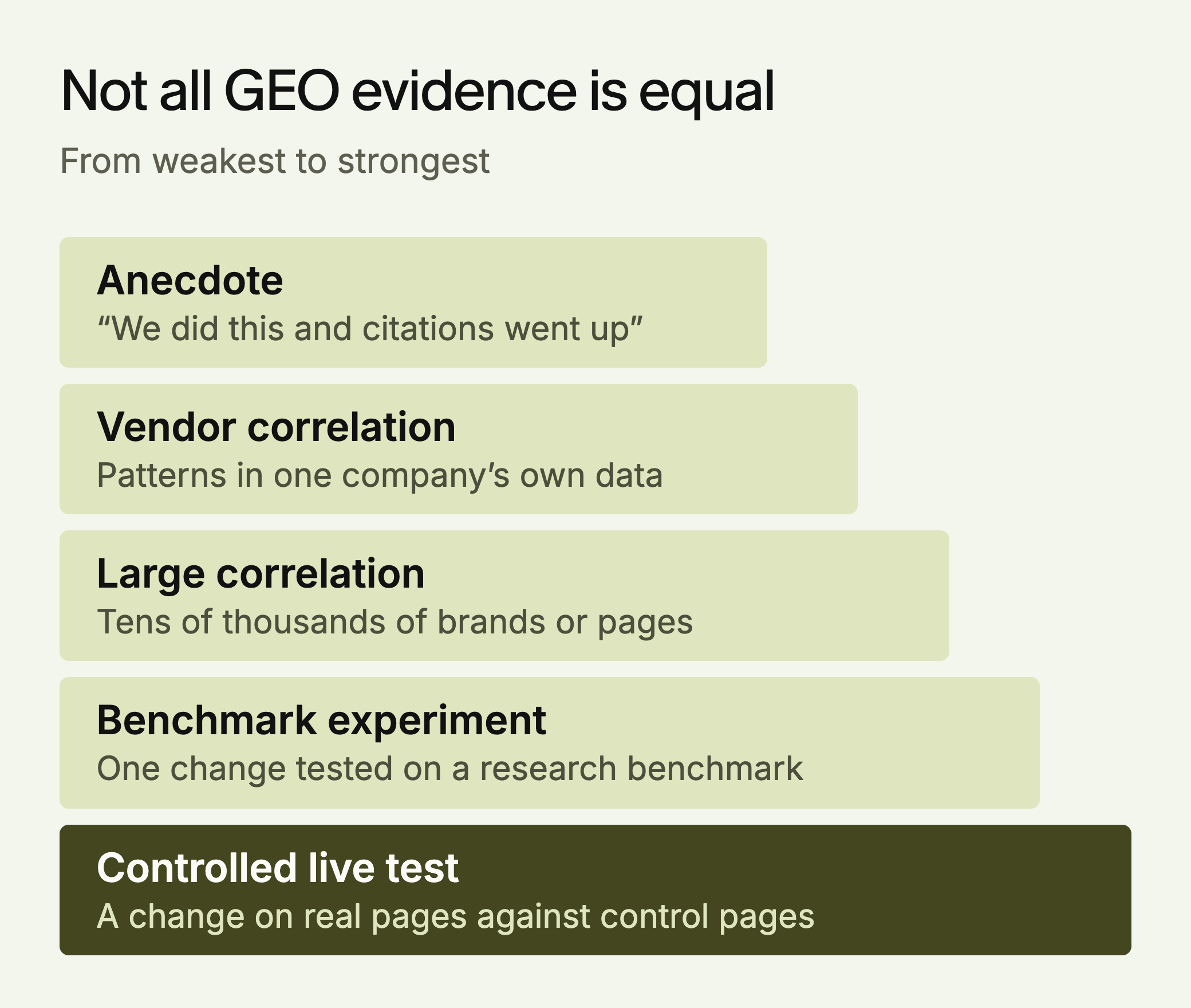
The higher a study sits on this ladder, the more it can tell you about cause. An anecdote tells you something happened once. A correlation across 75,000 brands tells you two things travel together, which is useful but doesn’t say which one drives the other. A benchmark experiment changes one thing and measures the result, but on a research setup rather than a live product. A controlled live test does it on real pages, against comparable pages that didn’t change.
Controlled live tests are rare in this field, and most large datasets come from companies that sell GEO or SEO tools. That doesn’t make the data wrong. It does mean you should know who collected it, and we flag that throughout. The grades below are our judgment, based on the strongest evidence we could trace to its original source.
The Scorecard
Here are 12 common GEO claims, the strongest evidence we found for each, and what we’d conclude today.
| Tactic | Best evidence | What it showed | Our grade |
|---|---|---|---|
| Adding quotations and statistics | Benchmark experiment | Visibility up about 41% and 31% | Supported on a benchmark |
| Restructuring a page | Benchmark experiment | Citation rate up from 45.0% to 52.8% | Supported on a benchmark |
| Earning brand mentions | Large correlation | 0.664 with AI Overview mentions | Strong correlation |
| Earning YouTube mentions | Large correlation | About 0.737 across three AI platforms | Strong correlation |
| Ranking in Google’s top 10 | Vendor comparisons | 28.6% on Perplexity, 8.0% on ChatGPT | Depends on the engine |
| Earning third-party coverage | Vendor correlation | Median 239% citation lift, no control group | Promising, unproven |
| Building backlinks | Large correlation | 0.218 with AI Overview mentions | Weak signal |
| Adding schema markup | Closest to a controlled live test | No significant lift, one small decline | Tested, no lift |
| Publishing llms.txt | Large correlation | No measurable link to citations | No measurable link |
| Writing longer pages | Vendor correlation | 0.04 correlation with citation | Near zero |
| Adding named authors | Vendor correlations | Studies point in opposite directions | Studies conflict |
| Keyword stuffing | Benchmark experiment | Visibility down about 8% | Avoid |
Three patterns stand out. The tactics with test results behind them change what’s on the page: more substance, clearer structure. The strongest correlations sit off your site, in how often the web talks about you. And several tactics with the loudest reputations, schema and llms.txt above all, have the least to show for it.
What Has Held Up in Tests
The best-known experiment in this field is the Princeton GEO study (Aggarwal et al., KDD 2024). The researchers built a benchmark of 10,000 queries and tested nine content edits one at a time against unedited pages.
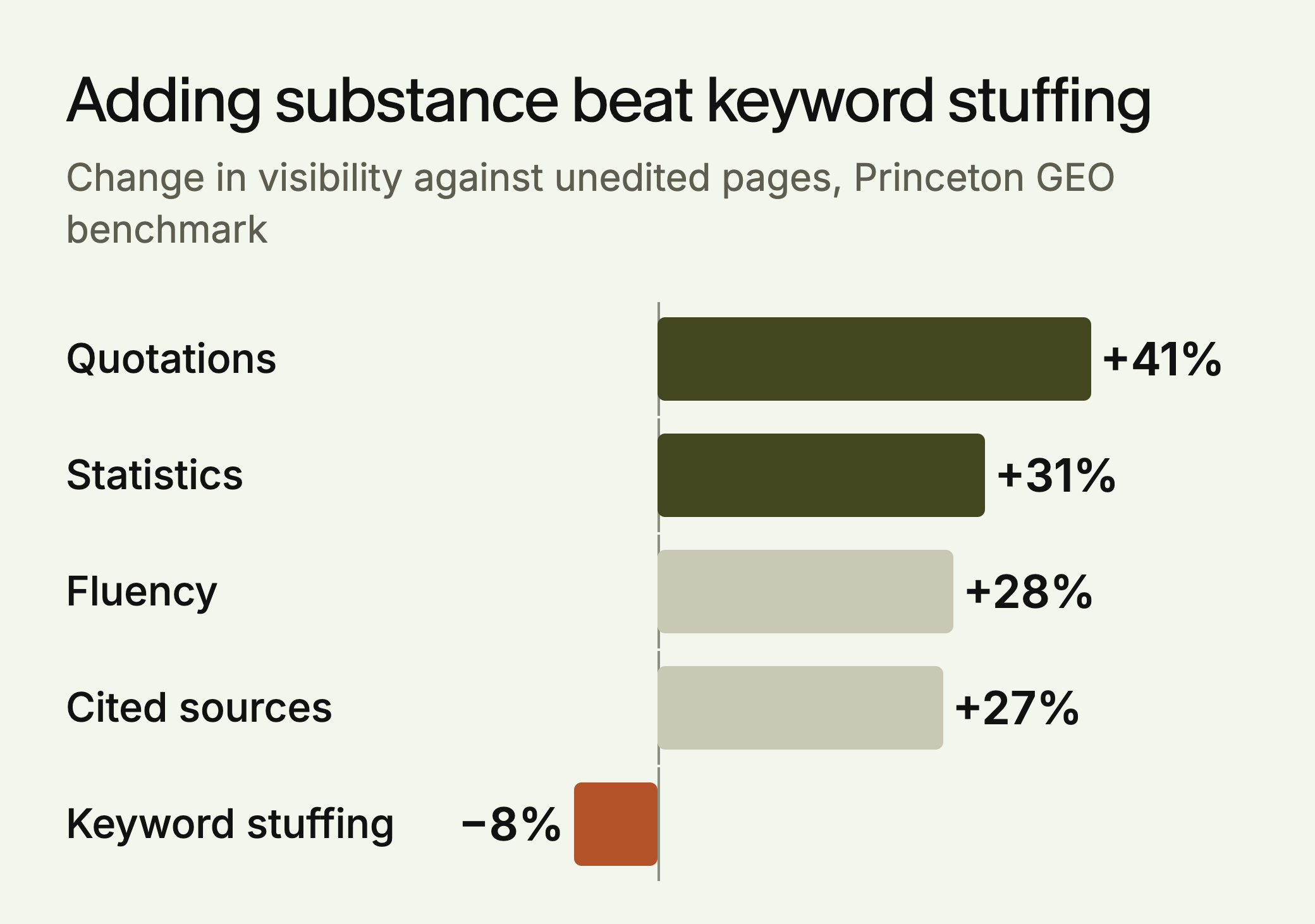
Adding quotations from credible people and adding statistics did the most. Keyword stuffing, a habit carried over from old SEO, made things slightly worse.
Two details matter when you apply this. First, the test engine was GPT-3.5 Turbo answering from the top five Google results, not ChatGPT’s product or AI Overviews. Second, the effect depended on where a source already stood. Citing sources lifted pages at rank 5 by 115.1% and cut pages at rank 1 by 30.3%. So the same edit may help a challenger more than a leader.
A second experiment points the same way. In GEO-SFE, a March 2026 paper from researchers at the University of Tokyo, the University of Tsukuba and Hiroshima University, restructuring 200 articles across six generative engines raised the citation rate from 45.0% to 52.8%, a 17.3% relative gain. An ablation in the paper credits document structure, chunking and emphasis with about 45%, 40% and 15% of that gain. List and table conversion sits inside chunking and wasn’t tested alone, so the paper can’t say what lists or tables did by themselves.
What Correlates Strongly, but Is Unproven
Ahrefs’ May 2025 study of 75,000 brands (vendor data) measured how often brands appeared in Google AI Overviews, then compared that with signals you might invest in.
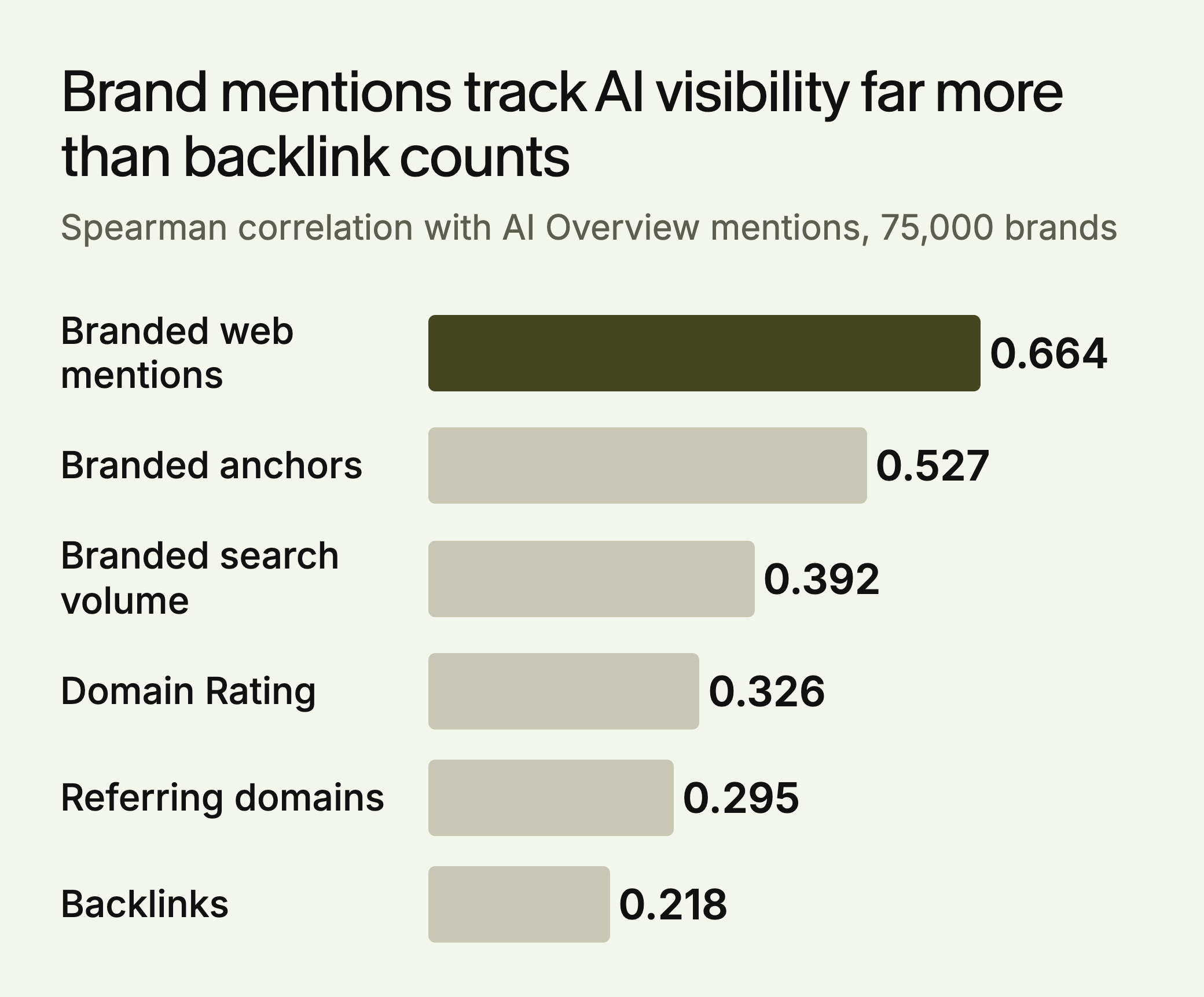
A December 2025 follow-up added ChatGPT, AI Mode and YouTube data. YouTube mentions had the strongest correlation, at about 0.737 across the three platforms, and branded web mentions came in between 0.656 and 0.709. Link metrics stayed very weak.
Big brands get mentioned more, searched more and recommended more, so these numbers can’t show that a new mention causes a new citation. It’s still the best available guide to where visibility tends to live: in what the rest of the web says about you.
Coverage on other sites shows a similar pattern with weaker evidence. Stacker’s study with Scrunch (vendor data, and Stacker sells distribution) reported a median 239% citation lift across 87 stories, 30 brands and 8 AI platforms. Stacker itself calls the data observational, and it reports no control group.
Where Google Rankings Help, and Where They Don’t
“Do SEO and AI will follow” is half right. How much your Google rank matters depends heavily on which engine you care about.
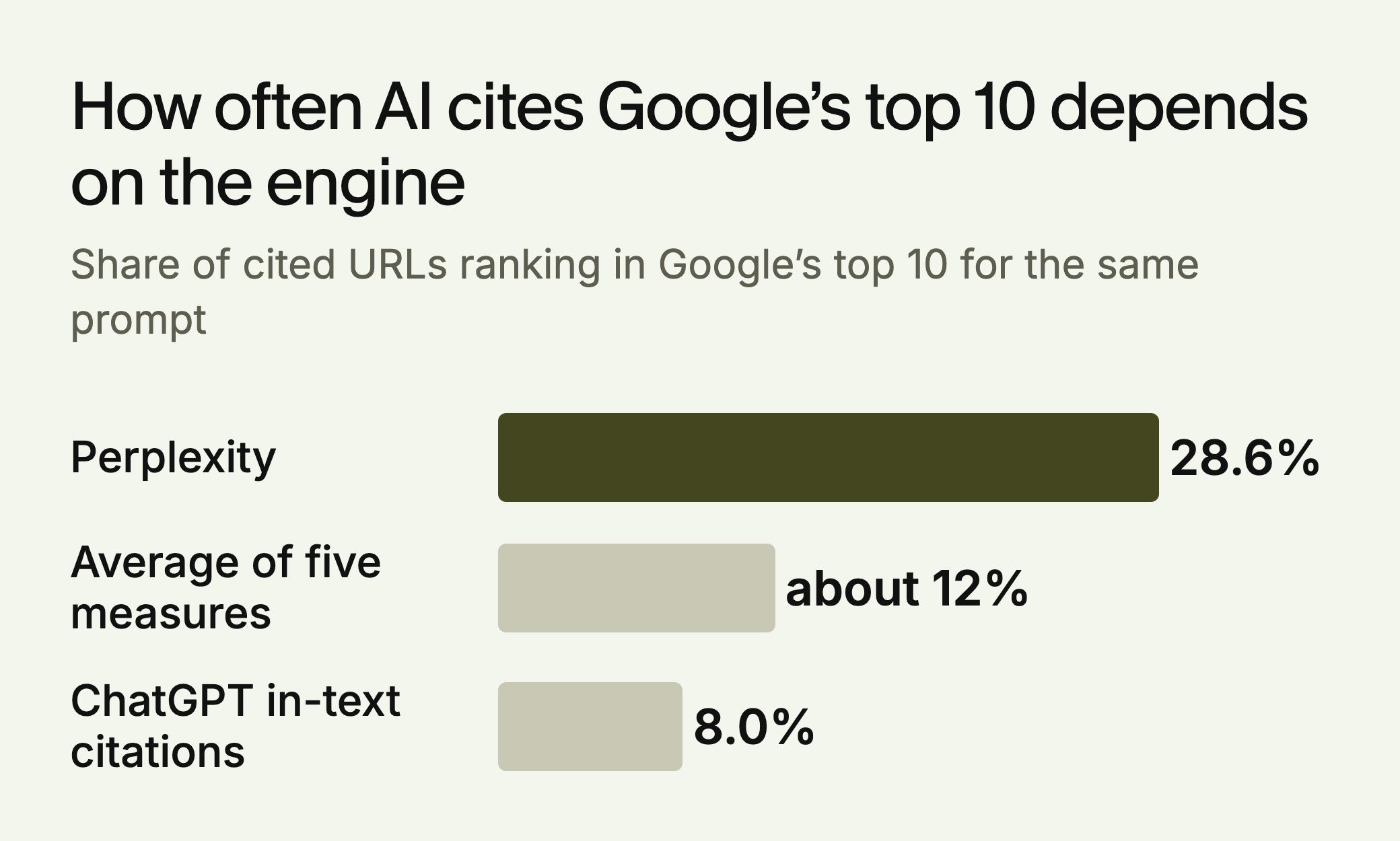
Ahrefs’ test of 15,000 long-tail prompts found about 8% of ChatGPT’s in-text citations ranked in Google’s top 10 for the prompt, against 28.6% for Perplexity. The 12% is Ahrefs’ average of five measures. On the other hand, AirOps’ ChatGPT data (vendor data) found that pages ranking first on Google were cited at a 43.2% rate, 3.5 times the rate for pages beyond the top 20. The report doesn’t define the base for that rate.
Those findings fit together. Most things ChatGPT cites aren’t in Google’s top 10 for that exact prompt, but in AirOps’ data a first-ranked page was cited far more often. Treat rank as helpful and insufficient. It isn’t a substitute for checking the answers themselves.
What Doesn’t Earn Its Reputation
Schema markup. Ahrefs’ May 2026 test is the closest thing to a controlled live test in this list. It tracked 1,885 pages that added JSON-LD against 4,000 control pages that never did, and compared citations in the 30 days before and after each change.
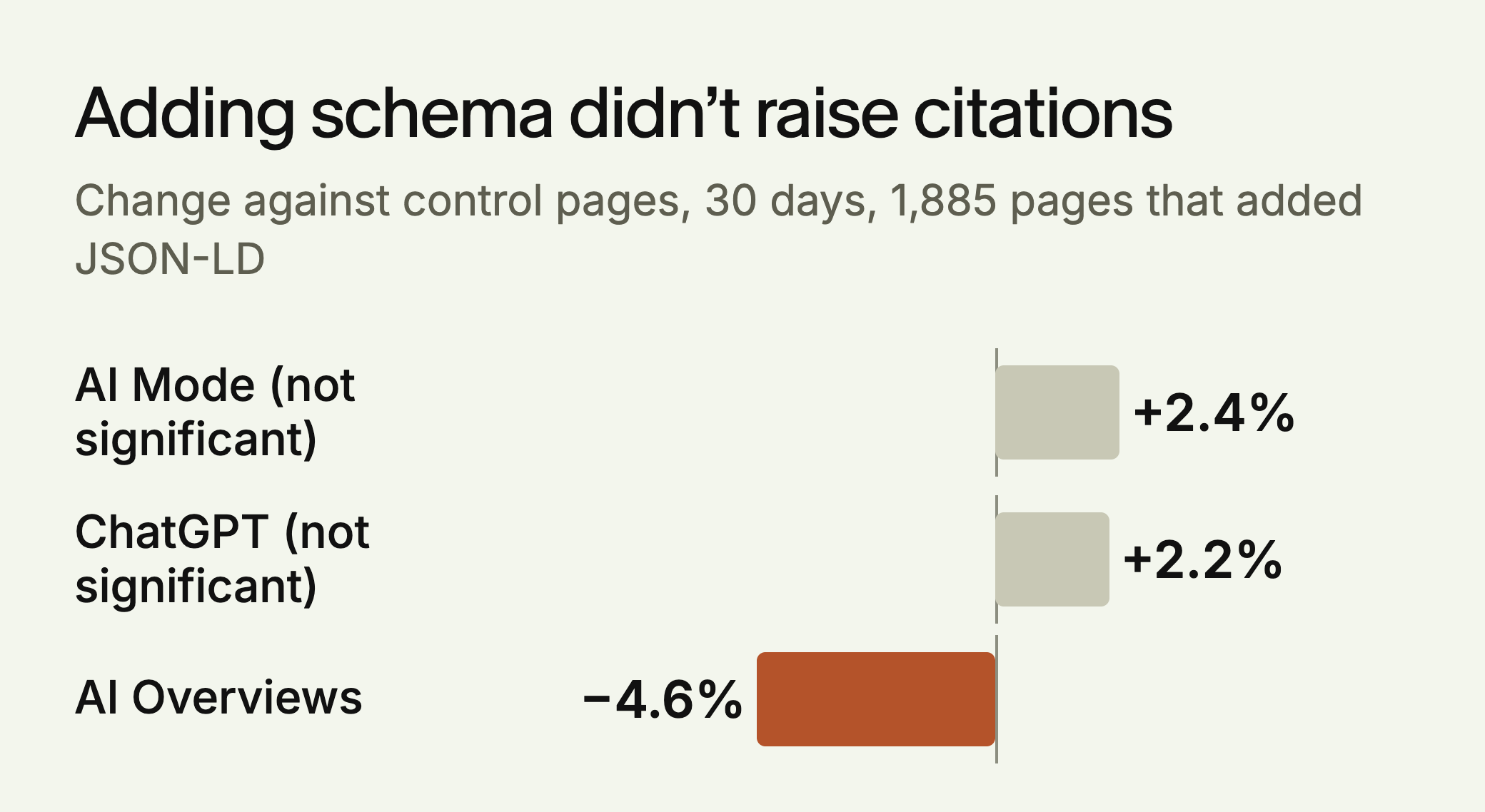
AI Mode and ChatGPT were indistinguishable from zero, and AI Overviews fell slightly. The pages weren’t randomly assigned, schema additions often came with other site changes, the pages tested were already heavily cited and the study pooled all schema types, so it doesn’t prove that no schema ever helps. It does make a universal uplift very hard to claim. Keep schema for what it’s known to do, such as eligibility for rich results and clear product data.
llms.txt. SE Ranking’s study of nearly 300,000 domains (vendor data) found no measurable link between having the file and being cited. Keep one if you already have it, since it may give agents a useful map. Don’t expect citations from it.
Word count. Ahrefs reports a Spearman correlation of 0.04 between word count and citation in AI Overviews. The longest cited blog post in that set was about 3,500 words, so it says little about very long guides. Write to the length the question needs.
Backlinks. At 0.218 in the Ahrefs data, they ranked seventh of the 11 signals it reported. They may still matter for ranking in search, which feeds some engines, but they’re a poor proxy for AI visibility.
Where Studies Conflict: Named Authors
Whether a named author helps is a good example of why one study isn’t enough. TJ Digital’s analysis of 21,874 cited and 4,507 passed-over pages found that pages with a byline had 28% lower odds of being cited, adjusted for Domain Rating and page type. Machine Relations Research, comparing 706 page pairs, found an author named in markup or meta tags on 67.0% of cited pages against 57.9% of same-site comparison pages.
Both come from companies selling services in this field, and neither is peer reviewed. They used different samples and different definitions, so we wouldn’t pick a winner. Name your authors because readers deserve to know who wrote something, and treat any citation benefit as a possible bonus.
Why Every Result Carries a Warning
Two findings should temper every number in this article. The first is how unstable answers are. In a SparkToro study of 2,961 runs from 600 volunteers, there was less than a 1 in 100 chance that ChatGPT or Google’s AI would give the same list of brands twice. A single before-and-after check can’t tell you much.
The second is how little has been proven. A critical survey of 45 GEO studies by Olivier Martinez, posted to arXiv in July 2026, found no technique with a stable, cross-platform causal effect. The survey is a preprint, and its set mixes peer-reviewed papers with workshop papers and other preprints. Its point stands: GEO is a young field, and the honest position is a set of informed bets.
A Worked Example: Rewriting One Paragraph
Here’s what the two best-supported edits look like on a page. The company, the people and the figures below are made up for illustration. On a real page, use numbers and quotes you can source.
| Before | After |
|---|---|
| Our payroll software saves finance teams a lot of time and is trusted by companies around the world. Customers love how easy it is to use. | Quillon runs payroll for employees and contractors in 30 countries on one monthly pay run. In our 2026 survey of 412 finance teams, the median team closed payroll in 2.1 days, down from 3.8. “We stopped reconciling three spreadsheets every month,” says Dana Levi, controller at Northfield. |
The “before” version gives an engine nothing it can quote or check. The “after” version adds a specific capability, a sourced statistic and a named person. It also answers the question a buyer is likely to ask: does this cover contractors abroad?
What to Do First
If you’re deciding where to spend the next quarter, this is the order we’d use.
- Check that engines can reach your pages. Blocked or unrendered pages can’t be cited, whatever else you do.
- Add substance to the pages that matter most. Sourced statistics, named quotes and specifics have the best test results here.
- Make those pages easy to extract from. Put the answer early, use clear headings, and use tables where the content is comparative.
- Invest in being talked about. Earn mentions in the publications, communities and videos your buyers already use.
- Measure by engine. Rank matters differently on each one, so a single blended number hides what’s happening.
- Stop spending on what hasn’t shown results. Don’t build llms.txt or schema projects expecting citations.
How to Test a Tactic on Your Own Site
Published studies tell you what tends to happen. Only a test tells you what happened to you. A simple version takes one person and a spreadsheet.
- Pick 20 to 40 buyer questions, and group your pages into two matched sets.
- Run each question several times on each engine, in fresh chats, and record who gets named and cited. This is your baseline.
- Change one thing on the first set only. Leave the second set alone.
- Wait long enough for pages to be recrawled, then run the same questions the same way.
- Compare the change in the first set with the change in the second, by engine.
- Believe only a difference that’s larger than the swing you saw between repeat runs.
Run by hand, this gets tedious quickly. LLMagnet asks the same questions on seven AI engines on a schedule and records who gets named, so changes can be read as a trend. Its free audit is one place to start.


 Perplexity




 30-day free trial · no credit card