

 Ask Gemini

ChatGPT, Perplexity and Google cite different sources, and each one searches a different index and applies its own selection. In a Profound analysis of 100,000 prompts (vendor data), only 11% of domain citations appeared in both ChatGPT and Perplexity, so measure each engine separately.
This post covers how each engine finds pages, what the checkable data shows, and how to pick one to work on first. No engine publishes its selection formula. Most of the third-party Google data below covers AI Overviews rather than AI Mode, and most of the data overall comes from vendors.
Contents
- Each Engine Finds Pages Differently
- How Much the Engines Overlap
- Which Crawlers to Allow
- ChatGPT: Be Reachable and Match the Fan-Out
- Perplexity: Make Each Passage Stand Alone
- Google: Win at Search First
- Where to Earn Mentions, by Engine and Business
- What Is Worth Doing on Every Engine
- How to Measure Each Platform
- Common Mistakes
- Pick One Platform for 90 Days
- FAQ
Each Engine Finds Pages Differently
A model can answer from what it learned in training, or it can search the web and work from what it finds. Only the second path gives a page you publish today a chance of being linked.
- ChatGPT search uses third-party providers, including Microsoft Bing, as TechTarget reported in December 2024.
- Perplexity says it runs its own index of over 200 billion URLs.
- Google AI Overviews and AI Mode use core ranking systems to retrieve pages from the Search index.
Different pools can produce different answers. In Ahrefs’ test of 15,000 long-tail prompts (vendor data, published August 2025, with ChatGPT results collected in early July), 28.6% of Perplexity’s cited URLs ranked in Google’s top 10 for the prompt, against 8.0% for ChatGPT’s in-text citations.
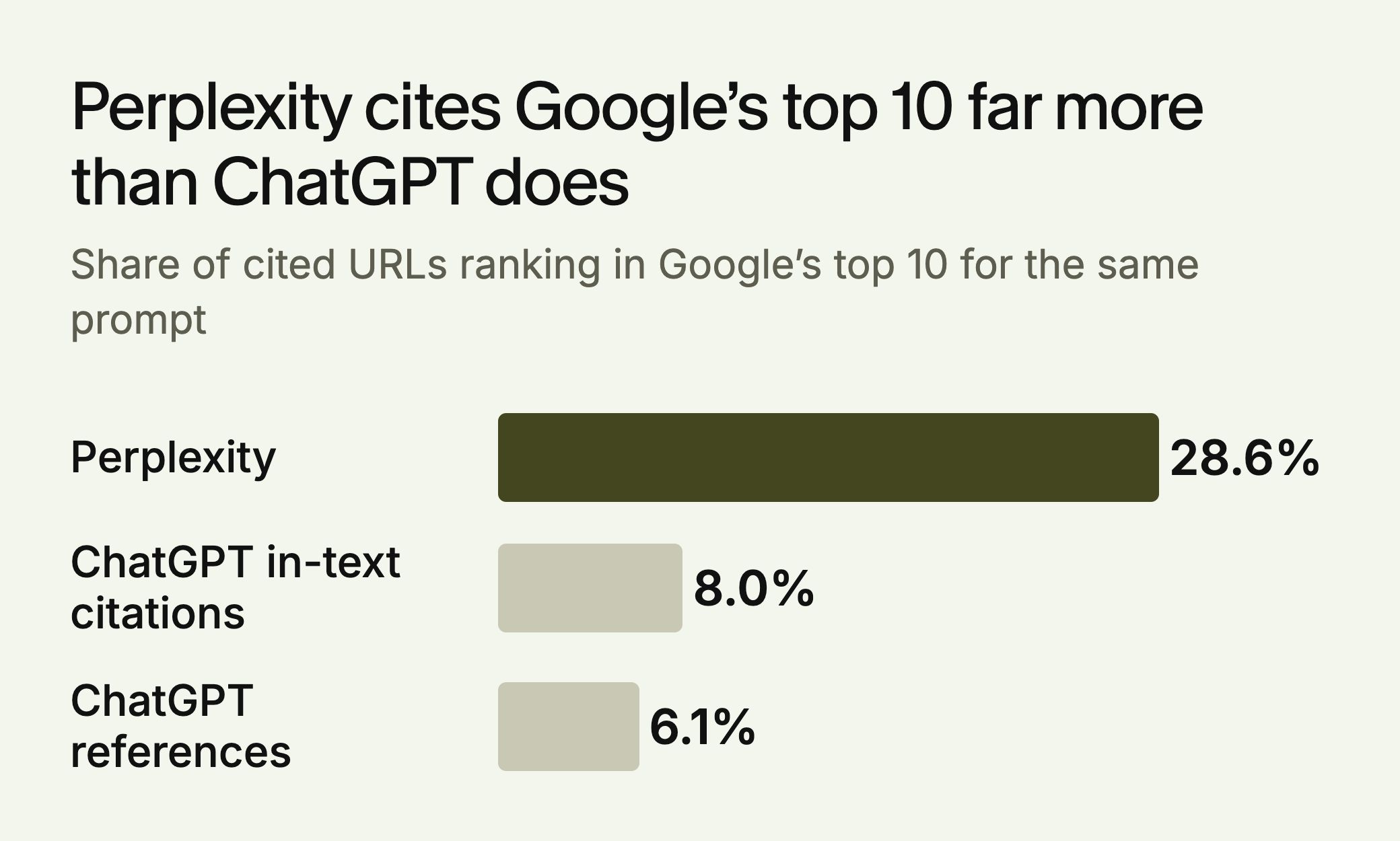
Ahrefs’ explanation is that assistants often search variants of the prompt rather than the prompt itself, and may favor pages that rank consistently across those variants. That’s its reasoning, not a published description of any engine. Perplexity’s result is the odd one: it runs its own index, yet sits closest to Google.
How Much the Engines Overlap
Very little, at least between the two engines measured most directly. In Profound’s July 2025 analysis (vendor data), 11.0% of domain citations were shared.
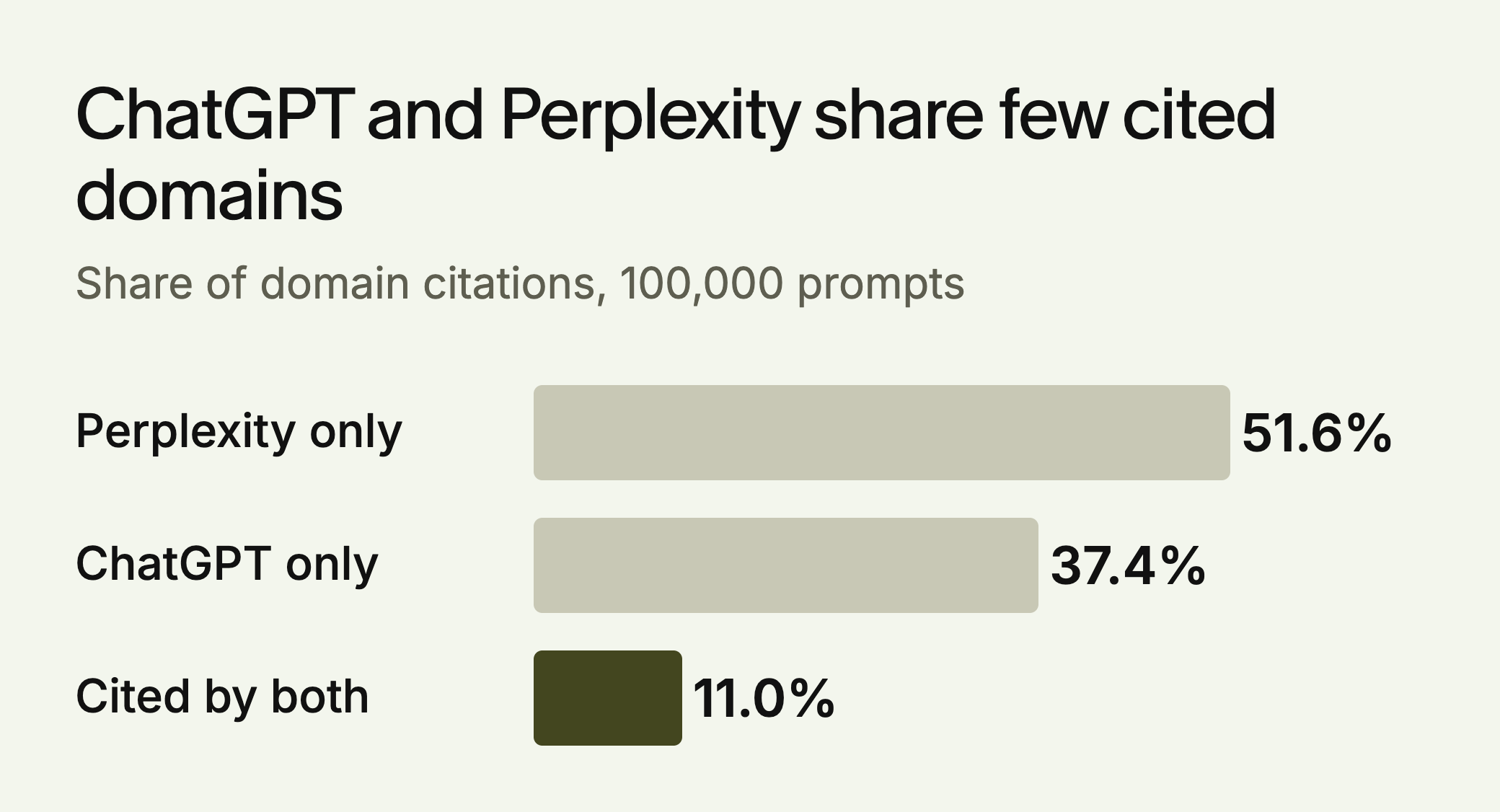
Profound also reports a range for other pairs, from 6% (Google AI Overviews and Copilot) to 16.4% (Perplexity and AI Overviews). That top figure fits Ahrefs’ finding that Perplexity sits closest to Google, though the two studies measure different things. Profound counts domains, not URLs, and doesn’t report URL-level overlap.
The engines also differ in how many sources they show at all, which changes how competitive each answer is.
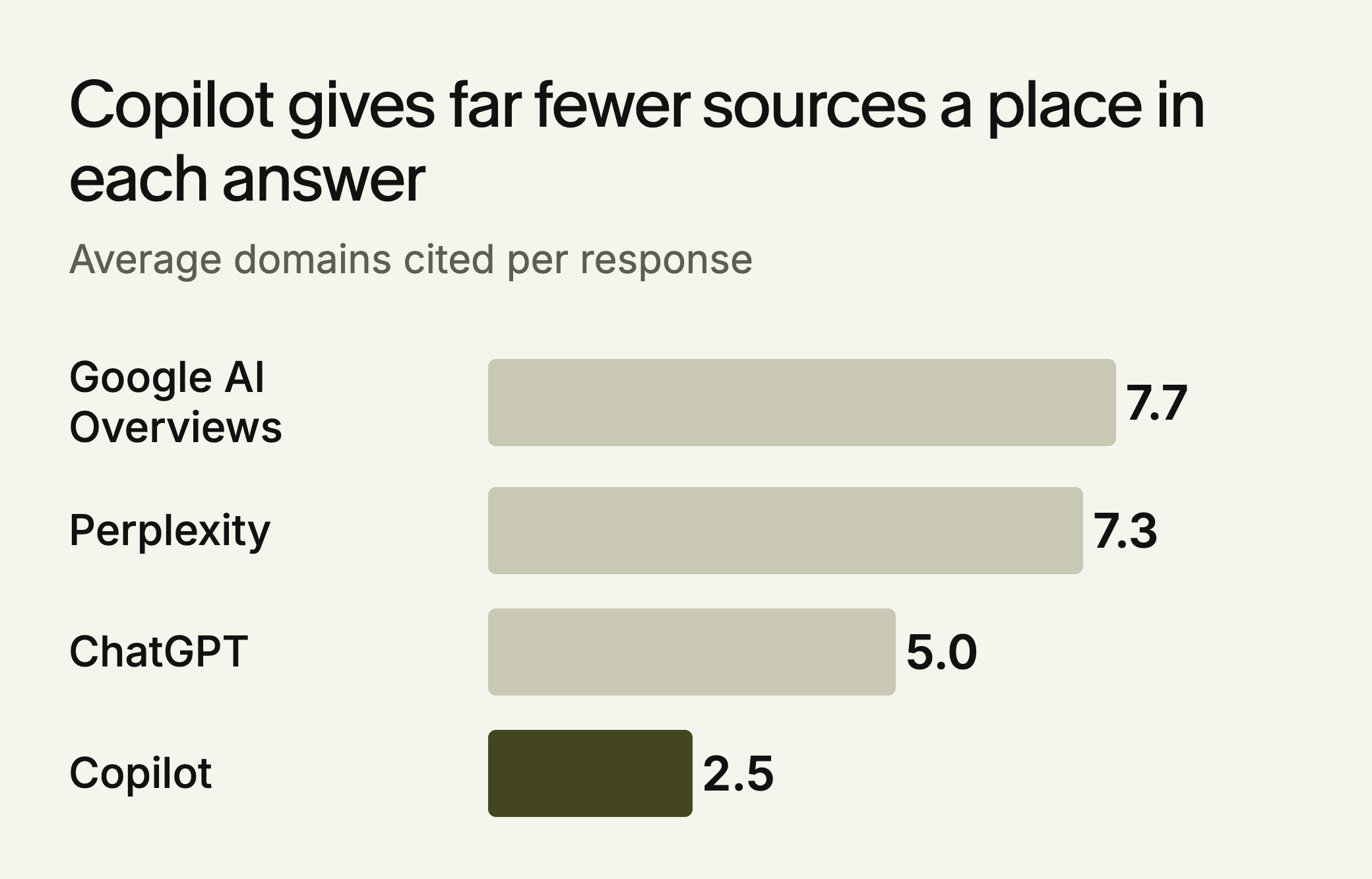
These datasets are more than a year old, and engines change often. Use them to understand that engines differ, then check your own category.
Which Crawlers to Allow
Each engine separates search from training, or from user-triggered fetches, and blocking the wrong one is a quiet mistake.
| Engine | Crawler | What it does | Control |
|---|---|---|---|
| ChatGPT | OAI-SearchBot | Decides whether you can appear in ChatGPT search answers | robots.txt, about 24 hours to apply |
| ChatGPT | GPTBot | Model training, controlled separately | robots.txt |
| ChatGPT | ChatGPT-User | User-initiated visits. Not used for search eligibility | robots.txt may not apply |
| Perplexity | PerplexityBot | Surfaces and links sites in results | robots.txt, up to 24 hours to apply |
| Perplexity | Perplexity-User | Fetches a page when a user asks | Generally ignores robots.txt |
| Googlebot | Crawling for Search, which feeds AI features | robots.txt, plus snippet and noindex rules | |
| Google-Extended | Limits AI training and grounding in some other Google systems | robots.txt |
Sources: OpenAI, Perplexity, Google. Perplexity also advises matching each bot’s user agent and its published IP ranges in your firewall, and warns that Cloudflare’s Bot Fight Mode can still challenge its crawler when a custom rule allows it. Check your logs for 200 responses after any change.
ChatGPT: Be Reachable and Match the Fan-Out
AirOps’ March 2026 report (vendor data, 15,000 prompts) found ChatGPT left 85% of retrieved pages uncited. Pages ranking first on Google were cited at a 43.2% rate, 3.5 times the rate for those beyond the top 20. And 95% of ChatGPT’s fan-out queries had no monthly search volume by traditional metrics.
Bing matters, but less simply than “rank in Bing and ChatGPT cites you”. In Ahrefs’ data, 8.1% of ChatGPT’s in-text citations ranked in Bing’s top 10 for the prompt, about the same as Google’s 8.0%. Ranking for the literal prompt on either engine explains little.
SE Ranking’s study of 129,000 domains (vendor data) shows a strong pattern with referring domains. Sites with up to 2,500 averaged 1.6 to 1.8 citations, and sites above 350,000 averaged 8.4. The biggest jump came past 32,000, from 2.9 to 5.6. That is correlation, and those are very large sites.
Profound’s data on 680 million citations (vendor data, August 2024 to June 2025) has Wikipedia as ChatGPT’s most cited source at 7.8% of total citations, ahead of Reddit at 1.8%.
Behind those came Forbes and G2 at 1.1% each, then TechRadar at 0.9%, so ChatGPT’s list leans toward reference and editorial sources. In SE Ranking’s data, domains with profiles on several review platforms averaged 4.6 to 6.3 citations against 1.8 without. That’s also correlation.
What to do: Allow OAI-SearchBot. Check your indexing in Bing Webmaster Tools. List the follow-up questions around your main topics and answer them. Earn links and mentions through real PR.
Perplexity: Make Each Passage Stand Alone
Perplexity says it scores results at both the document and sub-document level, so a clear passage on an otherwise ordinary page has a chance. It also lists freshness among the design goals of its index. We couldn’t find a verifiable figure for how recent a page must be, so be skeptical of anyone quoting a specific window.
Its published design explains the passage advice. Parsing splits documents into self-contained spans that are ranked individually. Retrieval runs both by keyword and by meaning, early filters remove stale or off-topic content, and later stages rerank with heavier models. A model also decides which URLs to refresh, weighing importance and likely update frequency, and those refreshes compete with indexing new pages. So fast-moving pages that change often have a better case for recrawling than pages that never change.
In Profound’s data, Reddit led Perplexity’s sources at 6.6% of total citations, followed by YouTube at 2.0%. That is the highest Reddit share of the three engines in the dataset.
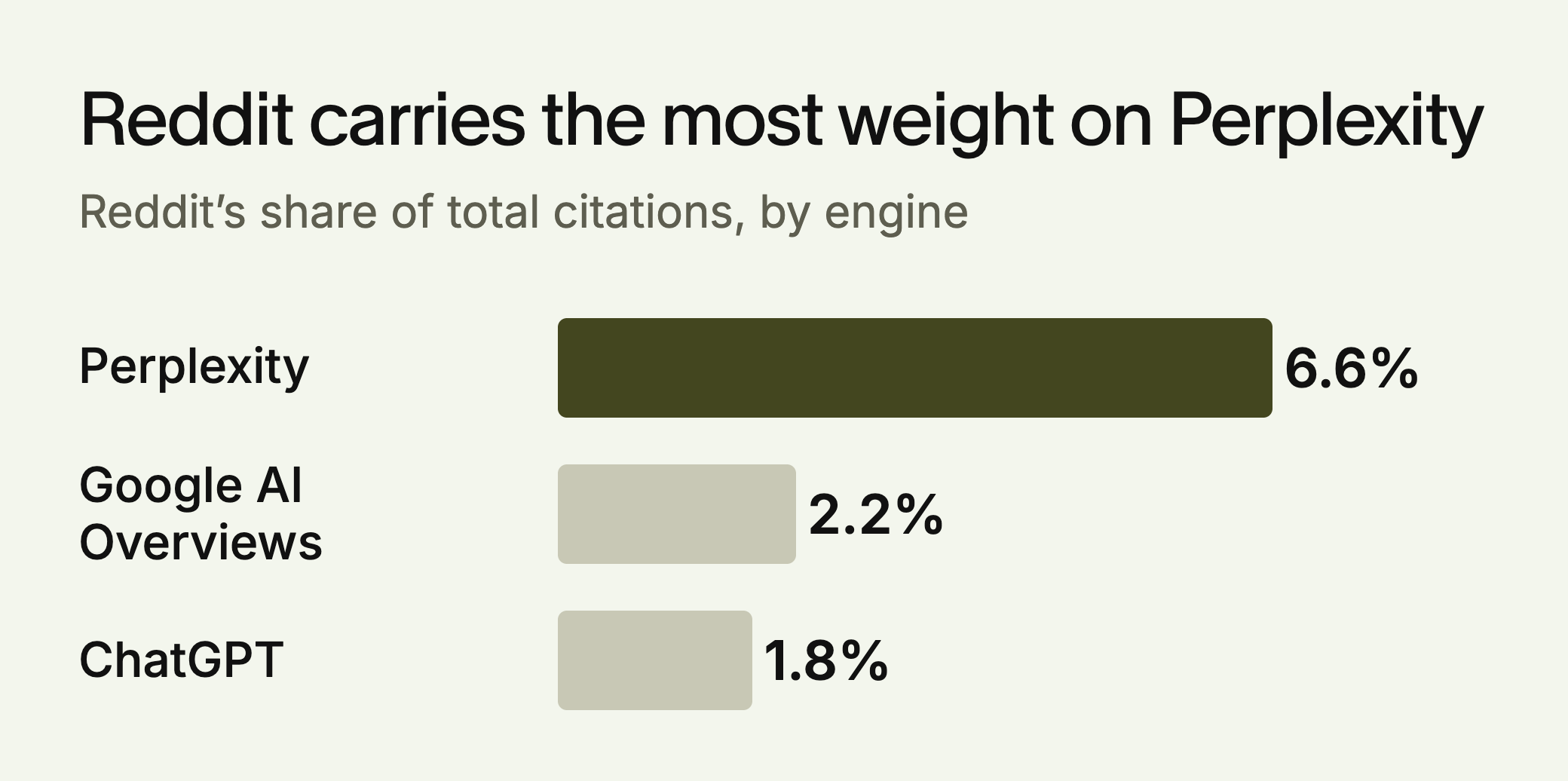
Even at 6.6%, most Perplexity citations go elsewhere. Don’t turn that into a Reddit campaign unless your buyers actually discuss your category there. In the Princeton benchmark’s 200-example Perplexity check, quotations moved the word-count measure from 24.1 to 29.1, and keyword stuffing dropped it to 21.9, so adding attributed quotes is a cheap test.
What to do: Open each section with a direct answer that makes sense alone. Confirm PerplexityBot isn’t blocked in robots.txt or at your CDN. Show publication and updated dates in the page’s HTML. Refresh the pages that cover fast-moving topics.
Google: Win at Search First
Google says there are no additional requirements to appear in AI Overviews or AI Mode. A page must be indexed and eligible for a snippet. It also says no special schema.org markup is needed. Evidence on schema elsewhere is mixed, as our review of the schema studies explains.
AI Overviews and AI Mode aren’t interchangeable. Google says the two may use different models and techniques, so their answers and links can differ, and that AI Overviews appear only when its systems judge they add value beyond classic Search. Check both before concluding anything.
Its optimization guide favors content with a unique point of view, such as a first-hand review, over summaries of common knowledge. Our summary of the guide lists what it says you can skip.
In Ahrefs’ study of 75,000 brands (vendor data), branded web mentions correlated with AI Overview visibility at 0.664, against 0.218 for backlinks. Profound describes the top sources in AI Overviews as a more balanced mix, and across all its citations Reddit leads at 2.2%, with YouTube at 1.9%.
Ahrefs’ December 2025 follow-up (vendor data) adds AI Mode: branded web mentions correlated at 0.709 with AI Mode visibility, higher than in the other two platforms it measured. Domain Rating was weaker on AI Mode (0.285) than on AI Overviews (0.326). All of this is correlation, and the sample only includes brands with a Domain Rating above 40. A separate Ahrefs analysis from March 2026 (vendor data, 4 million AI Overview URLs) found 37.1% of cited URLs ranked in the organic top 10 for the same query, down from about 76% in its July 2025 study. That is still far above ChatGPT’s 8.0%, though the two were measured differently.
What to do: Fix indexing issues in Search Console. Add first-hand detail to your top pages. If you sell products or serve a local area, maintain your Merchant Center feed and Business Profile, which Google says can help you appear in AI responses.
Where to Earn Mentions, by Engine and Business
Profound’s top sources show that the engines reward different places. These are shares of total citations in its dataset (vendor data, August 2024 to June 2025).
| Engine | Most cited sources |
|---|---|
| ChatGPT | Wikipedia 7.8%, Reddit 1.8%, Forbes 1.1%, G2 1.1%, TechRadar 0.9% |
| Google AI Overviews | Reddit 2.2%, YouTube 1.9%, Quora 1.5%, LinkedIn 1.3%, Gartner 0.7% |
| Perplexity | Reddit 6.6%, YouTube 2.0%, Gartner 1.0%, Yelp 0.8%, LinkedIn 0.8% |
- B2B: Prioritize review sites and analyst or trade coverage (G2, Gartner, Forbes), then LinkedIn for AI Overviews.
- Ecommerce: Keep your Merchant Center feed accurate, and look for editorial reviews and YouTube coverage. NerdWallet and PCMag appear in Profound’s top 10s, which shows that specialist reviewers can matter.
- Local: Start with your Business Profile. Yelp and TripAdvisor both make Perplexity’s top 10.
Each of these shares is small, and the top 10 lists favor sites that publish at huge scale. A trade publication your buyers read can matter more than a place on these lists, so check which sources appear for your own prompts first.
What Is Worth Doing on Every Engine
- Add sourced numbers and quotes. In the Princeton GEO study, adding quotations gained about 41% on its word-count measure and adding statistics about 31%, while keyword stuffing lost about 8%. Those are tests on a benchmark, with only a 200-query check on Perplexity, so they aren’t proof for live engines.
- Keep pages fast. SE Ranking found pages with a First Contentful Paint under 0.4 seconds averaged 6.7 ChatGPT citations, against 2.1 for pages above 1.1 seconds. It’s a correlation on one engine, but Google also recommends reducing latency.
- Cover your topic in depth. Engines split one question into several searches, so a site that has answered the follow-ups has more chances to match. Pick a narrow subject and finish it before starting another.
How to Measure Each Platform
- Google: Search Console’s Generative AI performance report shows impressions from AI Overviews and AI Mode by page, country, date and device. The help page describes impressions only, and doesn’t describe a way to separate the two features.
- Perplexity and ChatGPT: Segment referrals from perplexity.ai and chatgpt.com in your analytics, and compare landing pages. Referrals show only the people who clicked. Pew’s March 2025 data found people clicked a link inside a Google AI summary in just 1% of visits to pages with one.
- All engines: Test 20 to 30 important prompts, several times each. SparkToro’s research (not peer reviewed) found less than a 1-in-100 chance that ChatGPT or Google’s AI would return the same list of brands in any two responses, so track how often you appear rather than your position.
- Bing and Copilot: Bing’s AI Performance report shows citations by page and a sample of grounding queries, the phrases the AI used to retrieve what it cited. It covers Copilot, AI summaries in Bing and select partners, so don’t read it as ChatGPT data.
Common Mistakes
- Reporting one blended number. A rise on Perplexity can hide a fall on ChatGPT. Keep each engine on its own line.
- Treating AI Overviews and AI Mode as one thing. Google’s report combines them, but the answers can differ. Test both.
- Blocking GPTBot to protect content, then blocking OAI-SearchBot too. The first is a training decision. The second removes you from ChatGPT search answers, although navigational links may still appear.
- Copying a list of top sources. The most cited domains across all topics may not be the ones cited in your category.
- Reading a tactic’s effect from a small sample. Answers vary between runs, so run a test before crediting any change.
Pick One Platform for 90 Days
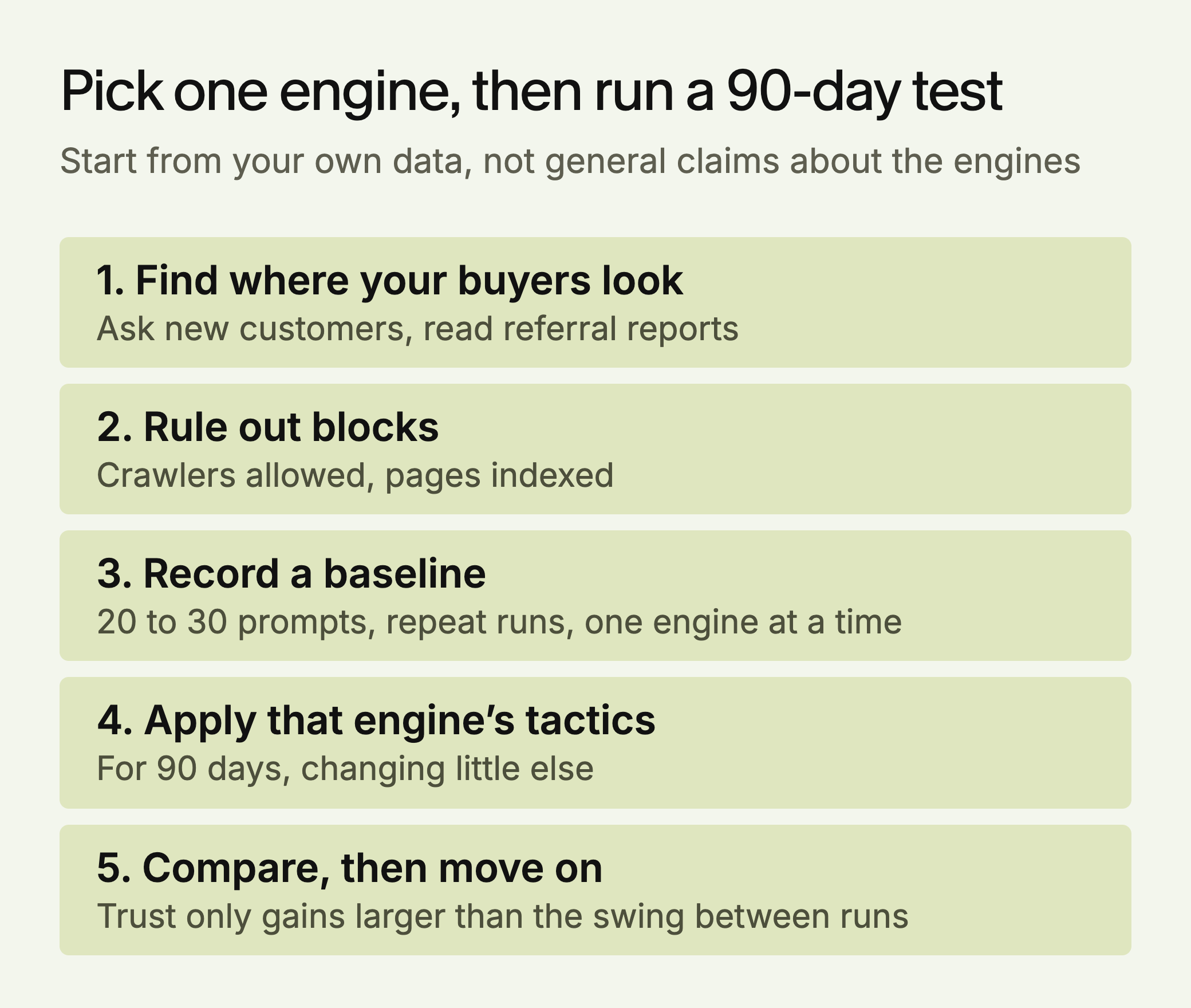
Choose from your own data, not from general claims about who uses which engine. Ask new customers which tools they used to research you, and look at your referral reports.
- Your buyers search Google first, or you sell locally or online: start with Google.
- Your category is researched in long, specific questions: start with ChatGPT and work on fan-out coverage.
- You publish often on fast-moving topics: start with Perplexity.
Record a baseline, apply that engine’s tactics for 90 days, and compare how often you appear. Then move to the next engine. Engines change often, so repeat the baseline each quarter.
A worked example. The company and figures below are made up for illustration. Brindle sells freight software to mid-sized shippers. Asking 40 new customers which tools they used before buying, it finds 22 used ChatGPT, 6 Perplexity and 30 Google. Its long, specific buying questions point to ChatGPT, so it starts there.
- Logs show OAI-SearchBot getting 200s. Bing Webmaster Tools shows a third of its comparison pages aren’t indexed, so it fixes those first.
- It runs 25 prompts eight times each, in two batches a week apart. Brindle appears in 18 and 24 of 200 runs.
- It adds sections on carrier coverage, customs and pricing to five pages, updates its G2 profile, and leaves everything else alone.
- After 90 days Brindle appears in 47 of 200 runs. That’s well beyond the 6-run gap between baseline batches, so the team treats the gain as real and moves to Google.
Had the result been 27 of 200, the honest reading would be no clear change. In that case, check whether the pages were recrawled before trying something else.
LLMagnet measures AI visibility across seven engines and has an agent that prepares fixes for your approval. The free audit shows where you stand today.








 30-day free trial · no credit card