

Brands mentioned more across the web and on YouTube tend to appear more in AI answers, and backlink count tracks that much less closely. In Ahrefs’ data, branded web mentions correlated with AI Overview visibility at 0.664 and backlinks at 0.218, and YouTube mentions reached about 0.737 in a follow-up. These are correlations from a vendor’s own data, so they point to where to look, not to what causes citations.
Contents
- The correlations
- What these numbers can’t prove
- What other studies add
- Why YouTube may stand out
- Earned media shows a similar pattern
- What changes in your budget
- What to do this week
- What to measure
- FAQ
The correlations
Ahrefs published two related studies of 75,000 brands. The first, from May 2025, measured Spearman correlation with brand mentions in Google AI Overviews:
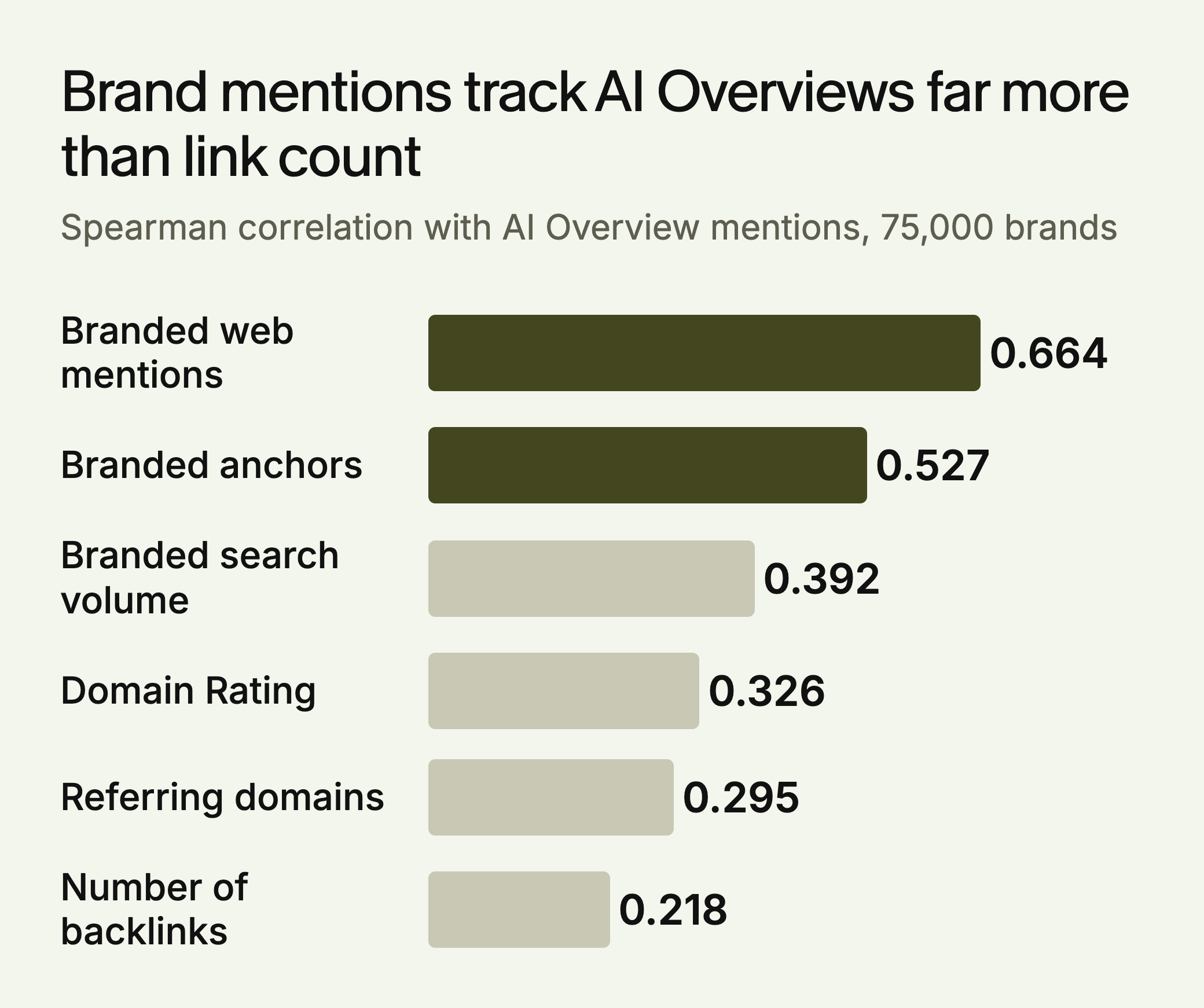
The other factors were weaker: branded traffic 0.274, branded ad traffic 0.216, branded ad cost 0.215, URL Rating 0.18 and number of site pages 0.17.
Spearman measures rank order. A 0.664 means brands that rank high for web mentions tend to rank high for AI Overview mentions. It isn’t a percentage, and it doesn’t say how many mentions buy one more appearance.
One link result deserves a second look. Branded anchors, links whose text names the brand, reached 0.527, far above 0.218 for backlink count. A link that names you is also a mention, so raw link count may undersell what some links do. That reading is ours.
The December 2025 follow-up added ChatGPT and Google AI Mode, and YouTube data. YouTube mentions had the strongest correlation, at about 0.737 across the three platforms, and YouTube mention impressions about 0.717. Branded web mentions came in between 0.656 and 0.709, with AI Mode at the high end. Backlinks and URL Rating were again very weak, and Ahrefs found almost no relationship between site size and AI visibility.
Don’t divide 0.737 by 0.218 and call it a 3x advantage. Those figures come from different studies, and correlation coefficients don’t scale that way.
The signals also vary by engine. Domain Rating correlated at 0.266 for ChatGPT, 0.285 for AI Mode and 0.326 for AI Overviews. Ahrefs reads ChatGPT as the easiest entry point for brands without strong recognition, and AI Mode as the hardest.
What these numbers can’t prove
Ahrefs says so directly: “correlation isn’t causation.” Well-known brands earn mentions, searches, links and AI answers together, so a high correlation doesn’t show that one more mention earns one more citation.
- The sample is filtered. It only includes domains with a Domain Rating above 40. That narrows the range of authority, which may understate how much links matter to sites below that line. That last point is our inference.
- About 26% of brands had zero AI Overview mentions and were excluded from the first analysis.
- The query sets differ. ChatGPT is drawn from a different question pool than the Google products.
- “Branded web mentions” aren’t only unlinked ones. Ahrefs counts linked and unlinked mentions together, so don’t read this as proof that unlinked mentions beat linked ones.
- It’s vendor data. Ahrefs sells the tools used to collect it.
What other studies add
Seer Interactive’s January 2025 study ran 10,000 finance and SaaS questions through GPT-4o and also found backlinks weak or neutral. Its strongest signal was Google page-one rankings, at about 0.65, which isn’t among the factors Ahrefs lists. The two agree on link count. They don’t agree on a single best signal, because they measured different inputs on different engines.
The closest thing to a mechanism is an October 2026 preprint by Mahe Chen and Nick Koudas, covering 158,099 answers on ChatGPT, Gemini and Perplexity. It reports that ChatGPT writes brands it knows into its searches and names brands with no supporting page. In controlled tests, brand names reordered its product rankings even when the facts were identical. That suggests familiarity itself carries weight. It doesn’t show that a new mention creates familiarity, and the paper isn’t peer reviewed.
Why YouTube may stand out
Ahrefs counts a YouTube mention as any time a brand appears in a video’s title, transcript or description. Its suggested explanation is that Google and OpenAI have trained models on YouTube transcripts. That is a plausible reason, not a tested one. It may also be that brands worth talking about on video are brands that AI answers name anyway.
Two details change how you act on this. First, the signals overlap: a brand in a YouTube title also counts toward branded web mentions. Second, being mentioned in a video isn’t the same as being cited from one. In TJ Digital’s agency study, YouTube appeared in 23% of AI Overview answers, 9% of AI Mode answers and almost no ChatGPT answers, while Ahrefs calls it ChatGPT’s sixth most cited domain. The question sets differ: TJ Digital used buyer questions for 78 client businesses.
The same study found the typical cited video had about 2,500 views, on a channel with about 12,000 subscribers, and nearly all had captions (details were available for 591 videos). So a specialist channel can be enough. Ask for your brand to be spoken on camera and spelled correctly in the description, since Ahrefs counts transcripts and descriptions.
The practical reading is modest: if your category has active review and tutorial channels and your brand isn’t in them, that’s a visible gap worth closing for its own sake.
Earned media shows a similar pattern
Muck Rack’s May 2026 report, which analyzed more than 25 million links cited by ChatGPT, Claude and Gemini, classed about 84% of citations as earned media and 27% as journalism. Owned media was 13.7%. Muck Rack sells PR software, and its “earned” category is broad: academic, government, encyclopedic and social sources all count. It also measures which links get cited, not how often a brand is named.
Together with Ahrefs, it suggests that what others publish about you carries a lot of the weight. It doesn’t tell you to stop earning links.
What changes in your budget
Keep link work that also earns real coverage, such as digital PR, original data and expert commentary. Those produce mentions as well as links. Cut first the link tactics that produce no readable mention of your brand, such as paid placements on sites nobody reads.
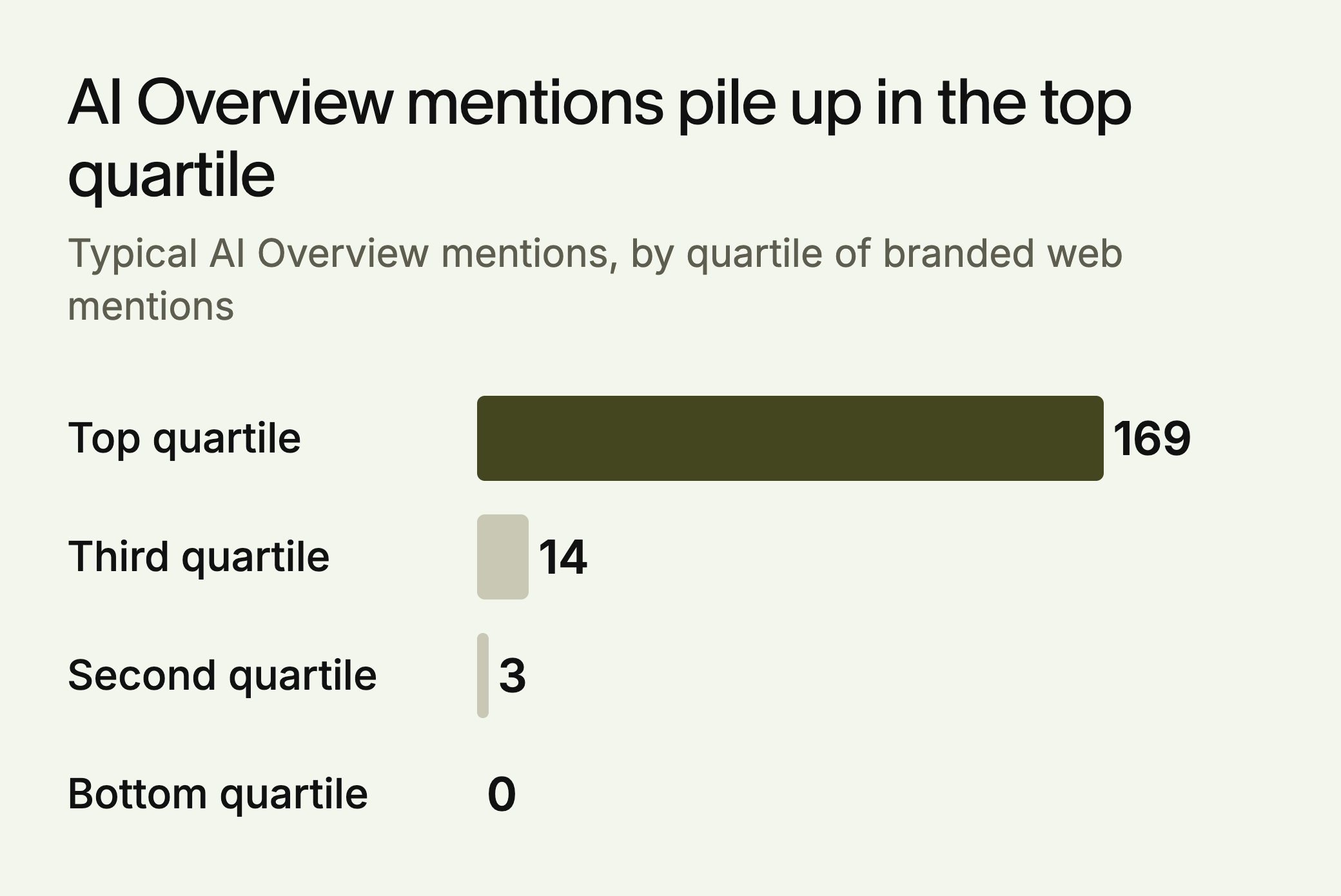
In the first Ahrefs study, brands in the top quartile for web mentions had a typical 169 AI Overview mentions, more than 10 times the 14 in the next quartile. Brands in the lower half were close to zero. If you’re in that lower half, general awareness is likely a bigger gap than any on-page tweak.
| Your position | Move | Why |
|---|---|---|
| Far fewer mentions than your main rivals | Put awareness work first | Lower-half brands were close to zero in Ahrefs’ data |
| Domain Rating below 40 | Keep earning links, and add mentions | Ahrefs excluded these sites, so it can’t justify cutting links |
| Strong mentions, weak AI visibility | Check page access and content | Mentions aren’t your limit, so more of them may not help |
| Active review channels that skip you | Start with one specialist channel | A visible gap with a clear first step |
What to do this week
- List your category’s conversations. Find the 10 YouTube channels and 10 publications that cover your category, and note which ones name you and your top competitors.
- Offer something worth covering. Send one channel a product access offer and one publication a data point or expert comment they can’t get elsewhere.
- Don’t chase the link in every placement. Ask for an accurate brand name and description first. A link is a bonus.
- Fix the brand name. Use one consistent spelling on your site, profiles and press pages, so that mentions are recognizable.
What to measure
Add three things to a report that only tracks links and Domain Rating: mentions on the web and YouTube, branded search volume, and how often you’re named for a fixed set of buyer prompts. Then watch whether they move together over several months. That’s a test on your own brand, which the studies above can’t give you.
Here’s how to read the result. The company and figures below are made up for illustration. Alderway, a small analytics vendor, compares January with July.
| Measure | January | July |
|---|---|---|
| Web mentions per month | 40 | 95 |
| YouTube videos naming the brand | 3 | 11 |
| Branded searches per month | 320 | 410 |
| Named across 40 tracked prompts | 6% | 14% |
| Referring domains | 210 | 225 |
Mentions and prompt visibility rose together while links barely moved. That fits the Ahrefs pattern, but a March product launch could explain all of it. Before crediting the campaign, pull the same numbers for two competitors. If they rose too, your category moved, not your brand.
LLMagnet measures AI visibility across seven engines, and its free audit is one way to get the prompt baseline.






 30-day free trial · no credit card