

 Perplexity
Adding quotations lifted a source’s visibility by about 41% in the GEO study by researchers at Princeton and IIT Delhi, and adding statistics lifted it by about 31%. Those are results on a research benchmark, so use them as a guide to what to try, not as a promise about ChatGPT or Google.
The paper’s authors also report that keyword stuffing, the old SEO habit, did worse than leaving the page alone on the paper’s main measure. These are sentence-level edits you can test on existing pages.
Contents
- What the Study Actually Measured
- Pattern 1: Quotations (+41%)
- Pattern 2: Statistics (+31%)
- Pattern 3: Cite Sources (+27%)
- Do the Patterns Stack?
- Lower-Ranked Pages Gain the Most
- What Held Up on a Live Engine
- A Worked Example: One Paragraph, Three Edits
- A Quick Audit of Your Existing Pages
- Many Brands Start at Zero
- FAQ
What the Study Actually Measured
“GEO: Generative Engine Optimization” (Aggarwal et al., KDD 2024) built a benchmark of 10,000 queries and tested nine edits, one at a time, against unedited pages on its 1,000-query test split. The test engine was GPT-3.5 Turbo answering from the top five Google results. It wasn’t ChatGPT’s product or Google AI Overviews. The queries span 25 domains and are about 80% informational, with 10% each transactional and navigational, so the results say little about product or checkout pages.
The main measure is Position-Adjusted Word Count: how much of the answer is attributed to a source, weighted toward the top of the answer. That’s not the same as a citation rate, a click or a sale. The percentages in the chart are calculated from the paper’s Table 1.
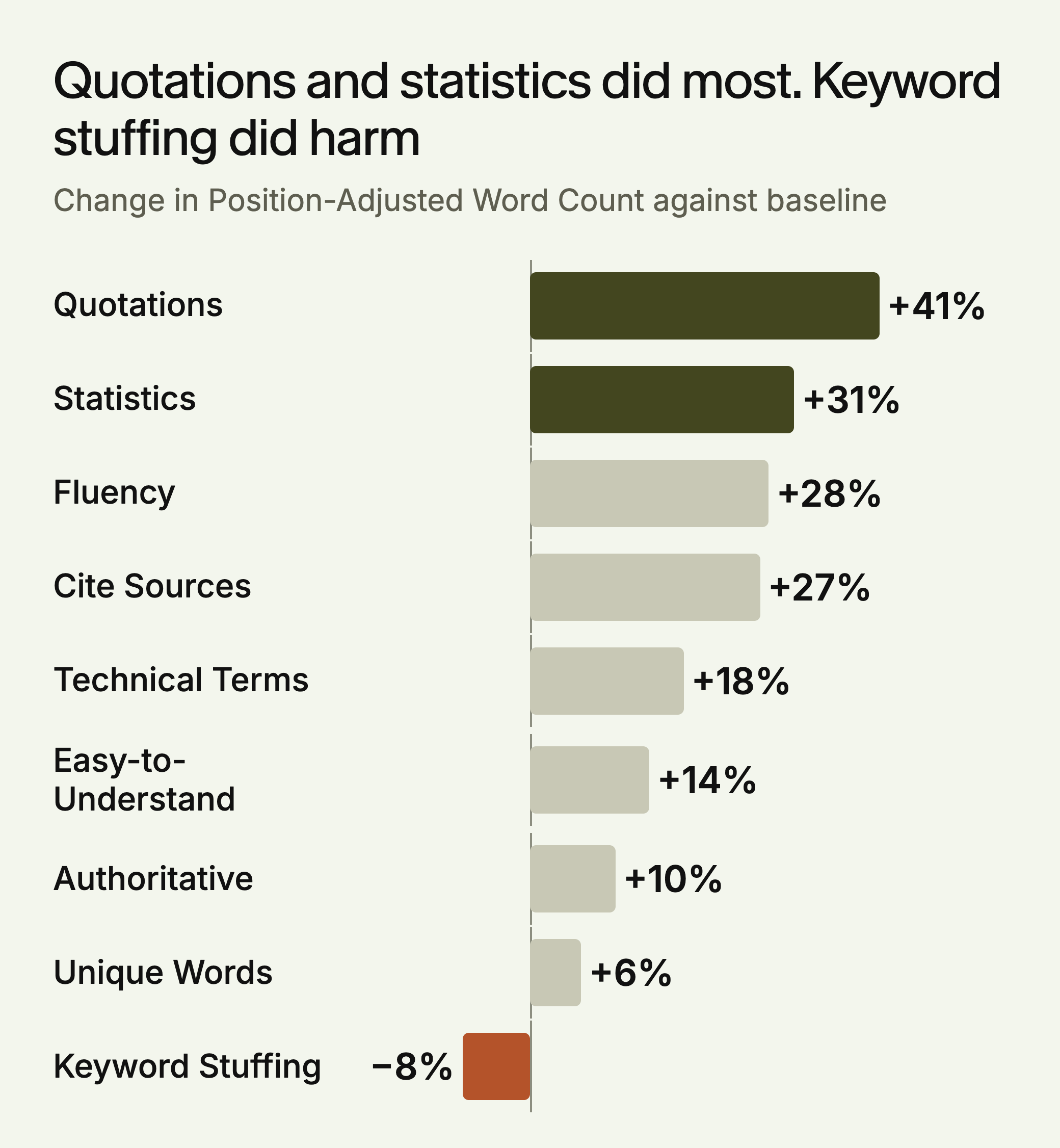
The paper also scored a second measure, Subjective Impression, which has GPT-3.5 rate seven qualities of the answer, such as relevance and how likely a reader is to click. The two measures don’t always agree:
| Method | Word Count score | Subjective score |
|---|---|---|
| No optimization (baseline) | 19.3 | 19.3 |
| Quotation Addition | 27.2 | 24.7 |
| Statistics Addition | 25.2 | 23.7 |
| Fluency Optimization | 24.7 | 21.9 |
| Cite Sources | 24.6 | 21.9 |
| Technical Terms | 22.7 | 21.4 |
| Easy-to-Understand | 22.0 | 20.5 |
| Authoritative | 21.3 | 22.9 |
| Unique Words | 20.5 | 20.4 |
| Keyword Stuffing | 17.7 | 20.2 |
Fluency Optimization scored level with Cite Sources, so a “top three” is really a top two and a tie. The paper doesn’t test why any edit works. Explanations about what AI models trust are guesses, including the ones you’ll read elsewhere.
Keyword Stuffing scored above the baseline on the second measure, so the loss is only on word count. And GPT-3.5 made the edits itself, rewriting one randomly chosen source per query. The experiment shows how an engine responds to text that looks better supported. It doesn’t test whether an engine can tell a real statistic from an invented one.
Pattern 1: Quotations (+41%)
This edit adds relevant quotations from credible sources to the page. It worked best for People and Society, Explanation and History queries.
Before: Google says you don’t need special markup for AI search.
After: Google’s guide to generative AI features says “there’s no special schema.org markup you need to add.”
Find the original wording for claims you currently summarize, and start with the two or three that matter most on the page. Every quotation must be real and must appear in a source you’ve read. Never write one to fit the sentence.
Pattern 2: Statistics (+31%)
This edit swaps qualitative statements for numbers wherever it can. It worked best for Law and Government, Debate and Opinion queries.
Vague: ChatGPT cites Wikipedia a lot.
Specific: Wikipedia made up 7.8% of all ChatGPT citations in Profound’s vendor analysis of about 680 million citations from August 2024 to June 2025.
Go through a page and mark words like “many”, “significant” and “growing”. Replace each with a sourced number, or cut the claim. In the paper, the edit added statistics to the text. On your site, a number you can’t source is a liability, whatever it does for visibility.
Pattern 3: Cite Sources (+27%)
This edit adds citations to credible sources in the text. It worked best for Statement, Facts and Law and Government queries.
- Name the organization, not “a study” or “researchers”
- Include the year
- State the scope, such as “of 1,000 test queries”
- Link to the original source
Weak: Citation rates improve with structured content, according to recent research.
Strong: A 2024 study on 1,000 test queries found that citing sources raised a page’s visibility by about 27% on its main measure.
Fluency Optimization matched this result without adding any new information, so simply making a page read better is worth doing too.
Do the Patterns Stack?
Partly, and not by simple addition. The authors tested pairs of the top four methods on 200 queries. The best pair was Fluency plus Statistics, at a 35.8% improvement. Statistics plus Quotations reached 35.4%, and Cite Sources plus Quotations reached only 20.1%. The best pair beat any single method by more than 5.5%, according to the paper.
So pair a readability pass with added statistics first. Don’t add the percentages together.
Lower-Ranked Pages Gain the Most
This may be the most useful result in the paper. In this analysis the authors edited all five sources at once, and effects depended heavily on where a source already ranked in search:
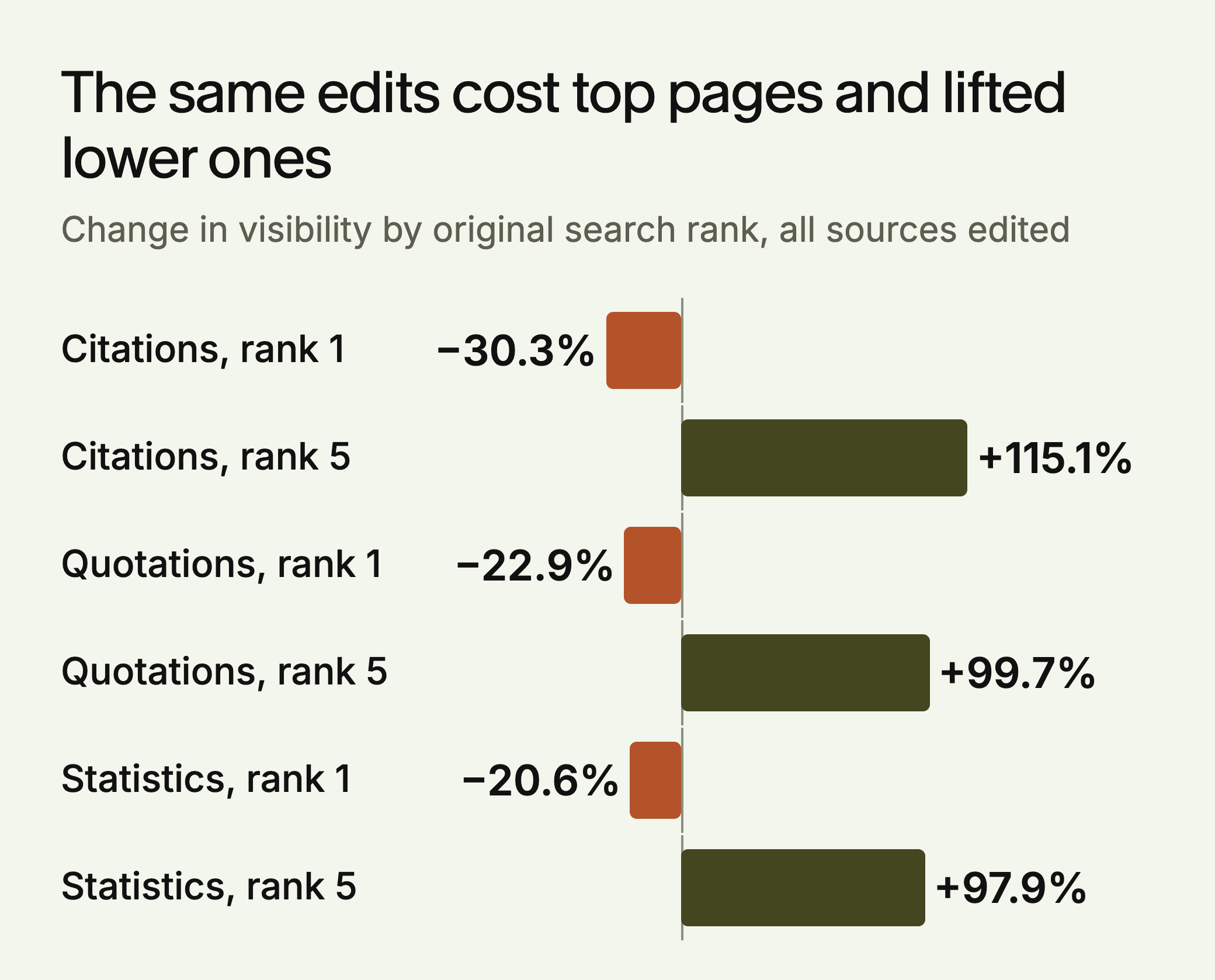
The switch comes around the middle of the list. Quotation Addition was −7.0% at second place, +3.5% at third and +25.1% at fourth. In that analysis Fluency barely moved at any position, between −4.4% and +5.2%, so it looks like the safer edit for a page already near the top.
If a page already ranks first, these edits may not help. In this test, with every competing source edited too, they cost it visibility. The paper doesn’t give this split for a single edited page. Try them first on pages ranking lower down.
What Held Up on a Live Engine
The authors also tested Perplexity, on 200 queries, supplying the sources as file uploads. Quotation Addition gained 22% on the word-count measure, Statistics Addition gained 37% on the subjective measure, and keyword stuffing did about 10% worse than the baseline on word count. That’s encouraging, but it’s a small sample from 2024, and engines have changed since.
The authors did not test Google AI Overviews. There, the starting point differs: Ahrefs’ March 2026 study found 37.1% of cited URLs also ranked in the top 10 blue links for the same query, so a good position doesn’t decide everything. Google’s guide says structured data isn’t required, so don’t expect markup alone to do this work.
A Worked Example: One Paragraph, Three Edits
The company, figures and quote below are made up for illustration. On a real page, use only numbers and quotes you can source.
| Edit | Text |
|---|---|
| Before | Warehouse robots can cut picking errors a lot. Many companies are adopting them, and experts expect this to continue. |
| Add a statistic | Sites using picking robots reported 38% fewer picking errors. |
| Name the source | Sites using picking robots reported 38% fewer picking errors in Ostwick Research’s 2026 survey of 640 warehouses. |
| Add a quotation | “We stopped re-checking every pallet,” says Mira Cole, operations director at Tallowmere Logistics. |
Which edit to lead with depends on the content. Besides the categories above, Fluency Optimization worked best for Business, Science and Health, so a B2B page should start with a readability pass. Ecommerce teams should try these on buying guides rather than product pages, given how few transactional queries the benchmark held. Those two calls are our judgment.
A Quick Audit of Your Existing Pages
Start with important pages that rank outside the top spot. For each one, check:
- Quotations: Are there at least two real quotations from named sources? If not, find the original wording for two claims you paraphrase.
- Numbers: Does each statistic have a source, a year and a sample? Replace vague words with sourced figures, or cut them.
- Attribution: Does each claim name and link its source?
- Readability: Read the page aloud and fix anything awkward. Fluency scored as well as citations.
Record each page’s AI visibility before you edit, then compare after a few weeks. Without a baseline, you can’t tell whether the edits did anything. Group pages by position, first and second against third and lower, and leave a few similar pages unedited as a comparison.
Three mistakes come up often. Adding quotations to a page that already ranks first, where the paper saw losses. Adding the percentages together, when the best pair reached 35.8%. And inventing a figure or quote because the test rewarded added ones. Readers can check them, and a false claim costs more than a missed citation.
Many Brands Start at Zero
Victorious’ Q1 2026 report, from an SEO agency, tested 177 brands across eight AI platforms and 107,011 responses. It found 89.8% of them had no mentions at all. That’s a small sample and it measures mentions, not links, but it matches what we’d expect: many brands aren’t named at all, so knowing your starting point comes first.
To see yours, try the free LLMagnet audit. LLMagnet measures AI visibility across seven engines, and its agent prepares fixes for you to approve.


 Gemini





 30-day free trial · no credit card