

 Perplexity
For local and category questions, business listings can matter about as much as your own website. Yext’s analysis of 6.8 million citations from ChatGPT, Gemini and Perplexity found 44% came from brand websites and 42% from listings. This is vendor data from four industries, so read it as a strong signal for businesses with locations, not a rule for every brand.
Yext sells listings management, so it has an interest in this result. Its research page is open about the limits: the data covers July and August 2025, comes from Yext clients and prospects through its Scout product, and spans finance, food, healthcare and retail only. It was collected through APIs, which can differ from what people see in the apps.
Contents
- The Citation Breakdown
- Why Listings Might Get Cited So Often
- Each AI Engine Leans a Different Way
- Rank Reports Miss Part of the Picture
- Which Listings to Care About
- Does This Apply to You?
- How to Audit Your Listings This Week
- A Worked Example: One Stale Address
- Mistakes to Avoid
- Conclusion
- FAQ
The Citation Breakdown
Yext’s dataset is 6.8 million citations, with each question tested at every location, across more than 200,000 locations. Yext gives about 1.6 million as the number of responses in one place and as the questions asked per model in another. It sorts citations by how much control a brand has over the source.
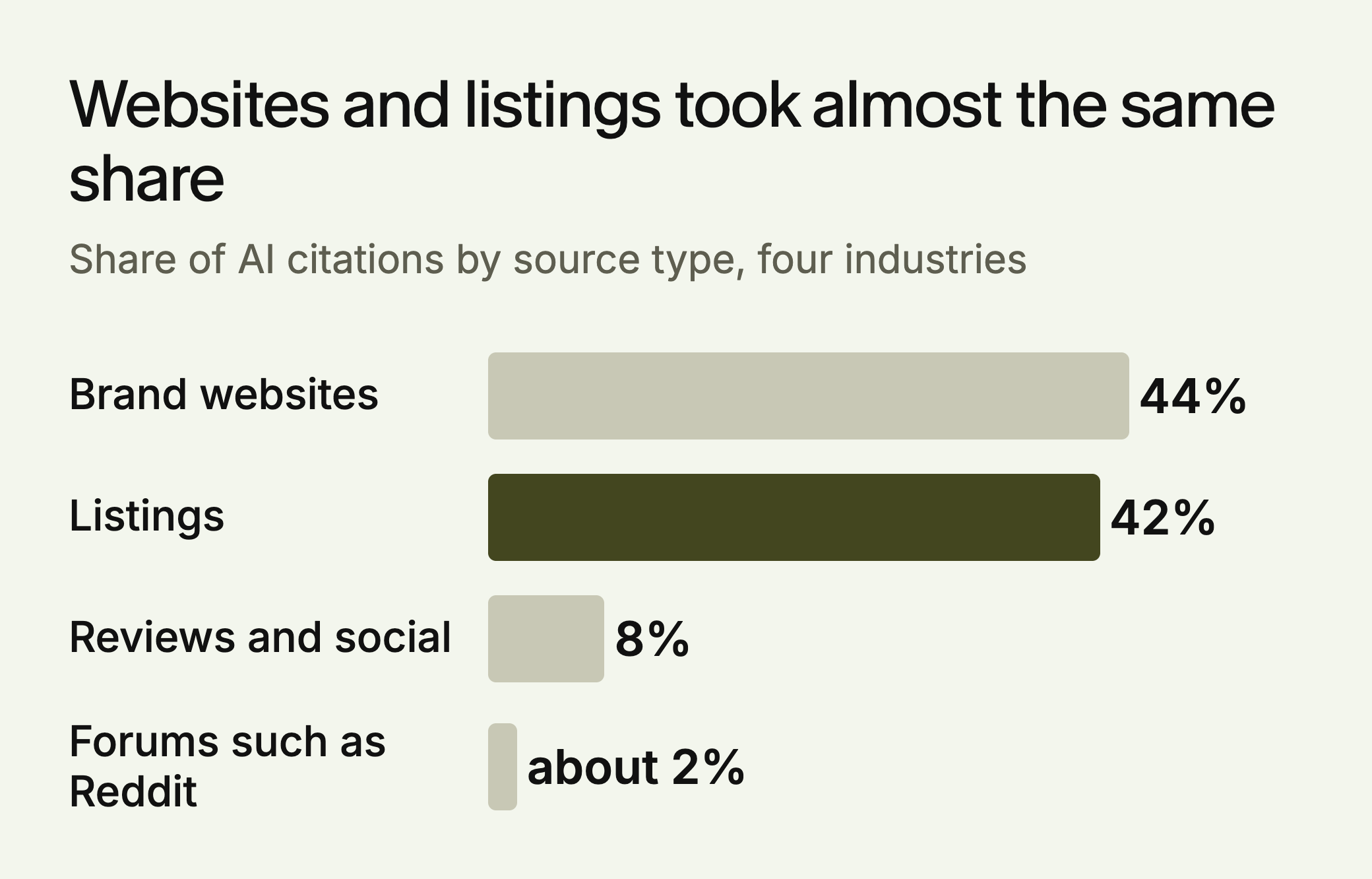
Websites means the brand’s own site, including local pages. Listings means third-party directories and platforms where a brand can claim and manage its profile, such as Google Business Profile, MapQuest, TripAdvisor and Zocdoc.
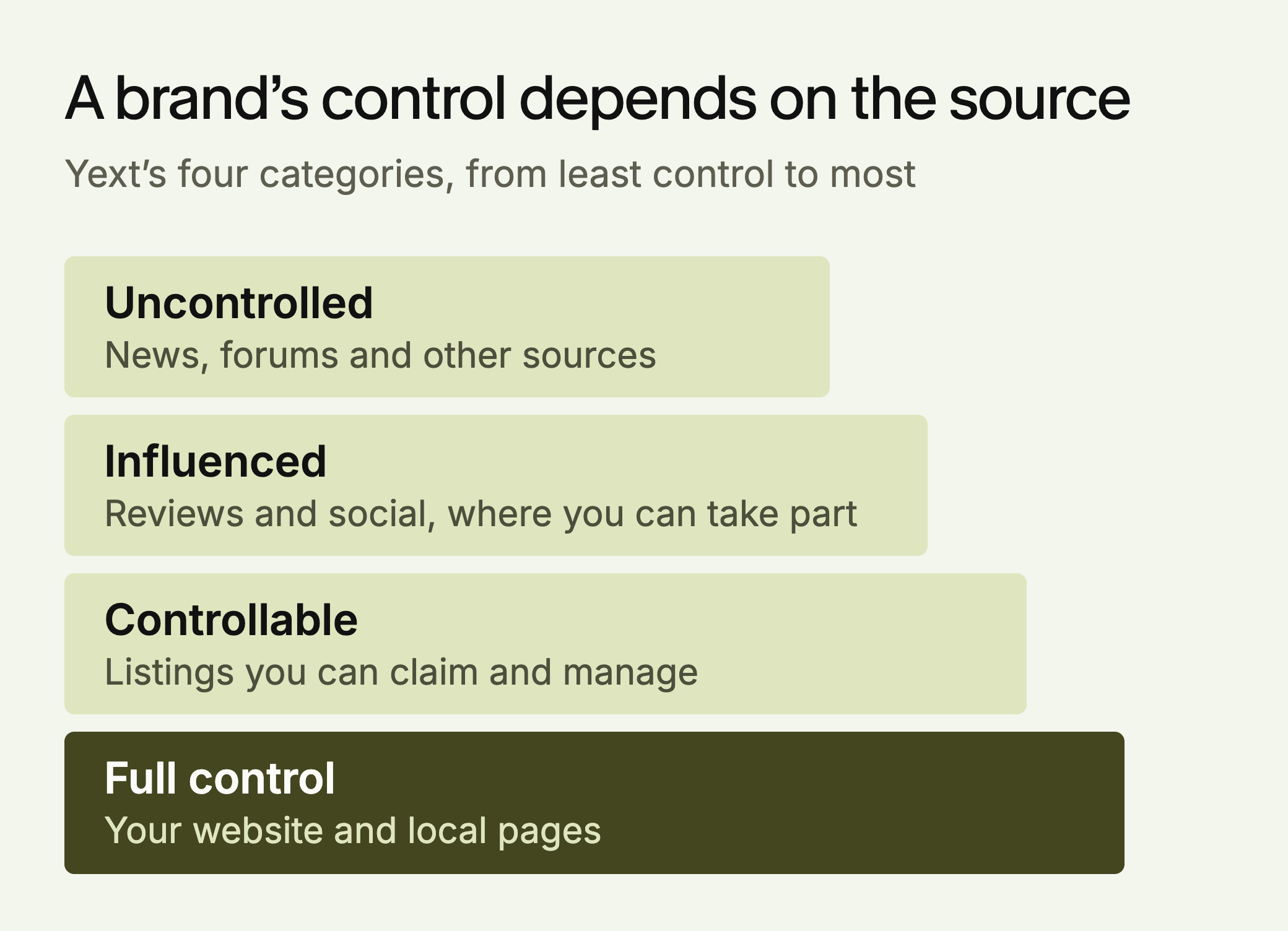
Websites and listings together make up the 86% that Yext headlines as brand-managed. Listings aren’t something a brand owns, though. You control the profile, and the platform controls everything around it.
The mix also changes by industry and query. Listings reached 52.6% of citations in healthcare and 41.6% in food service, while brand websites led in retail (47.6%) and financial services (48.2%). For unbranded, objective queries, websites and local pages made up nearly 60%.
Yext calls a query objective when it seeks facts, like “[category] near me”, and subjective when it seeks opinions, like “top 10 [category] near [location]”. Food service had the highest share of review citations, at 13.28%. Local pages ranged from 8% to nearly 20% of citations depending on engine and query type, so they’re worth keeping accurate as well.
Why Listings Might Get Cited So Often
Yext’s data shows that listings get cited, not why. Our reading is that a listing holds exactly the facts people ask about a business: category, address, hours, services. It’s also consistent in format across millions of businesses, which makes it easy to use.
That explanation fits local questions better than broad ones. The four industries in the study are full of location-based queries, so a software company shouldn’t assume its directory profiles carry the same weight.
Google describes local ranking in terms of relevance, distance and prominence. It says complete, current details and reviews help, and that you can’t pay for a better position. We haven’t seen a study showing that those same factors drive AI citations, so treat its advice as good upkeep rather than a citation tactic.
Each AI Engine Leans a Different Way
Yext’s breakdown by engine shows real differences:
Gemini favored brand websites, at 52.15% of its citations. It also uses Google Business Profile data without citing it, Yext notes, so citation counts may understate how much listing data shapes its answers.
ChatGPT leaned on third-party listing sites such as Yelp, TripAdvisor and MapQuest, at 48.73% of its citations.
Perplexity diversified its sources, Yext’s research page says, favoring MapQuest for listings and TripAdvisor for reviews, with no single overall share reported. Yext’s engine post adds that it leans on industry directories such as Zocdoc. Niche sources reached 24% of its citations on subjective, unbranded questions, the highest of the three.
The raw counts show where to look. The same research page reports more than 465,000 listing citations to Google in ChatGPT’s answers, over 364,000 listing citations to MapQuest on Perplexity and over 239,000 review citations to TripAdvisor. MapQuest is easy to overlook, so add it to your check.
In practice, a brand that only works on its website is better covered on Gemini than on ChatGPT. Check your own results by engine, because these shares come from one study in four industries.
Rank Reports Miss Part of the Picture
A related finding comes from a different company. Ahrefs looked at the 1,000 pages ChatGPT cited most in September 2025 and found that 283 of them (28.3%) had no organic keywords in its database. Ahrefs suggests freshness, niche topics and different evaluation by ChatGPT as likely reasons.
That study isn’t about listings, but the lesson carries over. A rank tracker can’t tell you whether AI engines are using a page, or whether they’re citing an out-of-date profile about you.
Which Listings to Care About
Yext’s definition covers profiles a brand can claim and manage. These layers are a practical way to work through them:
Local platforms: Google Business Profile, Bing Places, Apple Maps, Yelp, MapQuest.
Data aggregators: Data Axle and Foursquare pass business data to many maps and apps. If an aggregator holds your old address, correcting one directory may not stop it coming back.
Industry directories: In Yext’s healthcare data, WebMD, Vitals and Zocdoc-style directories were prominent. B2B companies may have equivalents in G2, Capterra or Clutch, but Yext didn’t study B2B, so check whether AI engines cite them for your queries before spending time there.
Structured data on your own site is a separate question. Google says no special markup is needed for its generative AI features, so don’t count on markup for a lift there.
Does This Apply to You?
The figures come from Yext. The priorities are our judgment.
| Business | Priority | Start with |
|---|---|---|
| Healthcare | Highest | Listings were 52.6% of citations. Check Zocdoc, WebMD and Vitals |
| Restaurants and food | High | Listings, then review platforms |
| Multi-location retail | High | Accuracy at each location, plus your local pages |
| Banks and financial branches | Medium | Your website led at 48.2%, so fix local pages first |
| Single-location service | High | Google Business Profile, Bing Places, Apple Maps, MapQuest |
| Ecommerce with no stores | Low | Your own product pages |
| B2B software | Test first | Check whether G2 or Capterra appear in answers to your questions |
How to Audit Your Listings This Week
Most AI visibility checks ask whether you appear. Add a second question: which source was cited, and is it right?
- Collect the sources. Run 20 questions about your business and category through ChatGPT, Gemini and Perplexity. Write down every listing or directory they cite.
- Check the facts. On each cited profile, compare name, address, phone, hours and services against your website.
- Check the category. Make sure each profile describes what you do now, not what you did three years ago.
- Fill the gaps. Add descriptions, attributes and service areas left blank.
- Fix the source. If the same error keeps coming back, look for it at the aggregator level.
Prioritize by what the engines actually cite for you, not by a generic directory list.
A Worked Example: One Stale Address
The business and details below are made up for illustration. Harbor Street Dental moved two blocks in March and updated its website and Google Business Profile that week. In October it ran 20 questions through the three engines and recorded each source.
| Cited source | Engine | Problem | Fix |
|---|---|---|---|
| Google Business Profile | Gemini | None | No action |
| MapQuest | Perplexity | Old address | Update the profile |
| Zocdoc | ChatGPT | Old Saturday hours | Update in the provider account |
| Yelp | ChatGPT | Old address, back after an earlier fix | Correct it at the aggregators |
The website was right the whole time, so a website check would have found nothing. Only asking which source was used turned up the errors. Track one number from here: the share of cited profiles with every fact correct. Re-run the audit each quarter and after any move, rename or change of hours.
Mistakes to Avoid
- Stopping at Google Business Profile. Perplexity favored MapQuest for listings in Yext’s data, so a perfect Google profile doesn’t cover every engine.
- Reading “86% brand-managed” as control. You manage a profile, but the platform owns the page and everything around it.
- Buying distribution before checking citations. Find out which sources engines use for you, then decide whether a tool is worth paying for.
Conclusion
If you run a business with locations, or work in healthcare, food service, retail or finance, listings deserve the same regular upkeep as your site. If you’re in another category, Yext’s 42% doesn’t apply directly. Run the audit and see what engines cite for you.
To check which sources AI systems use when asked about your brand, try the free LLMagnet audit. LLMagnet measures AI visibility across seven engines, and its agent prepares fixes for you to approve.


 Ask Claude





 30-day free trial · no credit card