

Inconsistent brand facts can feed wrong AI answers, and fixing them is cheap, but no reliable study shows how much they cost you in citations. Do the audit to protect accuracy, and don’t expect it to make AI recommend you.
An earlier version of this post said 89% of AI citation errors trace back to inconsistent brand data. We couldn’t find a source for that figure, so we removed it and rebuilt the post around what can be checked.
Contents
- What the Evidence Shows
- How AI Systems Get Brand Facts
- The Profiles Worth Checking
- How to Audit Your Brand Facts in 30 Minutes
- A Worked Audit
- Common Mistakes
- Organization Schema: Useful, Not a Citation Lever
- Where to Put the Facts on Your Pages
- After a Rebrand or Pivot
- The Priority Order
- FAQ
What the Evidence Shows
AI answers do get business facts wrong. An Empirank audit reported by PPC Land checked one search-enabled OpenAI setup in August 2026. Of 182 businesses it recommended, 20 (11%) had at least one claim the evidence contradicted, and 1.9% of the 1,257 testable claims were wrong. This is vendor data on local queries with automated checking, and the report doesn’t say what caused the errors.
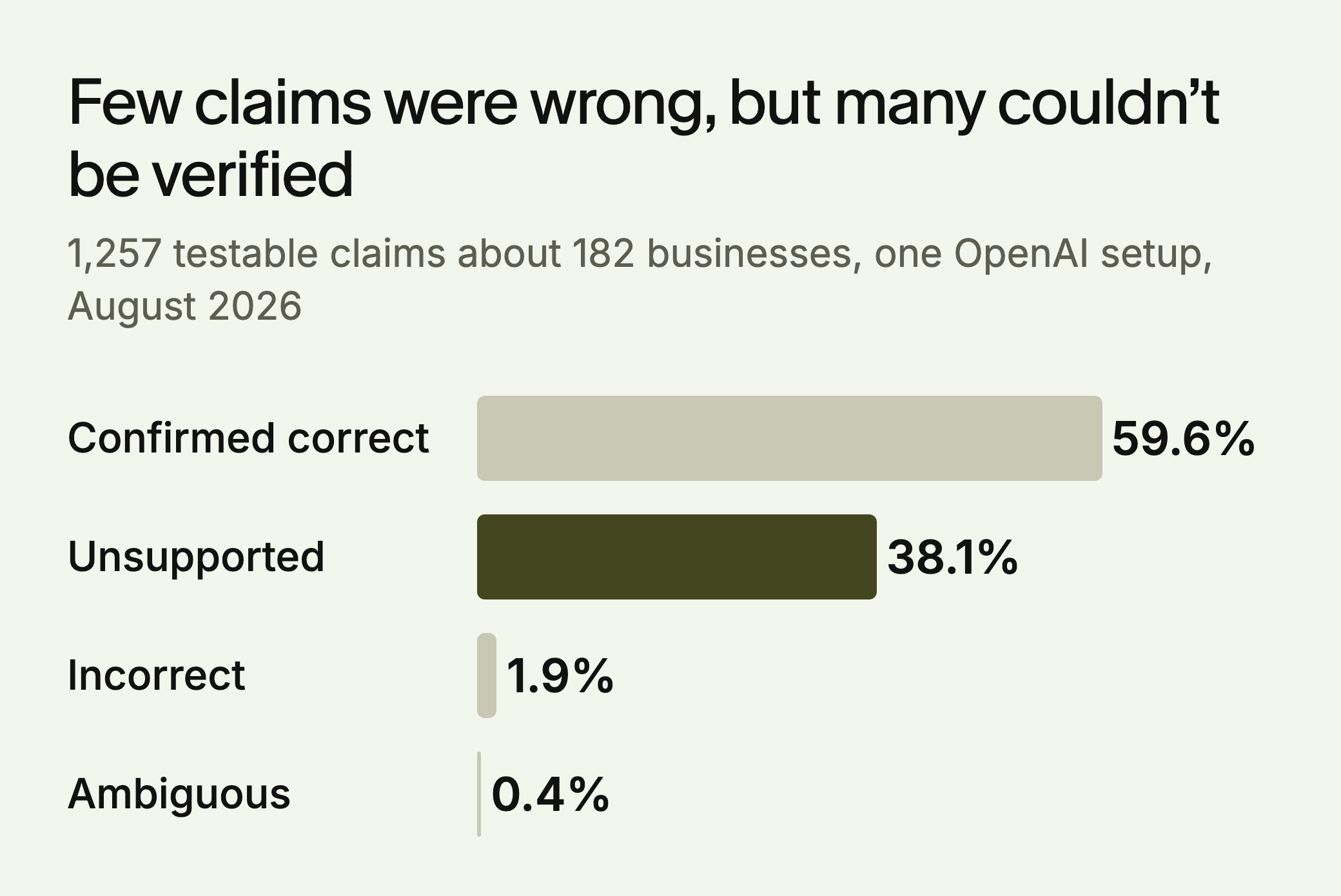
The unsupported group is the one to read closely. It means the checker found no evidence either way, not that the claim was false. Basic identity held up well, with 99.5% of 182 identity claims confirmed. Accreditation claims were confirmed only 19.2% of the time across 26 claims, which the study puts down mostly to missing evidence.
Claims resting only on a business’s own sources were confirmed 75.2% of the time (105 claims), against 57.5% for third-party-only sources (1,064 claims). The groups are uneven, and this doesn’t show first-party pages make answers more accurate. The practical step is simpler: if you hold a credential or serve an area, state it on a page anyone can check.
Being known isn’t the same as being recommended. In a preprint covered by the July 2026 GEO survey, ChatGPT recognized 99.4% of 112 startups when asked by name, but surfaced them in only 3.32% of category queries. Perplexity fell from 94.3% to 8.29%.
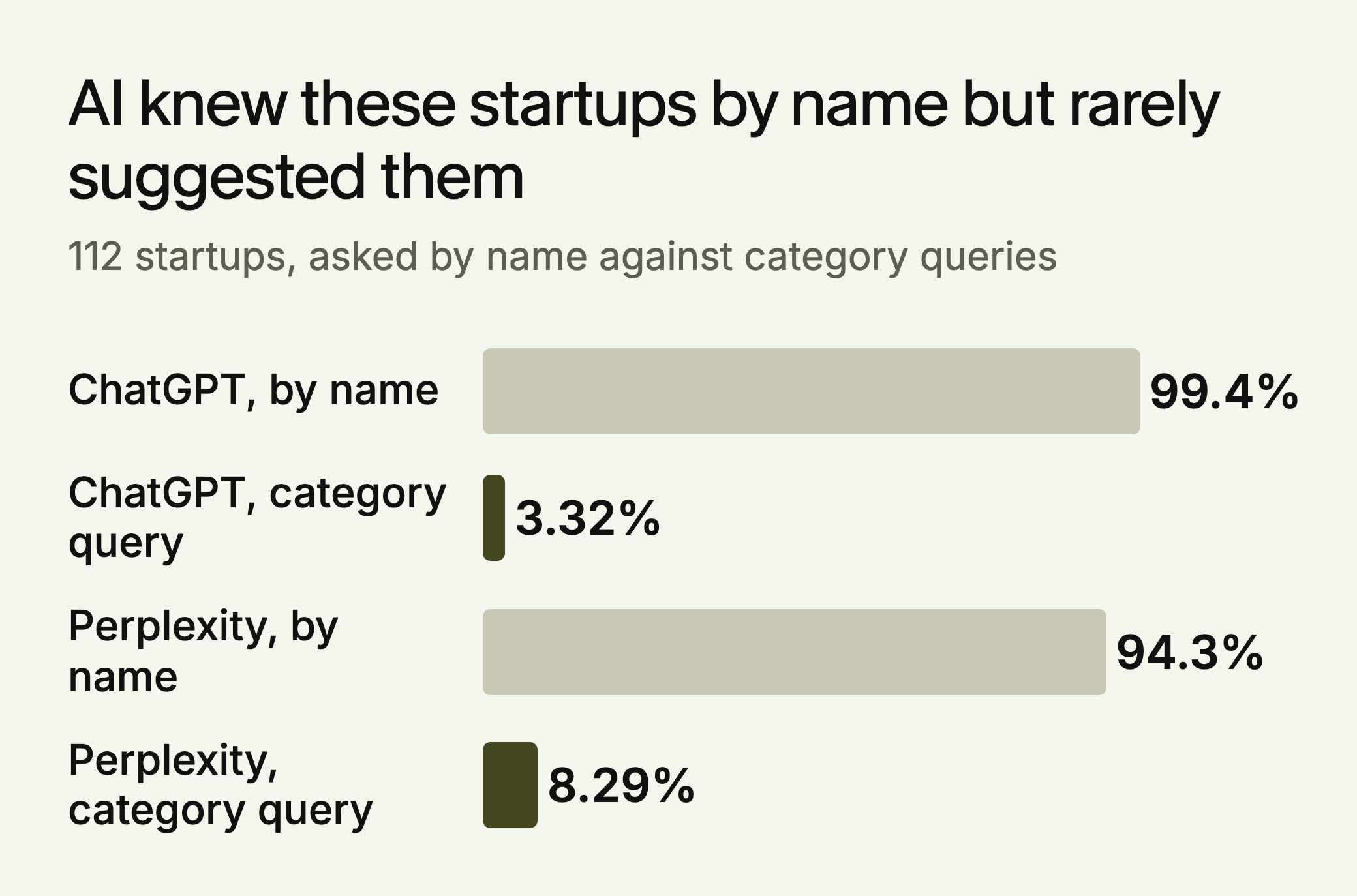
So clean entity data may stop wrong answers, but this preprint suggests that being known doesn’t by itself get you onto a shortlist.
How AI Systems Get Brand Facts
AI systems have two routes to facts about you: what the model absorbed in training, and what it retrieves live when it searches. We found no AI company that publishes how it weighs conflicting sources, so outsiders can’t measure exactly how a mismatch changes an answer.
The practical logic is still simple. If a live search returns three pages that describe your company in three ways, the answer may pick the wrong one. And if an old description dominates the web, a model may repeat it after you’ve changed.
The Profiles Worth Checking
We know of no reliable ranking of which profiles matter most, so start with the ones buyers and AI answers already use. Search your category and note what gets cited. Then work from the sources you control outward.
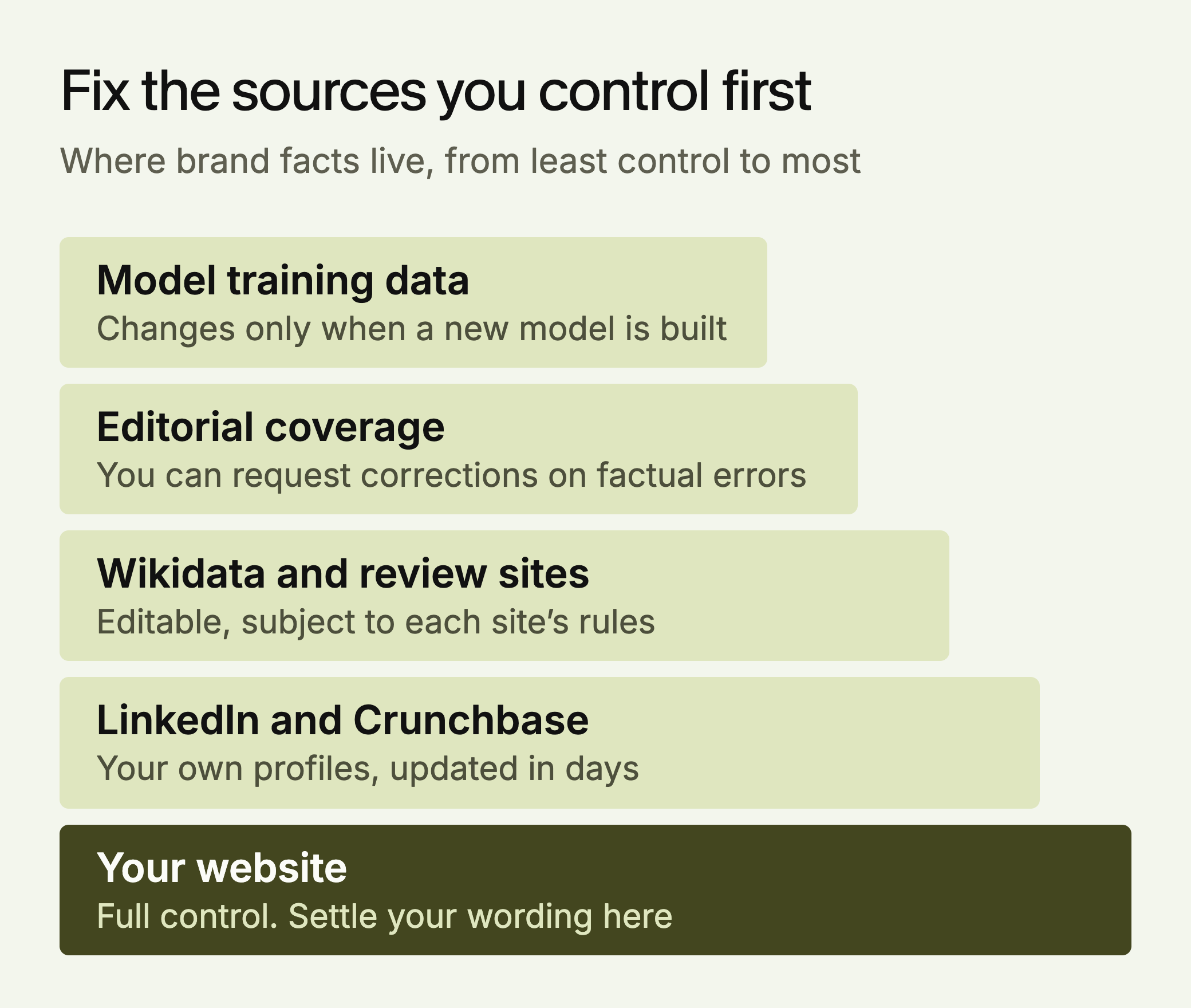
Your own website. It is the source you control fully, so settle your wording here first.
Wikidata. A structured, public database. Under its notability policy, an item qualifies if it has a Wikimedia sitelink, or describes a clearly identifiable entity backed by serious public references, or is structurally needed. There’s no employee or age threshold. Add only facts with public references. Google says knowledge panels draw on various sources across the web, and it doesn’t name Wikidata specifically.
LinkedIn and Crunchbase. Check the description, category, location and size. If yours were written years ago, they probably no longer match what you do.
G2, Capterra and similar review sites. For software and services, check that you are listed in the right category, since a wrong one also misleads buyers.
Google’s knowledge panel. If you have one, claim it from the link at the bottom of the panel. Once verified, or if someone already manages it, use Feedback to flag a wrong fact and link to a page that proves the correct one.
Editorial coverage. You can’t edit old articles, but you can ask for corrections on factual errors and give journalists accurate wording for new ones. Muck Rack’s May 2026 report (vendor data) found journalism made up about 27% of links cited by AI, and that Wikipedia was ChatGPT’s most-cited domain.
How to Audit Your Brand Facts in 30 Minutes
- Make a table with these fields as rows: company name, founding year, category, location, and a one-sentence description.
- Add a column for each source: your website, LinkedIn, Crunchbase, Wikidata if you have an entry, and your main review site. Fill in exactly what each one says.
- Highlight every mismatch. We’d check category and description first, since they shape which questions you seem relevant to.
- Ask ChatGPT, Perplexity, Gemini and Claude to describe your company. Run each prompt several times, since answers vary between runs.
- Where an answer is wrong, see if it cites a source. If it does, that page is your first fix.
A Worked Audit
The company and answers below are made up for illustration. Corvane moved from project management software to AI workflows for finance teams two years ago.
| Field | Website | Crunchbase | G2 | |
|---|---|---|---|---|
| Category | AI workflow software | Project management | Project management | Project management |
| Description | AI workflows for finance teams | Project tracking for teams | Project tracking for teams | Project tracking for teams |
| Founded | 2017 | 2017 | 2018 | Not listed |
| Location | Austin | Austin | San Antonio | Austin |
Corvane then ran the same prompt eight times on each engine. In six of eight ChatGPT runs the answer called it a project management tool, and most of those cited the G2 listing. That makes G2 the first fix, since it was the source in use and the wrong category also misleads buyers. LinkedIn and Crunchbase come next. The founding year and location matter less, but they take a minute to correct while you’re logged in. Corvane reruns the prompts after those pages have had time to be crawled again.
Common Mistakes
- Fixing only your own site. If the answer cites a review site, that page has to change.
- Writing a different description for each profile. Variety for keywords works against the goal. Use one sentence everywhere.
- Adding Wikidata statements without references. The notability policy depends on serious public references, so unsourced facts are the weak point.
- Linking stale profiles in sameAs. Update the profile first, or you point machines at the old description.
- Judging from one run. Answers vary, so count how many runs were wrong.
Organization Schema: Useful, Not a Citation Lever
Organization markup states your official details in machine-readable form. Google says it can help Google understand your organization’s details and disambiguate it in results, and defines sameAs as the URL of a page on another site with more information about your organization. It doesn’t guarantee that any feature will use the markup.
The effect on AI citations is unproven. Ahrefs’ test of 1,885 pages that added JSON-LD (vendor data) found no major uplift on any platform, though it pooled all schema types and covered only pages already heavily cited.
It takes little work and it states the facts plainly, so it is still worth adding. A minimal version:
{
  "@context": "https://schema.org",
  "@type": "Organization",
  "name": "Your Company Name",
  "url": "https://yoursite.com",
  "foundingDate": "YYYY",
  "description": "One sentence describing what you do.",
  "sameAs": [
    "https://www.linkedin.com/company/yourcompany",
    "https://www.crunchbase.com/organization/yourcompany",
    "https://www.wikidata.org/wiki/QXXXXXXX",
    "https://www.g2.com/products/yourproduct"
  ]
}
Write the description as a plain statement of what you do and who you do it for, and use the same wording everywhere.
Google recommends placing the markup on your home page or one page that describes the organization, not on every page. Its guidance also says to use the most specific subtype, such as a LocalBusiness subtype for physical locations or OnlineStore for ecommerce. Check the result in the Rich Results Test and fix any critical errors.
Where to Put the Facts on Your Pages
Say what you are early on the page, in the same words you use on your profiles. Kevin Indig’s analysis of 18,012 verified ChatGPT citations, based on vendor data from Gauge, found 44.2% came from the first 30% of a page. That is correlation on one engine, but it costs nothing to act on.
Keep the facts current, too. Ahrefs’ study of about 17 million citations (vendor data) found AI assistants cited URLs about 25.7% newer on average than organic results, with Google AI Overviews as the exception. Review your main pages each quarter, and update them when something has really changed.
After a Rebrand or Pivot
A pivot, a merger or a new product line can leave old descriptions behind. A company that moved from project management to AI workflows may still carry its old category on profiles and in older articles.
Your own profiles can be updated within days. Live search can only pick up a change once those pages are crawled again, and a model’s training data only changes when a new model is built. So update your profiles at the time of the change, not months later, and give journalists and review sites the new wording so that independent sources match yours.
The Priority Order
- Run the audit above and fix every mismatch on the profiles you control.
- Rewrite your LinkedIn and Crunchbase descriptions to match your website.
- Check your review-site categories.
- Add Organization schema with sameAs to your homepage. This may need a developer.
- Create a Wikidata item if you meet the notability policy and can cite public references.
- Set a quarterly reminder to repeat the prompt test.
Adjust the order for your business. Local and service businesses should start with the priorities the Empirank study names: location, availability, credentials, service scope and branches. Software companies should start with review-site categories, since a wrong category can keep you out of comparisons. Stores should check that the business name, returns and shipping facts match across their site and marketplaces.
LLMagnet measures AI visibility across seven engines and has an agent that prepares fixes for your approval. To see how AI answers describe your brand now, start with the free LLMagnet audit.


 Ask Claude






 30-day free trial · no credit card