

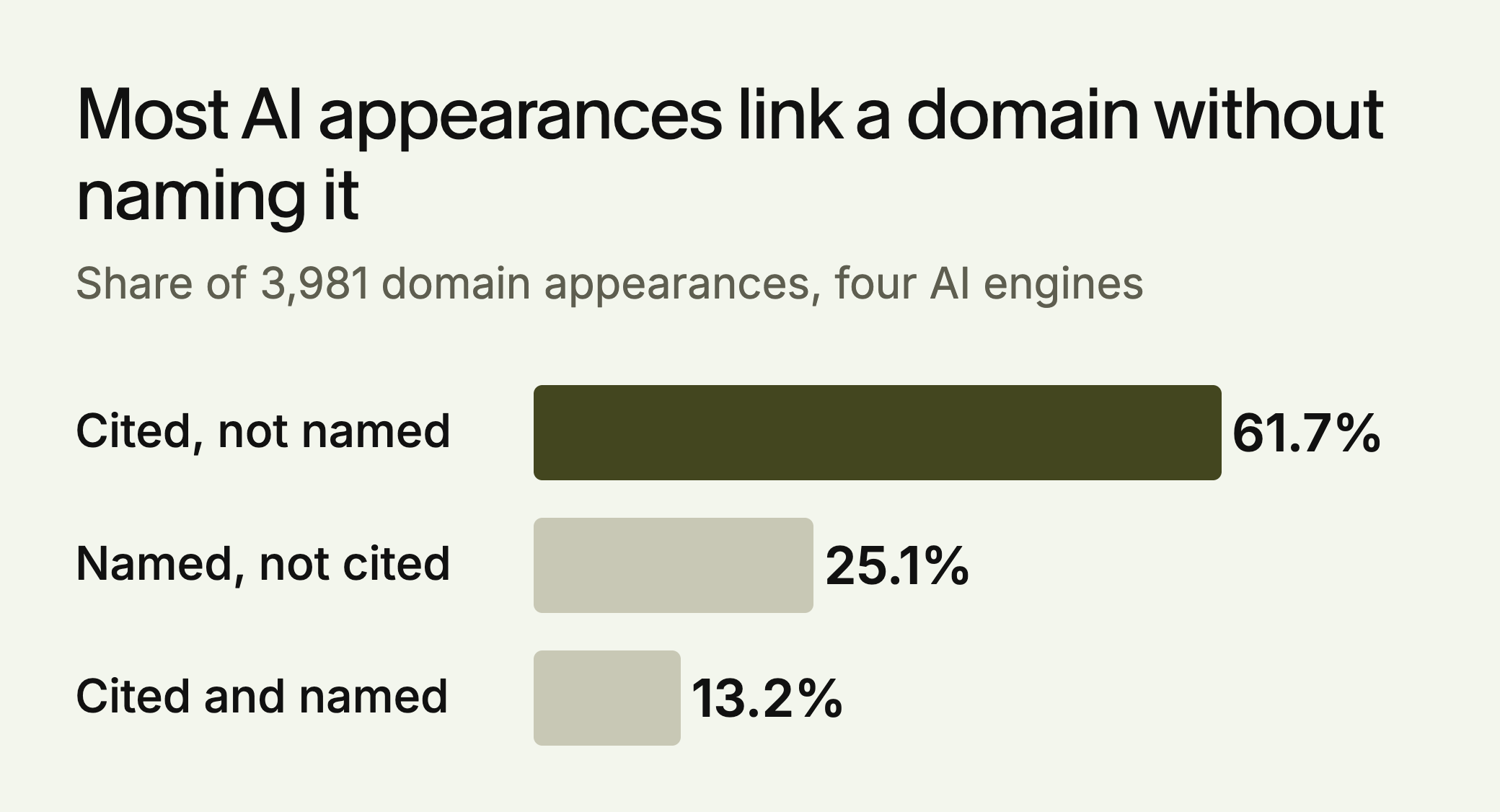
AI engines often link to a site without naming the brand behind it. In a June 2026 Semrush study with Kevin Indig (vendor data), 61.7% of 3,981 domain appearances were ghost citations: a source link with no brand name in the answer text. Another 25.1% named the brand without a link, and only 13.2% did both. The sample covers 115 prompts in 14 countries across ChatGPT, Gemini, Google AI Overviews and Google AI Mode.
Contents
- Why Ghost Citations Happen
- Measuring Ghost Citations: The Two-Metric Gap
- Why Another Study Found a Much Smaller Gap
- A Possible Fix: Put the Brand Inside the Claim
- Entity Markup: Cheap, but Unproven for Naming
- Third-Party Coverage: More Citations, Unknown Credit
- Common Mistakes When Closing the Gap
- Tracking Progress: The Attribution Ratio
- FAQ
Why Ghost Citations Happen
Semrush didn’t test why engines drop names, but its breakdowns show where it happens. Query intent is one clear pattern. Informational prompts had an 89.3% citation rate and an 18% mention rate. Comparative prompts reached a 43.3% mention rate, and commercial prompts sat at 84.4% cited and 35.6% mentioned. One reading is that a fact needs a source, while a choice between options needs the options named.
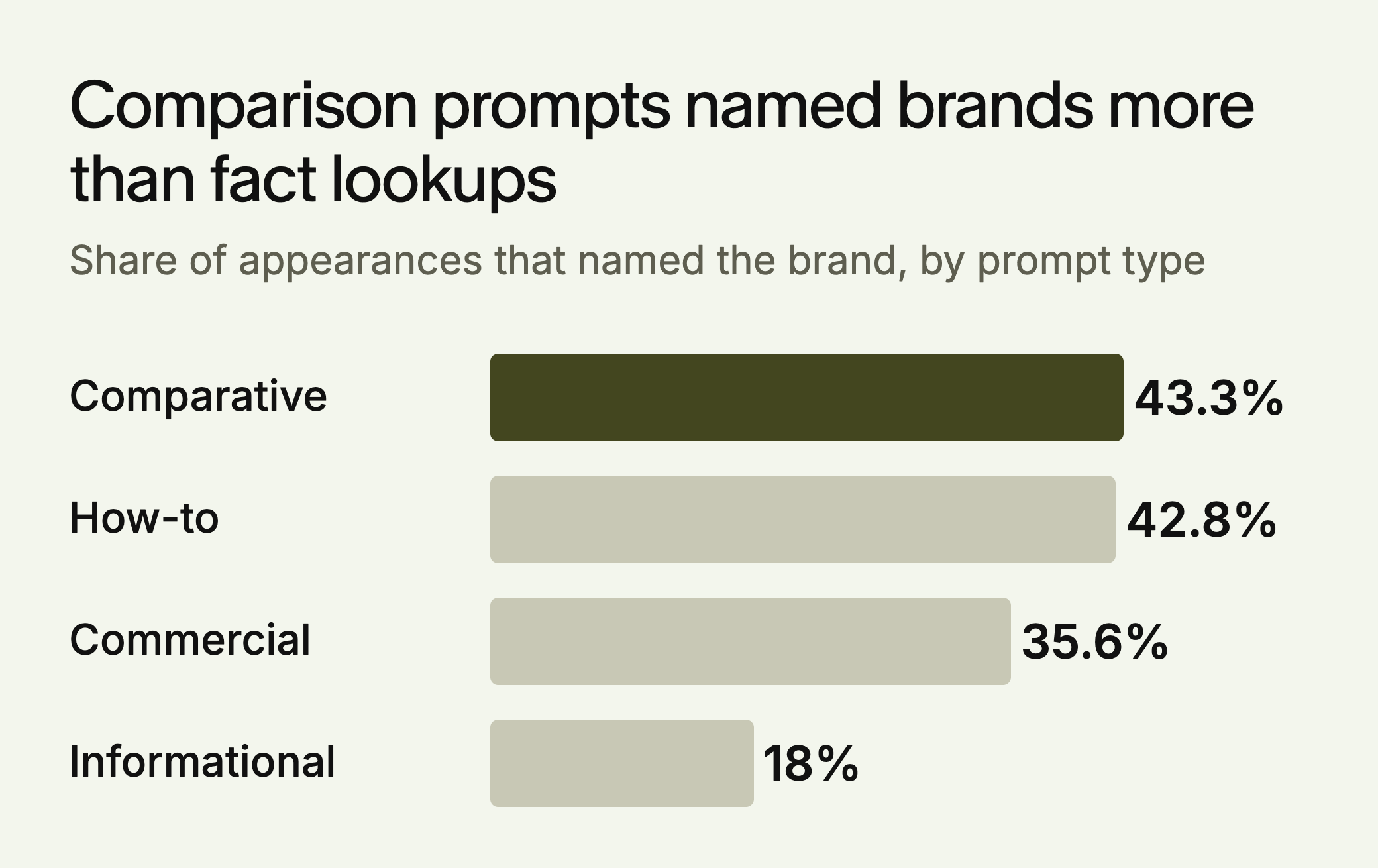
How-to prompts don’t fit that simple story, at 42.8%, which is close to comparative prompts. Wording matters too. Semrush reports mention rates of nearly 100% for short, conversational queries and 2% to 3% for long, structured prompts. If your tracking set is all long and formal, it will report a high ghost rate that may not reflect how your buyers ask, so write prompts the way they talk.
Engines also behave very differently. ChatGPT cited domains in 87% of appearances and named brands in 20.7%. Gemini named brands in 83.7% and cited in 21.4%.
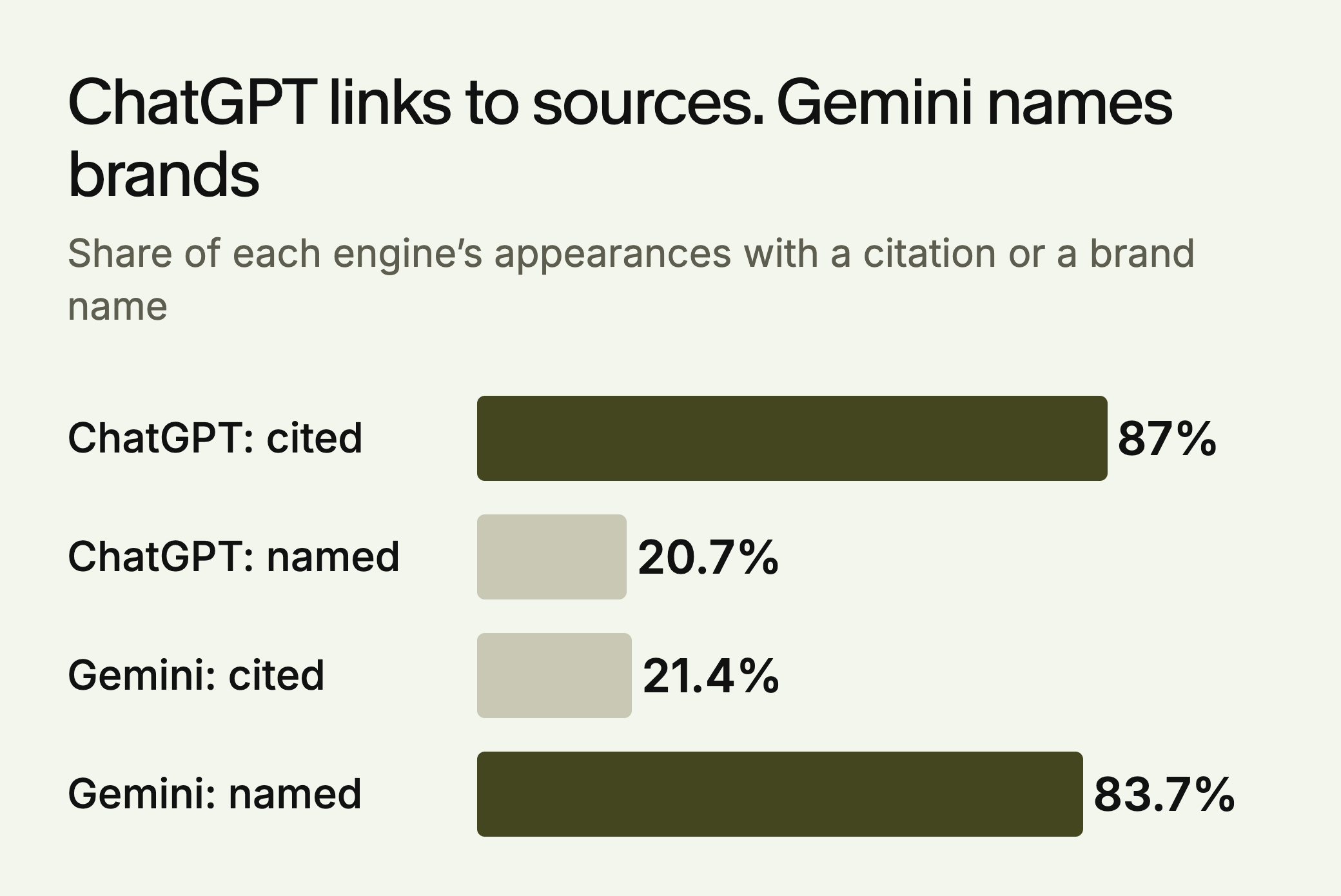
Semrush says Google AI Mode names brands at nearly twice ChatGPT’s rate, without giving the exact figure. A single company can be a ghost on one engine and a household name on another.
Our working explanation is simple. An engine lifts a claim and rephrases it. Unless the brand is part of the claim, the name doesn’t come along. Take two versions of the same sentence, about a made-up company:
Version A: “Average onboarding time fell to 12 days.”
Version B: “Acme’s 2026 customer survey found average onboarding time fell to 12 days.”
Version A can travel without its owner. Version B is harder to repeat accurately without the name. That is a reasoned guess and not a tested result.
A ghost citation isn’t always a problem. Semrush found medium.com cited 16 times and never named, and it advises publishers and research-style sites to track citations as their primary AI visibility metric. If you sell a product, the name matters more.
- Publishers and research sites: make citations the main metric. Semrush’s pattern is that aggregators and academic sites get cited, and strong consumer brands get named.
- Product brands: watch the ghost rate on comparative and commercial prompts, where a buyer is choosing. A ghost citation on a “what is” prompt costs far less.
- Small or new brands: a name is what a reader can remember and search for later, and a link only helps if someone clicks it.
Measuring Ghost Citations: The Two-Metric Gap
Citation and mention are separate measures. In Semrush’s data, 74.9% of appearances included a citation and 38.3% included a mention. A report that counts only links will describe a different reality from one that counts only names.
To measure your own gap, run the same target prompts on each engine and log three outcomes for your domain: cited only, named only, or both. Your ghost rate is cited-only appearances divided by all appearances, which is how Semrush’s 61.7% is calculated.
Report each engine on its own. Engines disagreed on naming the brand in 100 of 454 prompt-domain combinations (22%), so a blended score hides the signal. Don’t treat 61.7% as a benchmark either. It comes from 115 prompts, Semrush doesn’t state the collection window, and mention rates ranged from 18% to 22% in Italy, Brazil and the Netherlands to 50% in India and Sweden.
Why Another Study Found a Much Smaller Gap
BuzzStream’s study of 12,000 AI responses (vendor data, updated July 2026) covered about 200 brands on Google AI Mode, AI Overviews, Gemini and GPT-5.4-mini. When a brand’s own domain was cited, the response also named the brand 69.9% of the time. Semrush’s equivalent is about 17.6%, which is our arithmetic from its published shares.
| Measure | Semrush | BuzzStream |
|---|---|---|
| What was counted | Every domain in an answer, 3,981 appearances | About 200 tracked brands and their own domains |
| Prompts | 115, in 14 countries | About 2,967: single-brand, head-to-head and category |
| Cited, and also named | About 17.6% (13.2 of 74.9) | 69.9% |
| Named, and also cited | About 34.5% (13.2 of 38.3) | 23.1% |
Two design choices probably explain most of the difference, though neither study tested them. BuzzStream’s set included single-brand questions and head-to-head comparisons, where the answer repeats a name the user typed. Semrush counted every domain, including sites like medium.com that an answer has little reason to name, and it doesn’t say whether its prompts named brands.
The studies agree on the reverse direction: most names arrive without a link, 76.9% in BuzzStream and about 65.5% in Semrush. For your own tracking, the lesson is to split your prompts. Report the ones containing your brand apart from the ones that don’t. Only the second group tells you whether engines connect your content to your name.
A Possible Fix: Put the Brand Inside the Claim
Find the pages that earn citations but no mentions, then rewrite their key claims with the brand inside the sentence, as in Version B above. Semrush makes a hedged version of the same recommendation: in some cases, “clearer brand references, product mentions, or comparison sections” can help close the gap.
Only do this for claims that are really yours, such as original data, named methods and product facts.
Format has some evidence behind it, on one engine. 5WPR’s 2,400-test experiment (agency data) rewrote 40 brand facts in four formats. Perplexity explicitly named the publisher 66% of the time when the fact sat in a table, against 55% when it was the third sentence of a paragraph. Document position mattered far more on Perplexity: 71.9% when the document came first and 39.4% when it came in the middle. That is the document’s place in the supplied set, not a claim’s place on a page. The test used a supplied document set on three models, so read it as directional.
This week, pick your five most-cited pages. Put one branded claim near the top of each, and add a comparison table where the page compares options. Neither step is proven, so record a baseline first.
Entity Markup: Cheap, but Unproven for Naming
Organization schema with sameAs links to your LinkedIn, Crunchbase, Wikipedia or Wikidata records tells machines that a name and a domain belong together. It takes an hour and it is good hygiene.
We found no study showing that it changes how often engines name a brand. The citation evidence on schema is mixed. Rankability’s August 2026 snapshot (vendor data) found that no schema type consistently improved AI citation position, and Google says there is “no special schema.org markup you need to add” for generative AI search. Add it to remove ambiguity, especially if your brand name is shared with something else, and don’t expect it to fix ghost citations.
Third-Party Coverage: More Citations, Unknown Credit
Coverage on other sites has been associated with more citations for a story. Stacker’s study with Scrunch, published in March 2026 (vendor data; Stacker sells distribution) reported a median 239% citation lift across 87 stories, 30 brands and 8 AI platforms. Stacker calls the data observational, and it shows patterns rather than cause. It also doesn’t report whether answers named the brand.
Distribution can move credit away from you. In Stacker’s earlier eight-story test, some answers cited only the syndicated copy and not the brand’s original.
The practical step is small. In any press release, data story or contributed piece, write the attribution into the finding itself: “according to Acme’s 2026 customer survey.” A journalist who copies that sentence carries the name with it.
Common Mistakes When Closing the Gap
- Putting the name only in the title or logo. If our working explanation is right, the sentence that gets lifted is the one that has to carry the name.
- Branding every sentence. Save it for claims that are yours. In the Princeton GEO benchmark, keyword stuffing lowered visibility by about 8%, and forcing a name into every line looks like the same habit to us.
- Counting prompts that already contain your name. The answer will often repeat it, which flatters your naming rate.
- Judging from one run. In a SparkToro study of 2,961 runs from 600 volunteers, there was less than a 1 in 100 chance that ChatGPT or Google’s AI would give the same list of brands twice. Repeat each prompt several times.
Tracking Progress: The Attribution Ratio
We call the useful number the attribution ratio: the share of your AI appearances with both a citation and a brand mention. Semrush’s blended figure is 13.2%, but that is a description of one sample and not a target.
Each month, run 10 to 20 target prompts per engine, split between informational and comparative intent. Log the three outcomes and compare each engine with its own history. A falling ghost rate with steady total citations means the same pages are earning more credit. A falling ghost rate with falling citations means you have only lost links.
Here is what one month can look like. The company and figures below are made up for illustration. Brightlane, a payroll software firm, logged 40 appearances on non-branded prompts.
| Engine | Cited only | Named only | Both | Ghost rate | Attribution ratio |
|---|---|---|---|---|---|
| ChatGPT | 14 | 1 | 3 | 78% | 17% |
| Gemini | 1 | 9 | 2 | 8% | 17% |
| AI Overviews | 7 | 2 | 1 | 70% | 10% |
| All engines | 22 | 12 | 6 | 55% | 15% |
The blended 55% suggests one problem, and the rows show two. ChatGPT and AI Overviews use Brightlane’s pages without the name, so the work there is branded claims on the cited pages. Gemini knows the name but rarely links, so the question there is which third-party pages carry the name and whether Brightlane’s own pages answer the prompt at all.
LLMagnet measures AI visibility across seven engines, and its agent prepares fixes for your approval. The free audit is a starting point for seeing how engines treat your brand today.





 Gemini


 30-day free trial · no credit card