

 ChatGPT
AI-referred visitors don’t reliably convert better than search visitors, so measure your own site before you trust a benchmark. The widely repeated 15.9% ChatGPT conversion rate comes from one client of one agency, while a study of 973 e-commerce sites found organic search converted about 13% better than ChatGPT referrals.
This post sets out what each study measured, why the results differ, how to separate AI referrals in your analytics this week, and which changes are worth testing.
Contents
- What the Conversion Studies Measured
- Why the Results Differ
- Why AI-Referred Visitors Might Behave Differently
- What the Strategy Numbers Show
- Which Engines to Check First
- Does a Citation Lift Branded Search?
- Five Changes Worth Testing
- How to Measure the AI Channel
- A Worked Example: When the Gap Disappears
- Which Result Applies to Your Business
- Conclusion
- FAQ
What the Conversion Studies Measured
The high number comes from a Seer Interactive case study. Seer is an agency, and this is one unnamed client’s GA4 data from October 2024 to April 2025. It reports these conversion rates:
- ChatGPT: 15.9%
- Perplexity: 10.5%
- Claude: 5%
- Gemini: 3%
- Google organic: 1.76%
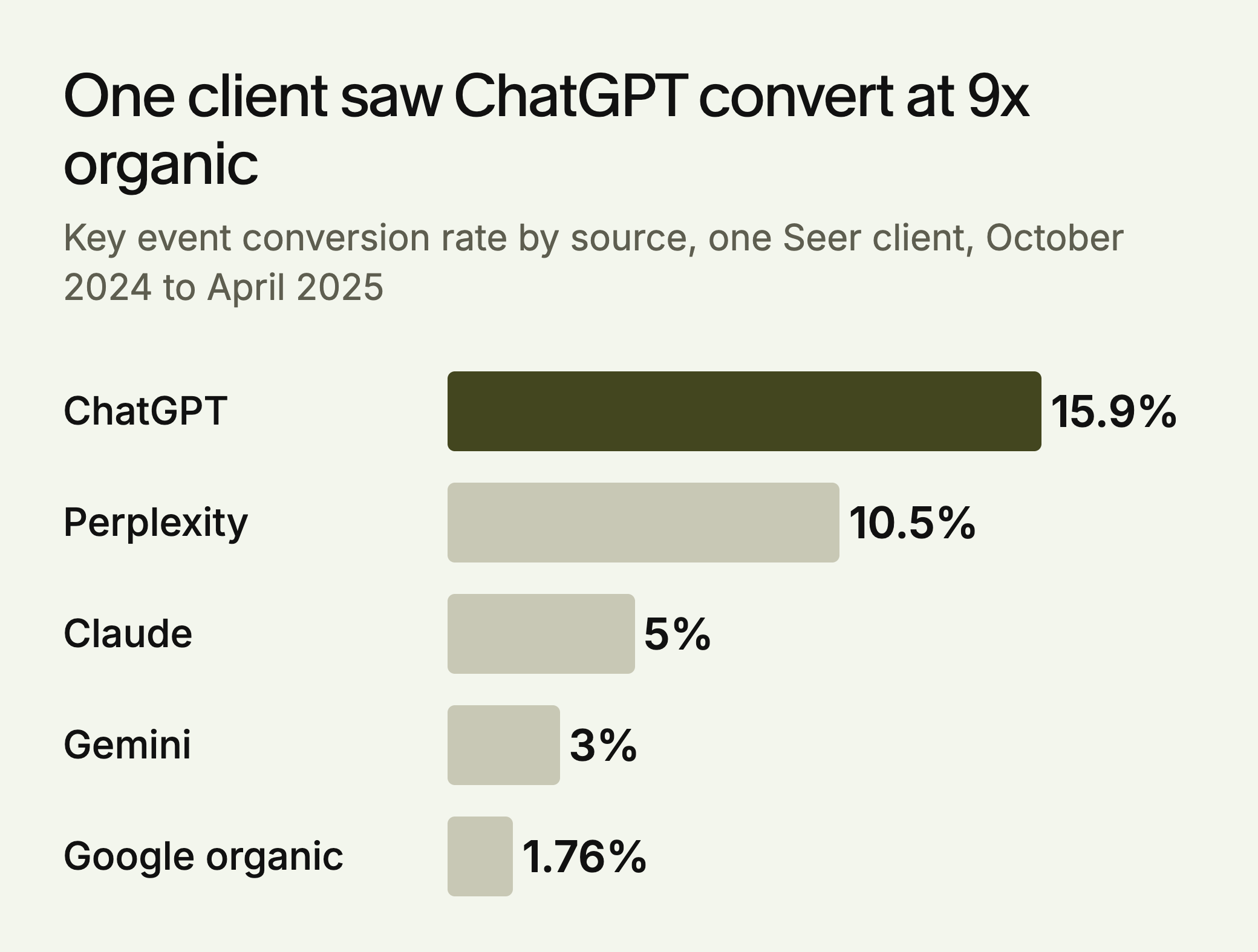
Seer calls this “just one client’s data.” AI sources sent just under 11,000 sessions, against almost 14 million from Google organic, and 1,370 conversions. The page doesn’t say which key events counted as conversions. It gives each engine’s share of AI traffic (ChatGPT 61%, Perplexity nearly 24%, Gemini 15%), but no session or conversion counts per engine, so the per-engine rates can’t be checked directly. The totals do hang together: 1,370 conversions on about 11,000 sessions is roughly 12.5%, close to the 12.7% those shares and rates imply. Claude’s share was “very small,” which makes its 5% the least reliable figure in the list.
The largest study we found points the other way. Maximilian Kaiser and Christian Schulze analyzed first-party data from 973 e-commerce sites with about $20 billion in combined revenue, covering more than 50,000 ChatGPT-referred transactions and 164 million from other channels. As reported by PPC Land, the data ran from August 2024 to July 2025, and organic search converted about 13% better than ChatGPT. Paid social was the only channel ChatGPT beat. ChatGPT was under 0.2% of sessions. The paper has since been published in Marketing Science.
Some of the gaps were large. PPC Land reports that affiliate traffic was 86% more likely to convert than ChatGPT traffic, and that direct, email and paid search all earned substantially more revenue per session.
The same study found ChatGPT’s conversion rate rising over the year while average order value fell. PPC Land reports projections of the conversion gap narrowing as the order-value gap widens.
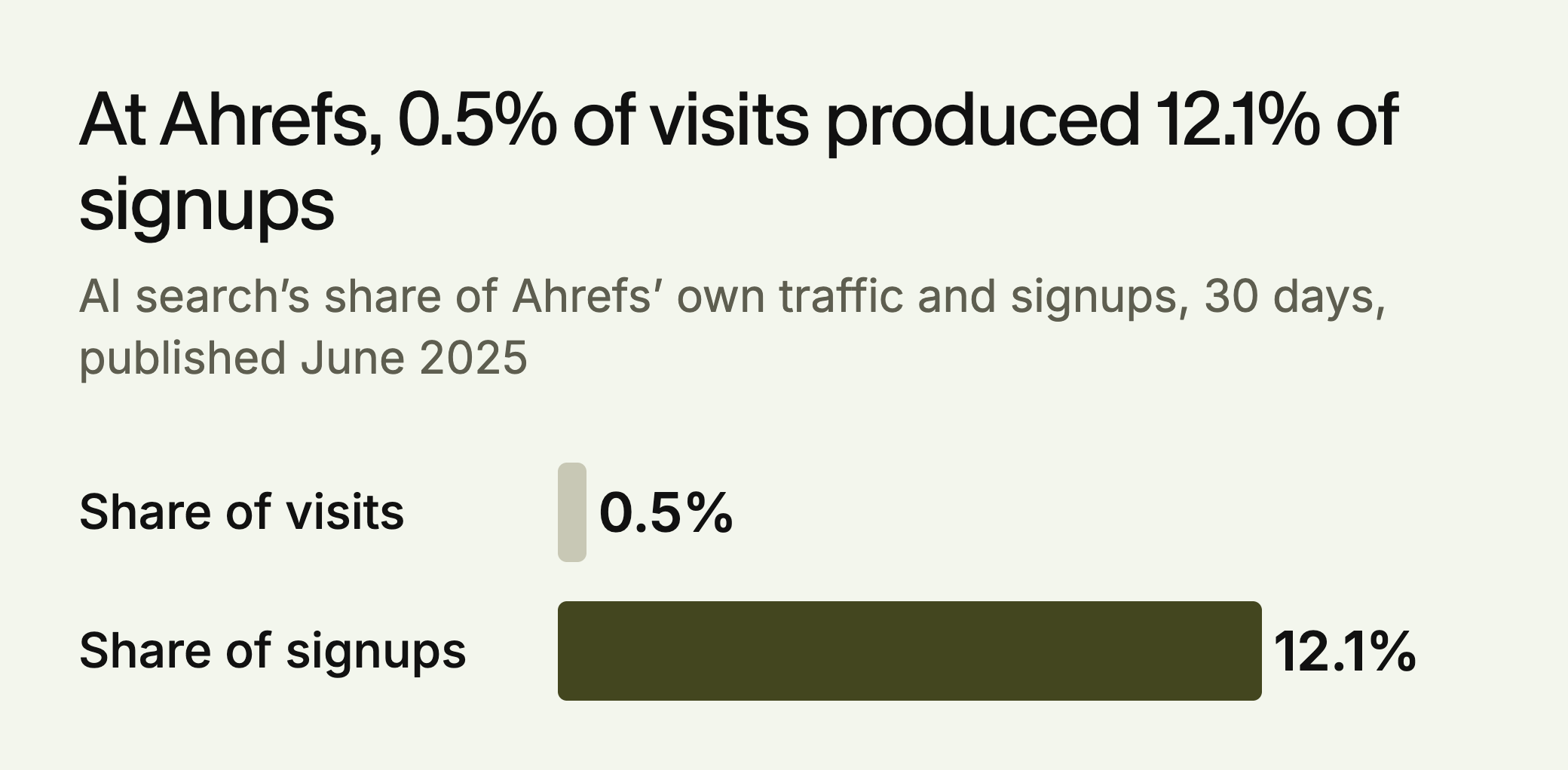
A third data point sits with Seer. Ahrefs reported in June 2025 that AI search brought 0.5% of its visits and 12.1% of its signups over 30 days, and that those visitors converted at a 23x higher rate than organic search visitors. This is vendor data about its own product, and its author writes that his “gut tells me it won’t be quite that good” as AI traffic scales.
Side by side, the three studies aren’t measuring the same thing:
| Seer Interactive | Kaiser and Schulze | Ahrefs | |
|---|---|---|---|
| Who | Agency, one client | Academic, 973 stores | Vendor, its own site |
| Period | Oct 2024 to Apr 2025 | Aug 2024 to Jul 2025 | 30 days to June 2025 |
| Conversion counted | Key events, not named | Purchases | Signups |
| AI against organic | About 9x (ChatGPT) | Organic about 13% better | 23x (all AI search) |
| AI share of traffic | 0.07% of organic | Under 0.2% of sessions | 0.5% of visits |
These results don’t have to contradict each other, and none of them tells you what your site will see. A July 2026 survey of 45 GEO studies rates the claim that citation scores predict clicks, conversions or revenue as very low confidence, and calls traffic and conversions the weakest evidence in the field.
Why the Results Differ
The range from “9x better” to “13% worse” gets easier to read once you see what each study counted.
- The conversion event. A purchase, a signup and an unnamed key event are different bars to clear. Only Kaiser and Schulze measured purchases.
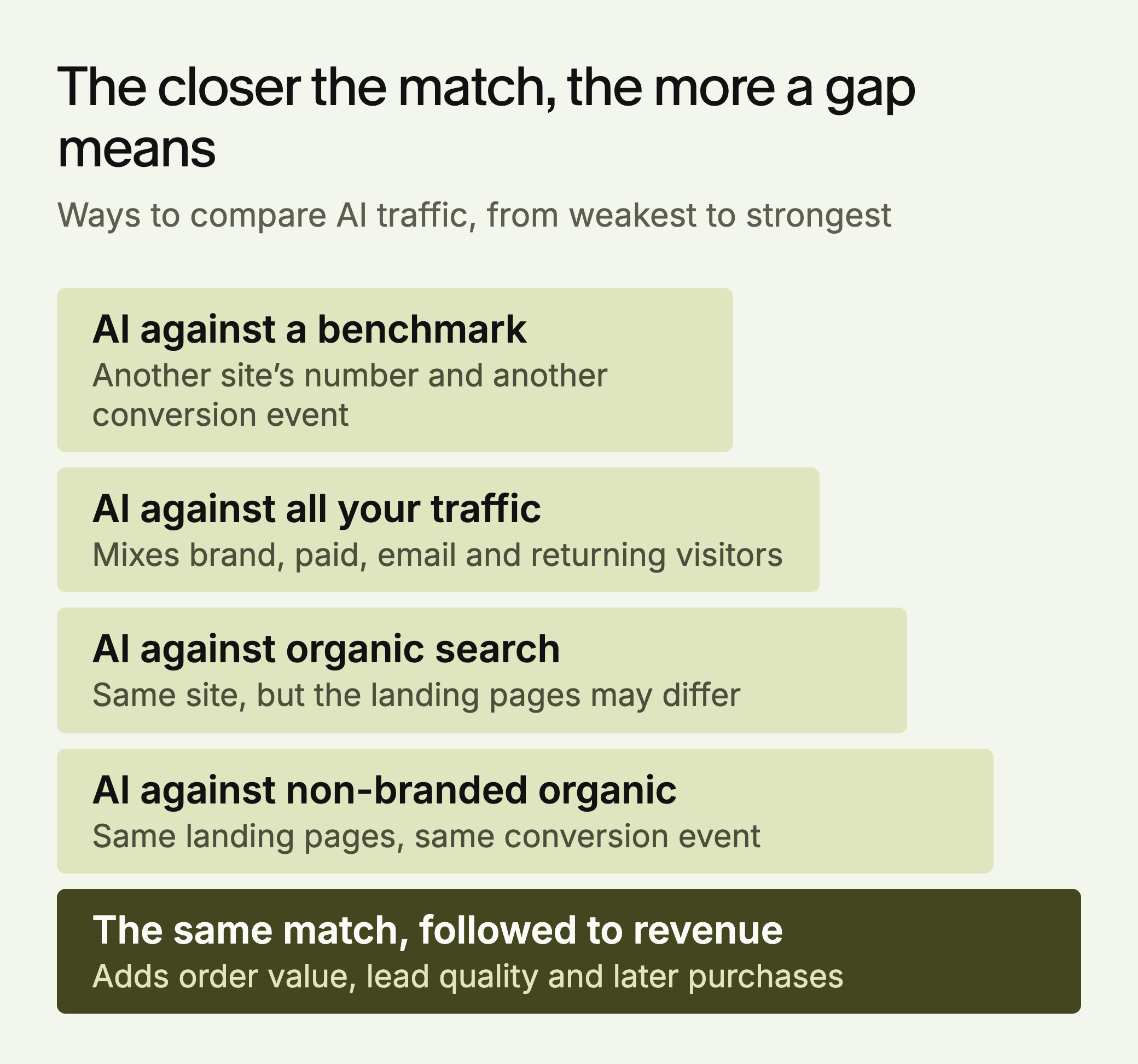
- The baseline. A multiple depends on what sits under it. If organic visitors mostly land on articles and AI visitors land on product pages, you’re partly comparing pages. Ahrefs reports that 80% of its AI search visitors landed on the homepage, free tools or product pages.
- The business. Seer’s ChatGPT conversions ran from solution pages to contact forms, and its Gemini conversions clustered on tools and calculators. Kaiser and Schulze studied online stores. Schulze says ChatGPT’s value is “currently limited” for simple purchases, while it can help with complex products that need guidance.
- Attribution. Kaiser and Schulze used last-click data, which PPC Land notes may understate ChatGPT’s role earlier in a purchase. Someone who reads an AI answer and later types your URL shows up as direct traffic.
- Volume. Under 1% of traffic means few sessions and noisy rates. Kaiser and Schulze aggregated weekly and used regression models to cope with sparse data. A single account has no such cushion.
Why AI-Referred Visitors Might Behave Differently
Seer’s explanation is that people finish part of their consideration inside the chat before they click. If someone asks an assistant to compare CRMs for a 10-person team, the answer may name a few options and explain the fit, so the visitor arrives with a shortlist.
That is a reasonable idea, but Seer offers it as an interpretation and didn’t test it. The people who click out of an AI answer may also simply differ from search visitors. A rate comparison between channels can’t separate those explanations.
Engagement data doesn’t settle it either. Seer’s ChatGPT visitors viewed 2.3 pages per session, against just over 1.2 from Google organic. Ahrefs saw about 50% more pages per visit from AI search, but shorter visits. In the 973-store study, ChatGPT visitors trailed every channel except paid social on session duration and page views. More pages can mean interest or confusion, so treat them as a clue.
What the Strategy Numbers Show
A figure you will see next to the conversion claims is that only 14% of brands have an AI visibility strategy. It comes from Visionary Marketing’s 2026 study, and the number is 14.2% of 2,400 marketers who said so in a survey run in February 2026.
That is agency data and self-reported. It measures what marketers say about their plans, not what they do, and it doesn’t show that brands with a strategy get cited more.
Which Engines to Check First
Start with the engines that already send you visits. Your analytics will answer this better than any benchmark, and engines differ enough that you can’t assume one result carries over to another.
- Sources overlap little. In one audit reviewed by the GEO survey, 26% of the domains cited across Bing Chat and Perplexity were cited by both. Another found that 53% of domains cited by Google AI Overviews weren’t in the organic top 10.
- Citing habits differ. Muck Rack’s May 2026 report (vendor data from more than 25 million cited links) found ChatGPT cited sources in 96% of responses, Gemini in 82% and Claude in 55%.
- Favorite sources differ. In the same report, ChatGPT’s most-cited domain was Wikipedia, Gemini’s was Reddit and Claude’s was PubMed Central.
Does a Citation Lift Branded Search?
Possibly. Visionary Marketing reports a 23.4% lift in branded search volume within about 30 days of an AI citation, based on 240 of its client accounts. Its write-up isn’t consistent about the exact window, or about whether the citations are AI Overviews only. The agency itself notes that correlation doesn’t imply causation, and those accounts aren’t a random sample.
Treat branded search as something to watch, not as proof of a compounding loop. A brand that earns a citation may also be running PR or campaigns that lift search on their own.
Five Changes Worth Testing
None of these has been shown to raise conversions. They are the changes with the most reasonable case for improving how you appear in AI answers, and each can be tested on a few pages.
1. Answer the question near the top of key pages. Kevin Indig’s analysis of 18,012 verified ChatGPT citations, using data from the vendor Gauge, found 44.2% came from the first 30% of the page. That is correlation on one engine. Write a short, self-contained answer for your five most important pages and compare them with five you leave alone.
2. Keep schema accurate, but don’t expect a citation lift. In a vendor test, Ahrefs compared 1,885 pages that added JSON-LD with control pages and found no major uplift: AI Mode +2.4% and ChatGPT +2.2%, both indistinguishable from zero, and AI Overviews -4.6%. Ahrefs pooled all schema types and tested only pages already heavily cited, so it doesn’t settle the question for individual types or for pages that aren’t cited yet.
3. Earn mentions on sites that AI answers already cite. Ahrefs’ December 2025 study of 75,000 brands found branded web mentions correlated 0.664 with ChatGPT visibility, while link metrics correlated very weakly. This is vendor data and correlation only. List the 10 sources that come up most often for your category, and work out which you could realistically appear on.
4. Make your brand facts match everywhere. Compare your name, category, location and description across your site, LinkedIn, Crunchbase and review sites. We know of no reliable measurement of the effect on citations, but this costs little and may prevent wrong answers.
5. Update dated pages when the facts change. Ahrefs’ study of about 17 million citations (vendor data) found AI assistants cited URLs about 25.7% newer on average than organic results. Google AI Overviews was the exception, citing slightly older content than organic. Change the date only when you change the page.
How to Measure the AI Channel
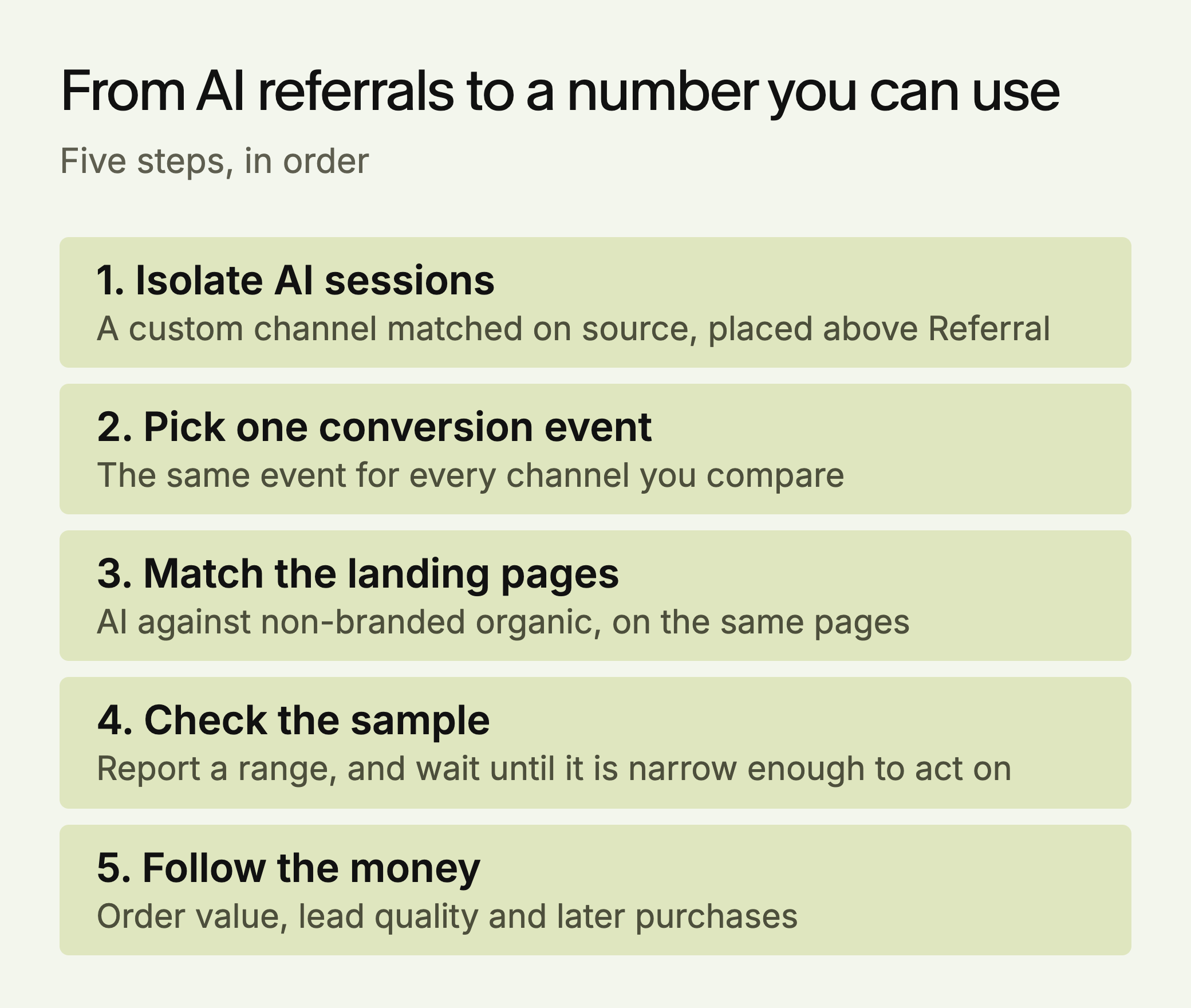
Separate the sessions. Google added an AI Assistant channel to GA4’s default channel group in May 2026, according to Search Engine Journal. Use it with care. Google’s page excludes AI Overviews and AI Mode, which count as organic search. Search Engine Journal found Perplexity wasn’t on the list, and the channel only counts from each property’s rollout date, so periods that span spring 2026 aren’t comparable.
A custom channel group gives you control. In Admin, under Data display, open Channel groups and create a new group. Add a channel called AI with the condition “Source matches regex,” then drag it above Referral and Organic Search:
^(.*\.)?(chatgpt\.com|perplexity\.ai|claude\.ai|gemini\.google\.com|copilot\.microsoft\.com)$Expect it to undercount. In Workshop Digital’s review of 181.6 million GA4 sessions across 22 clients (agency data), about 22% of ChatGPT sessions and 32% of Perplexity sessions had a “(not set)” medium. Visits from AI apps that send no referrer land in Direct, and no regex can recover those.
Compare like with like. Compare AI sessions with non-branded organic sessions on the same landing pages, using the same conversion event.
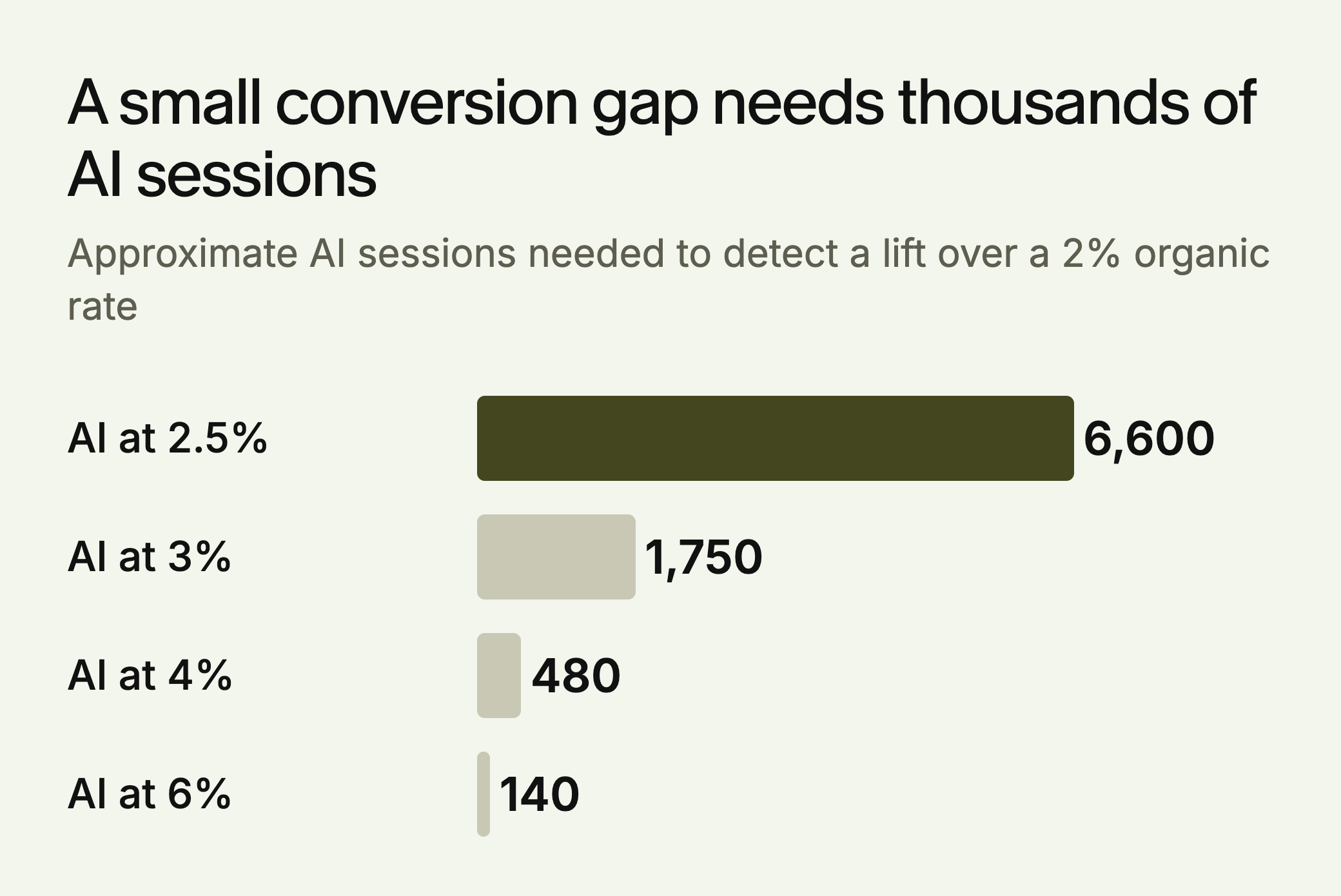
Wait for enough data. Don’t quote a rate until the sample can support it. Suppose organic converts at 2%. Telling a true 4% AI rate apart from 2% takes about 480 AI sessions. Spotting 2.5% takes about 6,600, which is nearly three years at 200 AI sessions a month.
- Repeat your prompts. AI answers change between runs. The GEO survey cites seven to eight repetitions per prompt as a starting point, from a small study. Take the 20 to 30 questions your buyers ask and log who gets cited each time.
- Watch branded search. Check Google Search Console for branded queries after a citation gain, knowing other activity can cause the same rise.
- Follow the money. For a store, track revenue per session and order value, since the 973-store study found order values falling as conversion rose. For B2B, count qualified leads, not form fills.
A Worked Example: When the Gap Disappears
The company and figures below are made up for illustration. Fernhollow, an online garden tools store, pulls 90 days of GA4 data and sees AI traffic converting at 3.5% against 2.0% for organic. That looks like a 75% advantage.
| Segment | Sessions | Conversions | Rate |
|---|---|---|---|
| All organic search | 48,000 | 960 | 2.0% |
| AI referrals | 1,200 | 42 | 3.5% |
| Non-branded organic, same 12 landing pages as AI | 14,000 | 476 | 3.4% |
AI visitors land almost entirely on 12 product guides. Organic visitors spread across thousands of pages, many of them articles that rarely sell anything. Once the comparison is limited to those 12 pages, the gap falls to 0.1 percentage points. The AI rate has a 95% interval of about 2.6% to 4.7%, so the two rates can’t be told apart.
Fernhollow’s conclusion: AI visitors arrive on pages that convert well, and that’s worth knowing. There’s no evidence yet that they’re better buyers, so the budget stays where it is and the segment keeps collecting data.
Which Result Applies to Your Business
| Your situation | What the evidence suggests | What to measure |
|---|---|---|
| Store, simple products | The closest match is the 973-store study: ChatGPT trailed most channels | Purchases, revenue per session, order value |
| Store, complex products | Schulze sees possible value where buyers need guidance | The same, plus assisted purchases |
| B2B or lead generation | Only single-company data, from Seer and Ahrefs, and it’s favorable | Qualified leads and pipeline by source |
| Under a few hundred AI sessions a quarter | Too few sessions for a rate to mean much | Session counts and landing pages only |
Before spending on this, decide when it would matter. Seer suggests a threshold such as AI reaching 5% of organic sessions, and putting a dollar value on AI conversions. Its example assumes $150 per conversion, or about $205,000 across the 1,370 conversions. Use your own value per conversion, and act when the channel is large enough to change a budget line.
Conclusion
AI referrals were a small share of traffic in all three studies above, and the published conversion data ranges from far better than search to somewhat worse. Your own numbers are the ones that matter. Set up the segment this week and let it collect data before you change budget.
LLMagnet measures AI visibility across seven engines and has an agent that prepares fixes for your approval. You can start with the free LLMagnet audit to see where AI answers cite you and where they don’t.







 30-day free trial · no credit card