

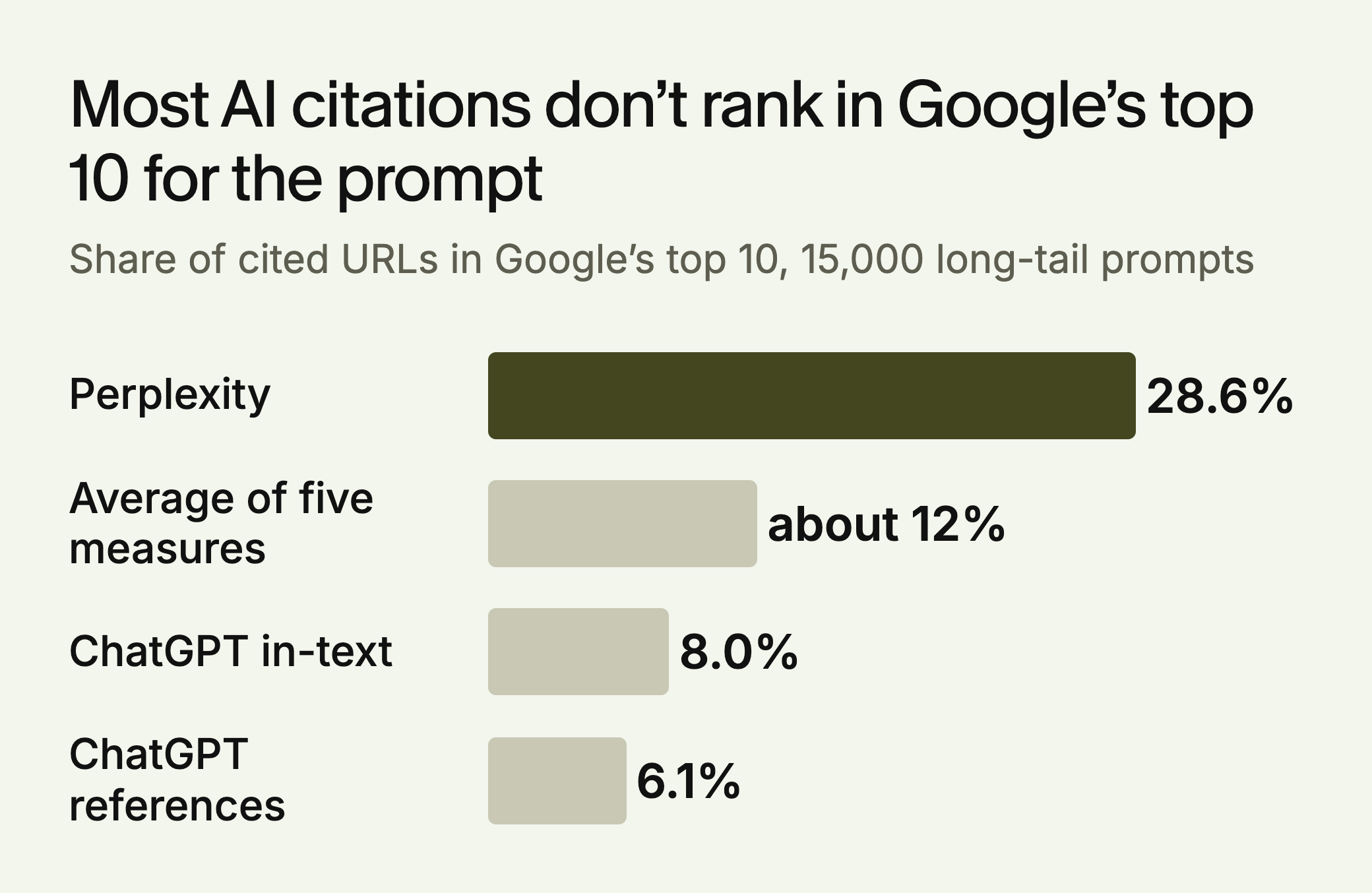
A high Google ranking doesn’t reliably get you cited by AI assistants, though it still counts for something. In Ahrefs’ test of 15,000 long-tail prompts, an average of about 12% of the URLs AI assistants cited ranked in Google’s top 10 for the same prompt. Nobody has proven what does cause citations, so the five areas below are informed bets.
Contents
- What the Ranking Data Shows
- Why the Numbers Disagree
- How Rank Feeds Into an Answer
- Signal 1: Clear Facts About Your Brand
- Signal 2: Independent Mentions in Your Category
- Signal 3: Answers Near the Top of the Page
- Signal 4: Presence Where Each Engine Looks
- Signal 5: Fresh Content, Where It Counts
- When Rank Matters Most
- A Worked Example: Ranking First and Not Being Cited
- Common Mistakes
- How to Prioritize: A Starting Audit
- FAQ
What the Ranking Data Shows
Ahrefs’ study, published in August 2025 with ChatGPT data collected in early July, is vendor data, and it found large differences by engine. About 8% of ChatGPT’s in-text citations ranked in Google’s top 10 for the prompt. Perplexity, at 28.6%, was the closest to Google. The 12% is Ahrefs’ average of five measures, Perplexity included. The others sat around 8%.
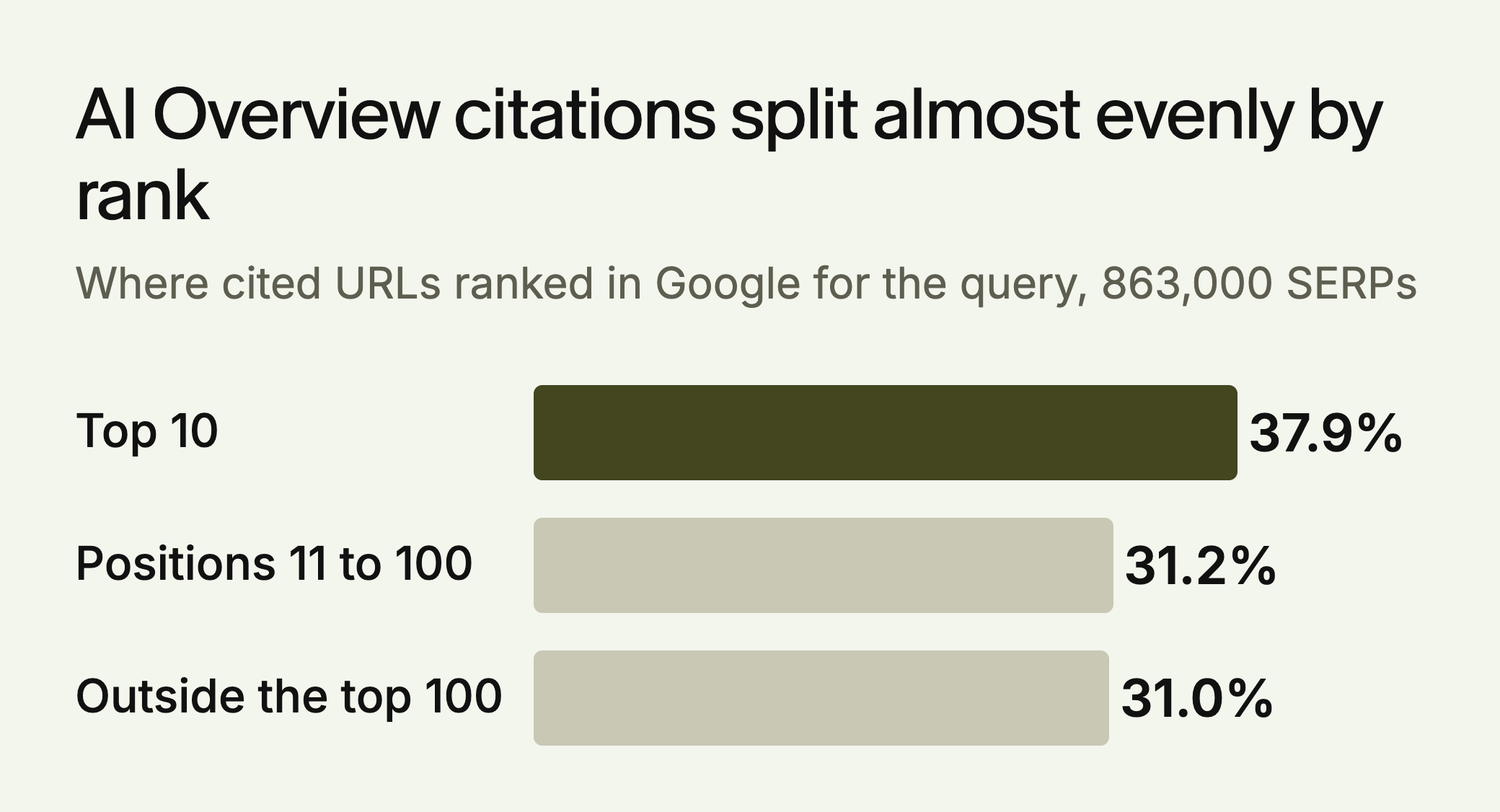
Google’s own AI features sit higher. In Ahrefs’ March 2026 update, covering 863,000 keyword SERPs, 37.9% of AI Overview citations also appeared in the top 10 SERP blocks. An earlier Ahrefs study reported 76%, but the parsing method changed between the two, so don’t read that as a clean decline.
There is one important limit. Assistants often run several related searches (query fan-out) instead of the exact prompt, so a cited page may rank well for a query the study didn’t check. These numbers show that most cited pages don’t rank in the top 10 for the prompt. They don’t show that SEO is useless.
Why the Numbers Disagree
You’ll see figures from about 12% to 76% quoted about the same question. They measure different things. Before you repeat one, check which of these it is.
| Figure | Source | What it counts |
|---|---|---|
| About 12% | Ahrefs, August 2025 | Cited URLs in Google’s top 10 for the exact prompt, across assistants |
| 37.9% | Ahrefs, March 2026 | AI Overview citations in the top 10 SERP blocks for that query |
| 76% | Ahrefs, earlier study | AI Overview citations from top 10 pages, using older parsing |
| 55.8% | AirOps, March 2026 | ChatGPT-cited pages in the top 20 for at least one query, fan-out included |
| 43.2% | AirOps, March 2026 | Pages ranking first on Google that ChatGPT then cited |
The last row asks the question backward. The Ahrefs figures start with cited pages and ask how many ranked. AirOps (vendor data, 15,000 prompts, observational) starts with pages ranking first and asks how many got cited. Those pages were cited at 3.5 times the rate of pages beyond the top 20. Both can be true: most citations come from pages that don’t rank for the exact prompt, and pages at the top of Google are still cited more often. That’s a correlation, not proof that rank causes the citation.
How Rank Feeds Into an Answer
The AirOps data lets you follow a prompt through ChatGPT’s process, and it suggests where rank may do its work.
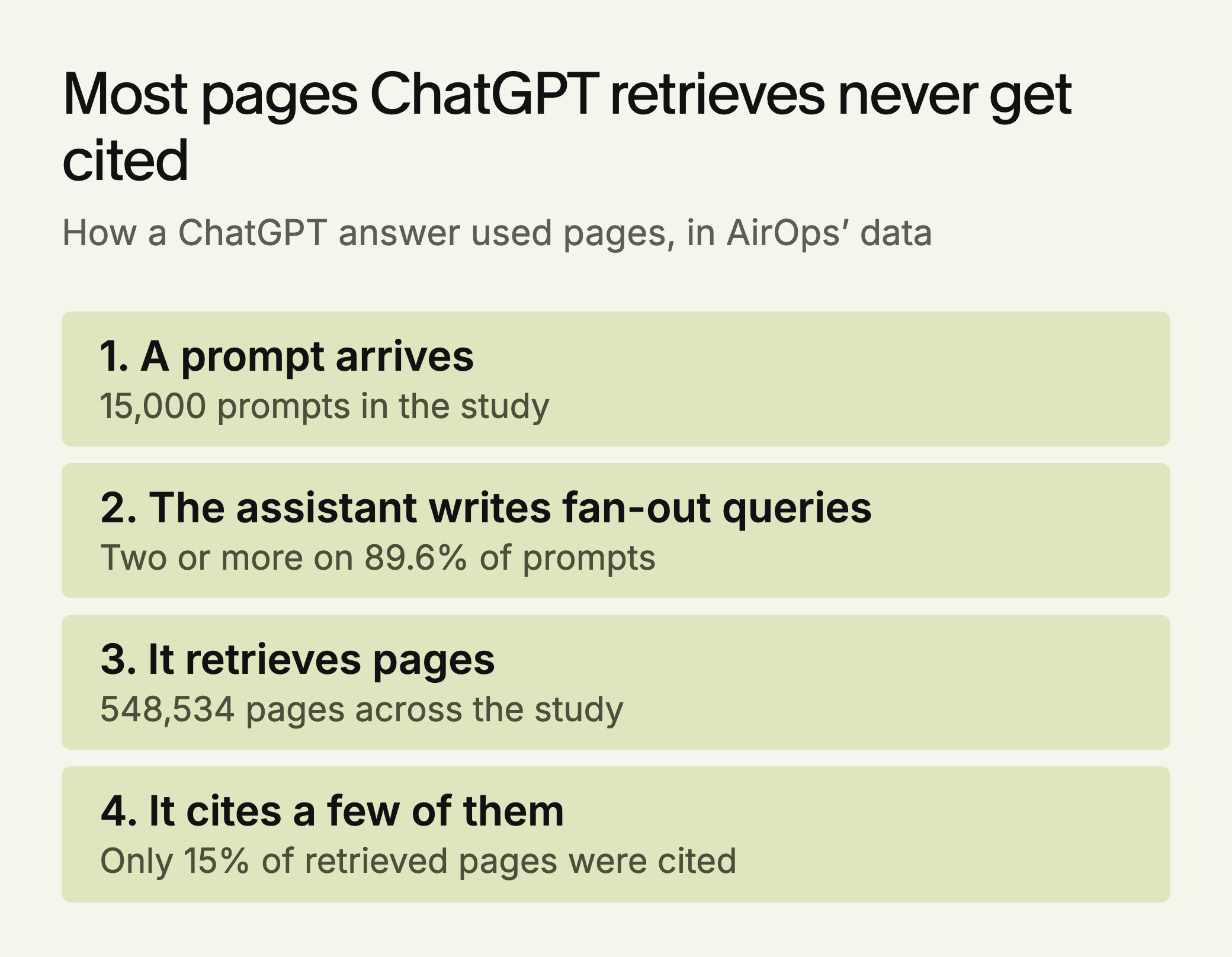
ChatGPT generated two or more fan-out queries on 89.6% of the prompts, and 95% of those queries had no monthly search volume by traditional measures. So keyword tools can’t list them for you. Of the 548,534 pages it retrieved, only 15% were cited. And 32.9% of the cited pages that appeared in any top-20 result were discovered only through fan-out.
Our reading is that rank can earn a page a place in the pile and goes with better odds of citation, but most of the pile goes unused. And a page can get into the pile by ranking for a question you never targeted. That’s an argument for covering the sub-questions of a topic, not only its head term.
Signal 1: Clear Facts About Your Brand
An engine that describes you wrongly can’t recommend you for the right reasons. We have no clean measurement of this effect, but the work is cheap and fixes real errors.
- Ask the engines what you do. Use the same three prompts everywhere: “What does [company] do?”, “Who is [company] for?” and “What does [company] cost?” Note wrong categories, old products and missing details.
- Use one description everywhere. Align your homepage, About page, directories and review profiles on the same category and product scope.
- Correct reference entries. If you have a Wikipedia article or Wikidata item, fix errors through the proper process and disclose your connection.
You’ll know it worked when the wrong statements stop appearing across repeat runs. Expect this to take time, since a fix only helps once the corrected page has been crawled and retrieved.
Signal 2: Independent Mentions in Your Category
Authority metrics look weak next to mentions. Ahrefs’ study of 75,000 brands (published May 2025, Google AI Overviews only) measured Spearman correlations with brand visibility. Branded web mentions came in at 0.664 and backlinks at 0.218.
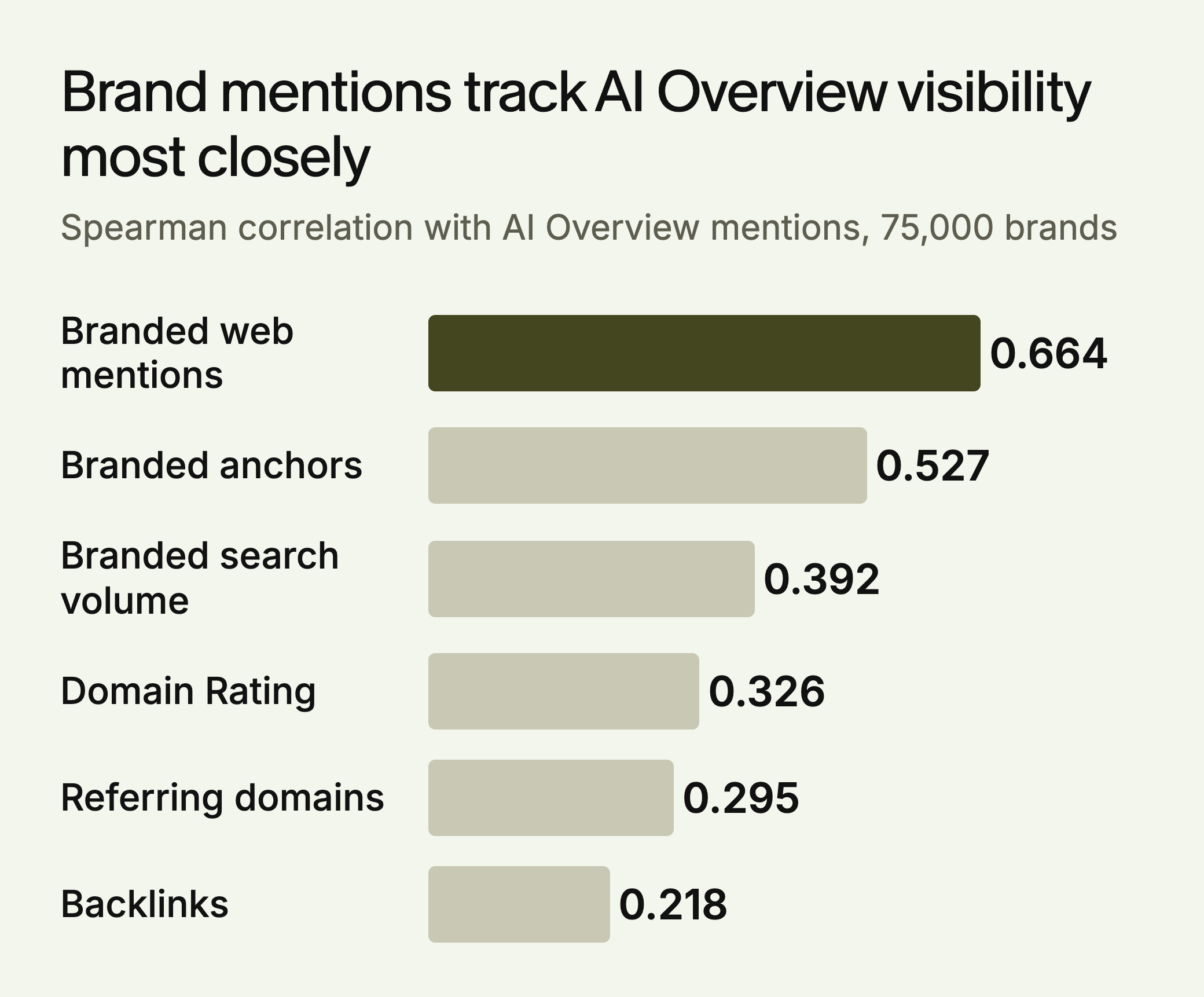
Correlation isn’t cause, and famous brands tend to score well on all of them. The sample also has a limit that matters to smaller companies: Ahrefs kept only domains with a Domain Rating above 40 and left out the roughly 26% of brands with no AI Overview mentions. So the study says little about a young brand trying to get its first mention. Treat it as a lead for other engines, too.
Being mentioned on a range of independent sites, in the context of what you sell, is a sensible goal. List the publications, newsletters and communities your buyers read. Then pitch them something they can use: original data, a customer story with named results, or an expert who will answer questions. Count mentions that describe what you do. A logo on a sponsor page says nothing an engine can repeat.
Signal 3: Answers Near the Top of the Page
Kevin Indig’s analysis (published February 2026, data from Gauge) matched 18,012 ChatGPT citations to page text and found 44.2% came from the first 30% of the page. The study is observational and reports neither peer review nor controls for page type, but it fits what readers want anyway.
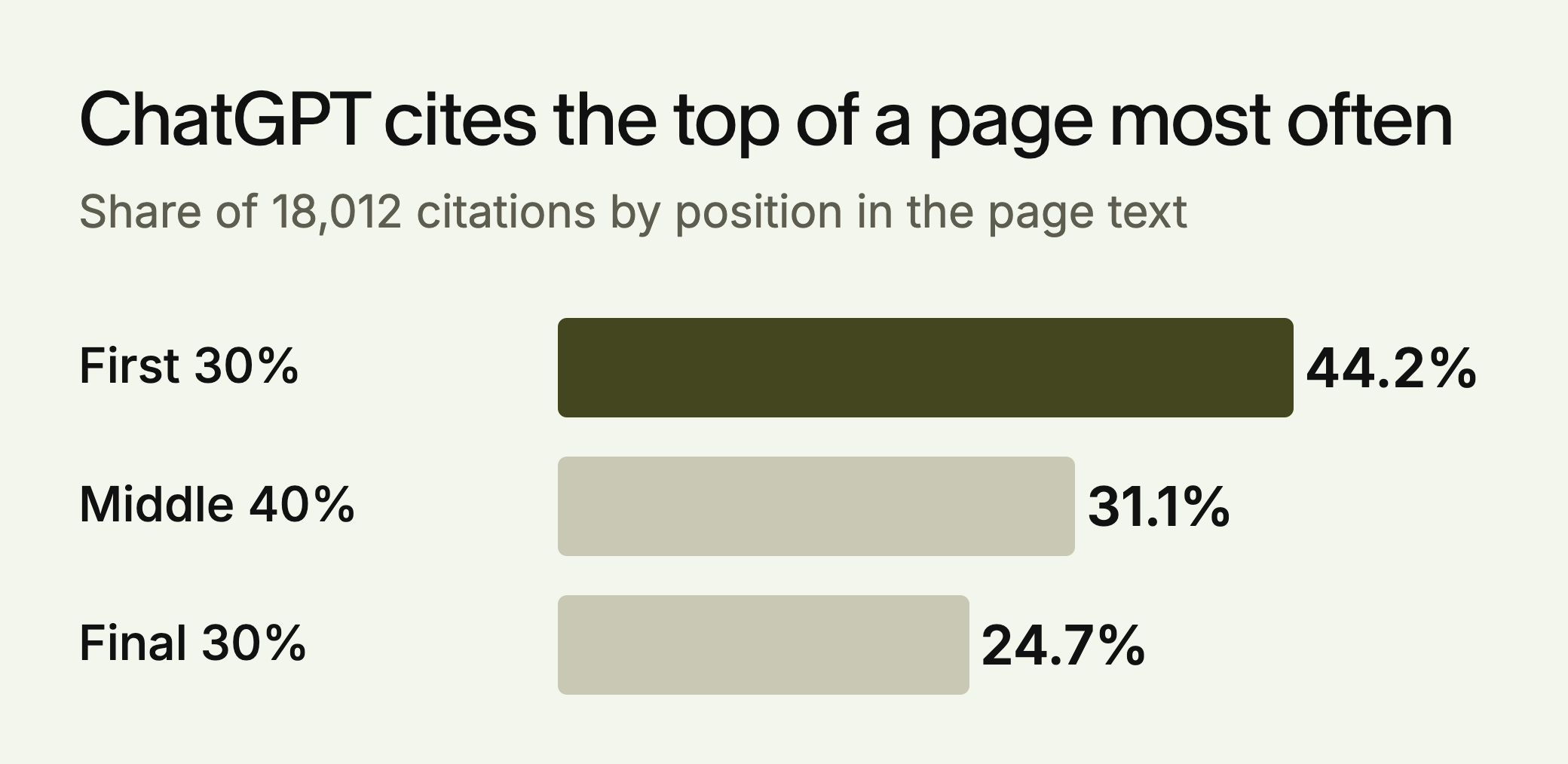
Note what the chart doesn’t say. More than half of the citations came from further down, so a good section halfway through a page can still be cited. The same analysis reports that cited text used definitive language more often than uncited text, 36.2% against 20.2%. Plain statements of what something is seem easier to lift than hedged marketing copy, though that’s also a correlation from one engine.
Open each important page with the direct answer, in plain sentences. A product page should say what the product does and who it’s for before any company history. Headings should say what the section answers. The example below is made up for illustration.
| Before | After |
|---|---|
| At Tallowmere, we believe inventory should feel effortless. For over a decade, we’ve helped teams rethink how they work. | Tallowmere is inventory software for restaurant groups with 5 to 50 locations. It counts stock by recipe, flags waste by shift and connects to most point-of-sale systems. |
Don’t count on schema to do this job. Google says no special schema is required for its AI features, and it no longer shows FAQ rich results in Search. Mark up only what is really on the page, and don’t expect a citation lift from the markup alone.
Signal 4: Presence Where Each Engine Looks
Each engine has favorite sources. Profound’s analysis of 680 million citations (vendor data, August 2024 to June 2025) shows the pattern:
- ChatGPT: Wikipedia was 47.9% of citations among its ten most-cited sources, and 7.8% of all its citations.
- Perplexity: Reddit was 46.7% of its top-ten citations, and 6.6% of all of them.
- Google AI Overviews: Reddit was 21.0% and YouTube 18.8% of top-ten citations, and 2.2% and 1.9% of all citations.
Top-10 share and overall share answer different questions, so don’t mix them. Profound also reported that only 11% of domain citations appeared in both ChatGPT and Perplexity in a 100,000-prompt test. Search your own category on each engine and see which of these sources appear for you.
Signal 5: Fresh Content, Where It Counts
Ahrefs’ study of about 17 million cited URLs (vendor data, published July 2025) found AI assistants cited pages that were on average 25.7% newer than organic results, counting age from when Ahrefs’ crawler first saw each page. That’s Ahrefs’ own calculation, which uses a slightly higher organic age than its per-platform table. By last-updated date, the gap was 13.1%. ChatGPT leaned newest on that first-seen measure, and Google AI Overviews cited slightly older pages than organic results.
The same study shows the average cited page was still 2.9 years old. So old pages can do well, and freshness is one factor among many. Update pages when prices, features or facts change, and start with comparison and product pages. Changing the date without changing the page is not an update.
When Rank Matters Most
Put the two kinds of work in proportion. This is our reading of the studies above, and the right mix also depends on where your buyers actually ask.
| Situation | Lean toward | Why |
|---|---|---|
| Buyers mostly use Google | Ordinary SEO, plus answer-first pages | 37.9% of AI Overview citations appeared in the top 10 blocks for the query |
| Buyers mostly use Perplexity | Both, with attention to community sources | Highest overlap with Google of the assistants tested, and Reddit is its top source |
| Buyers mostly use ChatGPT | Sub-question coverage and third-party mentions | About 8% of in-text citations ranked in the top 10 for the prompt |
| New site with little authority | Listings and coverage on sites already cited | Getting named on a cited source can be faster than outranking it |
A Worked Example: Ranking First and Not Being Cited
The company and details below are made up for illustration. Brackenhill sells payroll software and ranks first on Google for “payroll software for nonprofits.” Its page never appears when buyers ask ChatGPT the same thing.
- Read the answers. Brackenhill runs the prompt five times in fresh chats. The answers keep covering grant-funded salaries and restricted-fund reporting, and they cite a nonprofit finance newsletter and two comparison articles.
- Compare the page. Its first 200 words are about company history, and neither topic appears anywhere on it. Rank may have got the page considered, but the page gave the engine nothing on those two sub-questions.
- Make two changes. It opens the page with who the product is for, adds a section on each sub-question, and pitches the newsletter a short piece on grant-funded payroll.
- Check over four weeks. It reruns the same prompts weekly. A real result is Brackenhill being named in more runs than the swing between repeat runs, with the page or the newsletter among the citations.
The order matters. Reading the answers first shows which gap you have. Without that step, the team would probably have tried to improve a rank it already held.
Common Mistakes
- Cutting SEO because of the 12% figure. The figure covers exact long-tail prompts only. Fan-out means rank for other queries can still feed the answer.
- Assuming a first-place rank is enough. It goes with more citations, but AirOps found ChatGPT left 85% of the pages it retrieved uncited. Retrieval isn’t selection.
- Reading a correlation as a recipe. Buying mentions won’t turn you into the kind of brand that earns them, which is what the correlation may really be measuring.
- Tracking a single blended score. Rank works differently on each engine, so a blended number can hide opposite movements.
How to Prioritize: A Starting Audit
- Facts: Ask ChatGPT, Perplexity and Gemini to describe your company. List every error.
- Mentions: Count the independent publications in your category that have mentioned you in the past year. If you can’t name five, start there.
- Page openings: Read the first two sentences of your top five pages. If they don’t answer the page’s main question, rewrite them.
- Sources: Run your core prompts on each engine and list the domains cited in place of you.
- Freshness: List your ten most important pages by last real update. Fix any with outdated facts.
Measure over time, not once. Ahrefs found that 45.5% of the URLs cited in Google AI Overviews were new from one observation to the next. Run the same prompts weekly for at least four weeks and compare averages.
LLMagnet measures AI visibility across seven engines and has an agent that prepares fixes for you to approve. Its free audit is one place to see where you stand.

 ChatGPT


 Gemini


 30-day free trial · no credit card