

AI citations decay because each answer is generated again, the sources behind it turn over within weeks, and older pages lose ground. We found no study that shows a way to stop this, so review your most valuable pages every 8 to 10 weeks and track how often you appear. AirOps’ 2026 State of AI Search report (vendor data) found only 30% of brands stay visible from one answer to the next.
AirOps also found that just 20% of brands remain present across five consecutive runs, and that more than 50% of brands that drop out return within two runs. The report doesn’t publish a sample size or say how it defined visibility. Its direction is still useful: one missing citation is not a trend.
Contents
- Why AI Citations Are Unstable
- Three Problems That Look the Same
- What Cited Pages Have in Common
- How Fast Citations Fade
- Does Refreshing Bring Citations Back?
- What Doesn’t Help Much
- A Maintenance Routine
- A Worked Example: Reading a Decline
- Common Mistakes
- How to Audit Your Citation Stability
- FAQ
Why AI Citations Are Unstable
An AI answer is produced fresh for each request, so the sources it names can differ between two runs of the same prompt. In a SparkToro study of 2,961 runs from 600 volunteers, there was less than a 1 in 100 chance that ChatGPT or Google AI would give the same list of brands in any two of 100 runs. The authors note the work wasn’t peer-reviewed and that a tracking vendor took part.
The engines also differ widely. Superlines’ monitoring data (vendor data, 223,350 responses from December 2025 to January 2026) found at least one external URL in 28.44% of Grok responses, 14.01% of Perplexity, 1.29% of ChatGPT and 0.32% of Claude.
Being cited on one engine offers little protection on another. Profound (vendor data, 100,000 prompts run on both engines, published July 2025) found 11% of cited domains appeared in both ChatGPT and Perplexity.
Lifecycles barely line up between engines either. Profound’s half-life study (vendor data) found a page’s rise and fall on one engine correlated at only 0.03 to 0.09 with its path on another, and at 0.12 to 0.17 across Google’s three surfaces. A page fading on ChatGPT tells you almost nothing about Perplexity.
Most drops reverse on their own. AirOps says most brands that fall out reappear within one to three answers, and attributes that to models rebalancing for diversity, freshness and category coverage. It also reports that brands both mentioned and cited were 40% more likely to resurface across consecutive runs than brands that were only cited. That is another figure without a published sample, but it’s a reason to track mentions and citations as separate columns.
Three Problems That Look the Same
“We lost our citation” can mean three different things, and each needs a different response. Treating them as one is how a good page ends up rewritten for no reason.
| Problem | What you see | How to confirm it | What to do |
|---|---|---|---|
| Run-to-run noise | You vanish from one check and come back in the next | Repeat the prompt several times over a few days | Nothing. Measure how often you appear across many runs |
| Source turnover | Presence falls for weeks on one engine, and other URLs take your place | Compare the URLs cited before and after the drop | Find out what the replacement offers that you don’t, and close that gap |
| Page staleness | A slow slide across engines on a page nobody has touched in months | Check the last real update, and whether prices, names and figures still hold | Refresh the page with new or corrected substance |
What Cited Pages Have in Common
The strongest public data describes which pages get cited, not which stay cited. These are correlations, and none shows that changing a factor will hold a citation in place.
SE Ranking’s AI Mode study (vendor data, 2,328,533 pages, published December 2025) used a statistical model to rank page and domain factors:
- Domain traffic had a SHAP value of 0.63. Domains with over 1.16 million visitors averaged 6.4 citations, against 2.4 for those under 2,700.
- Freshness: pages updated in the past two months averaged 5.0 citations, against 3.9 for pages untouched for over two years.
- Readability: Flesch-Kincaid grade 6 to 8 pages averaged 4.6 citations, against 4.0 for grade 11 and above.
SE Ranking’s ChatGPT study (vendor data, 216,524 pages, published November 2025) found pages updated in the past three months averaged 6.0 citations against 3.6 for outdated pages. Pages with 19 or more statistical data points averaged 5.4 against 2.8 for pages with minimal data, and pages with expert quotes averaged 4.1 against 2.4. SE Ranking calls those last two supporting indicators with a relatively minor effect.
The Princeton GEO study (KDD 2024) tested edits directly on a 10,000-query benchmark. Against baseline, adding quotations raised Position-Adjusted Word Count by about 41%, statistics by about 31%, and citing sources by about 28%. In a smaller check of 200 samples on Perplexity, quotations gained about 22%.
How Fast Citations Fade
Published decay figures measure different things, so no single number is “the” half-life.
- 11 days. Profound (vendor data, 883,000 pages across seven engines, September 2025 to September 2026) found the median page loses half its citation share within 11 days of its peak.
- About 4.5 weeks. Scrunch and Stacker (vendor data, 3.5 million citation events, September 2025 to March 2026) measured how long it takes half of a cohort’s citations to disappear. The average was about 4.5 weeks, from about 3.4 on ChatGPT to about 5.8 on Perplexity.
- Under 13 weeks. AuthorityTech, as reported by Searchbloom, found half of AI citations go to content less than 13 weeks old. That is the age of cited content, not a decay rate.
AirOps adds that pages not updated in more than three months are over three times as likely to lose citations. Read together, sources turn over within weeks and pages left alone tend to lose ground. All of these are vendor estimates based on different samples.
The first two figures start from different places. Profound follows one page from its best moment, tracking its share of citations in its category, smoothed over 14 days, until that share halves and stays there for 14 days. Scrunch groups sources by the week they first appeared, then counts how many are still cited in later weeks. One measures a fall from a peak, the other the thinning of a group, so 11 days and 4.5 weeks can both be right.
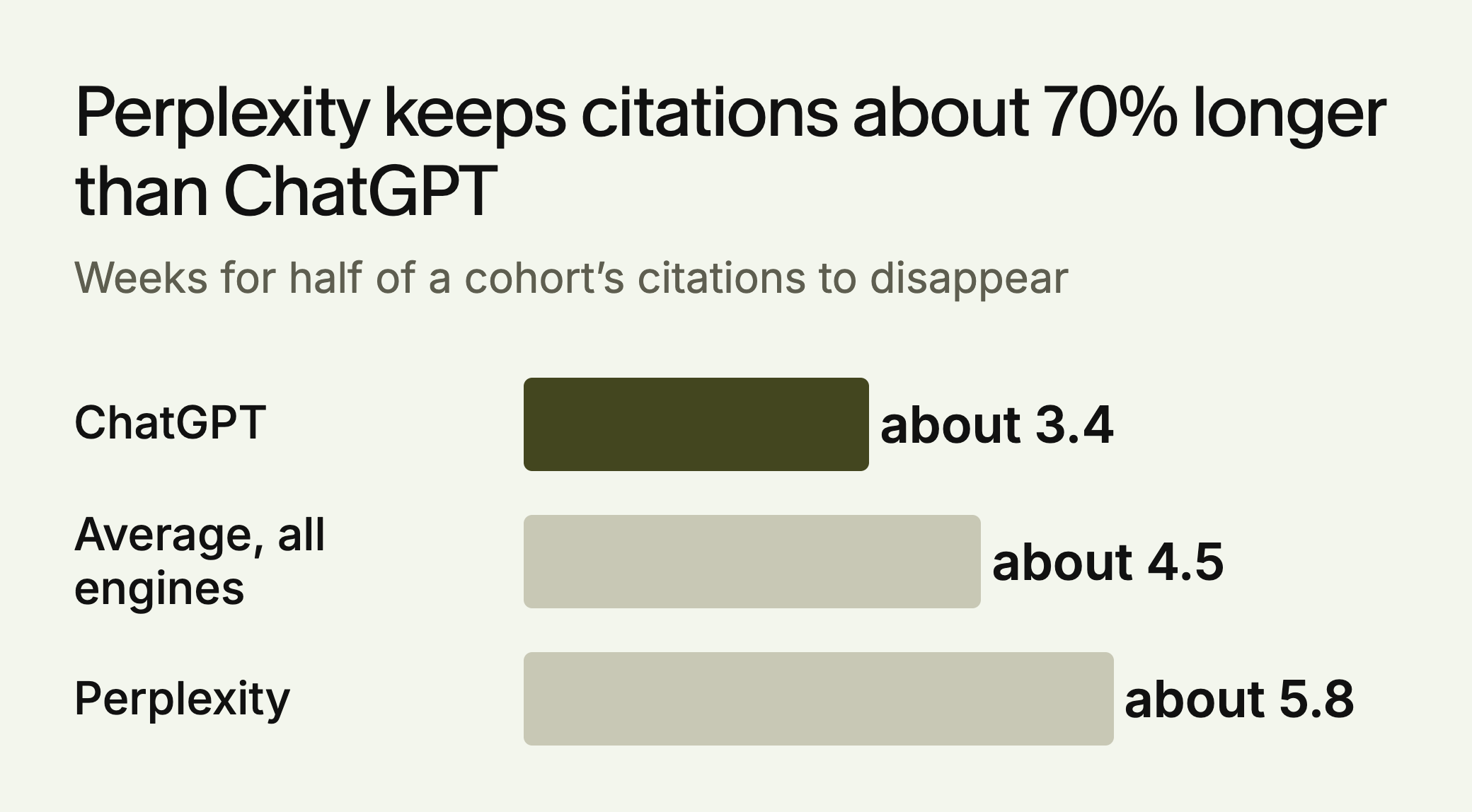
Google’s three surfaces sit in between, at about 4.3 to 4.8 weeks. In this data the engine mattered more than the industry: verticals ran only from about 4.1 weeks in healthcare to about 5.0 in insurance. If you report one blended decay number, ChatGPT’s faster turnover will be hidden inside it.
Most peaks are single events
Profound’s 11-day median mixes two kinds of page. Of 1.11 million page-engine pairs it could observe at least two weeks past peak, 78% had a half-life of 14 days or less. The other 22% were sustained pages, with a median half-life of 27 to 29 days depending on the engine. So 11 days describes a typical spike, not the clock a durable page runs on.
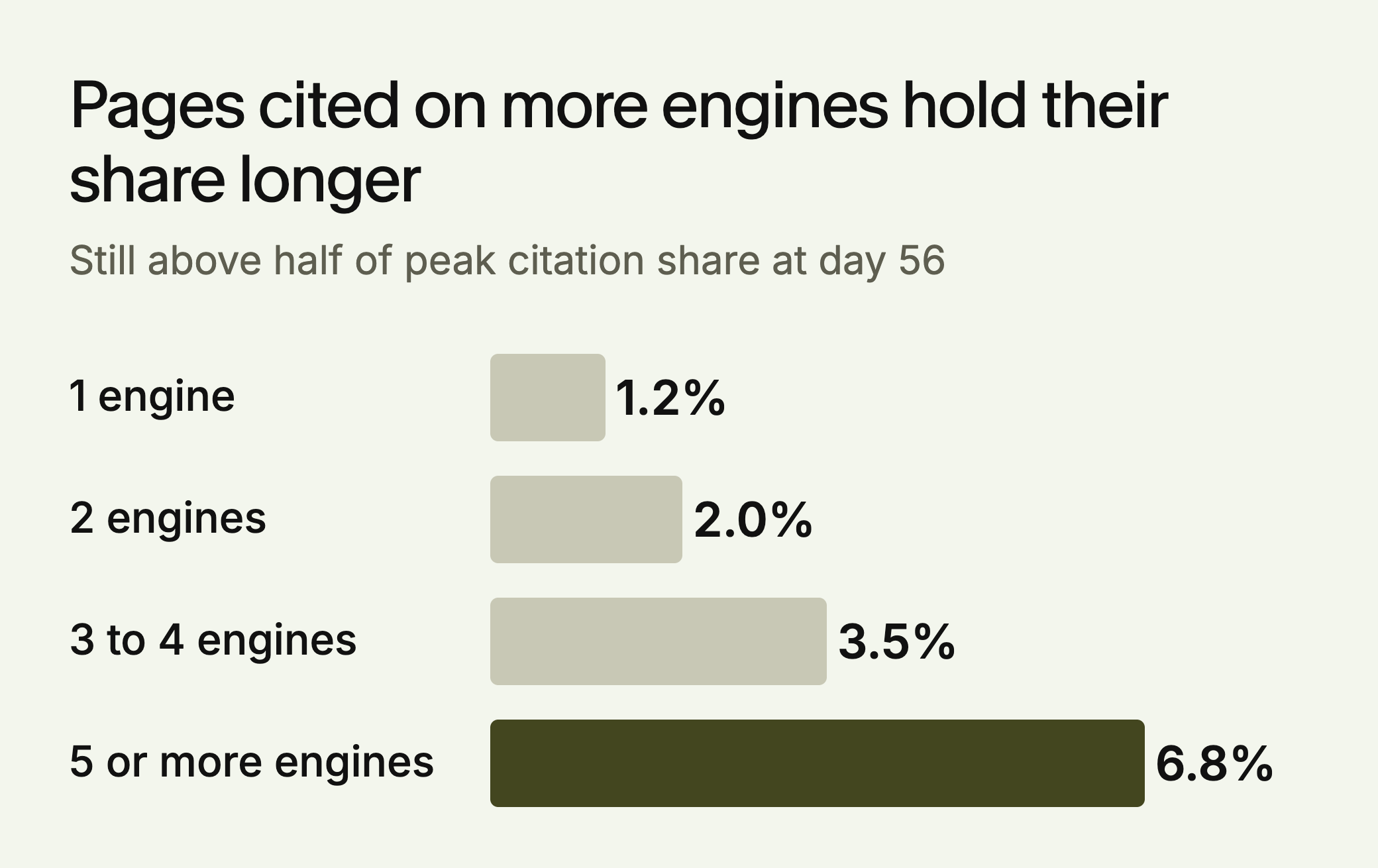
Pages cited on five or more engines were 5.5 times as likely as single-engine pages to hold half their peak after eight weeks. Pages that many engines pick up may simply be stronger pages, so this is an association. Even in the best group, more than nine in ten had fallen below half by day 56, which is why the goal is a routine and not a permanent fix.
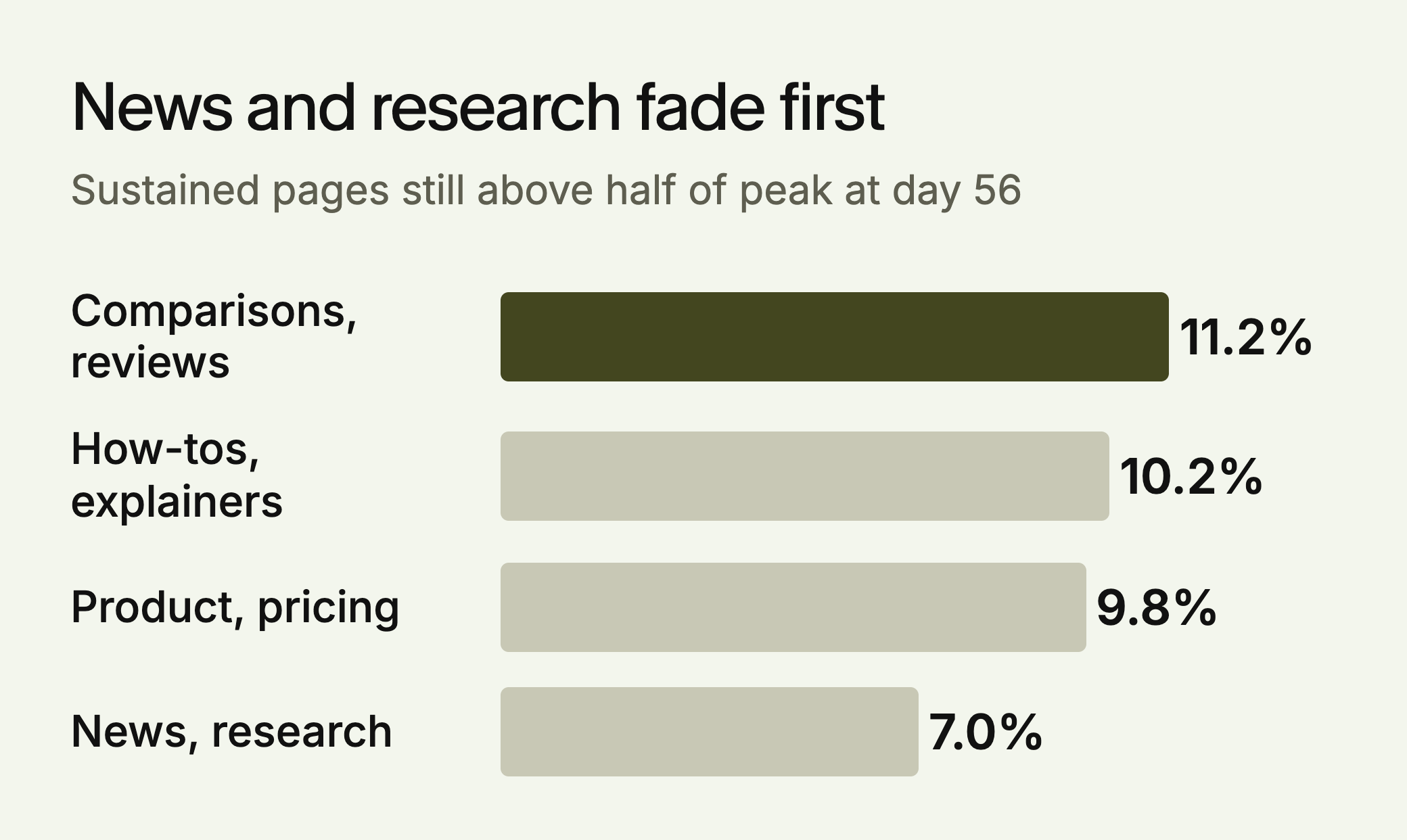
News, announcements and research came last on all seven engines, and they peaked faster too. The gaps are modest, since median half-lives ran from only 27 to 29 days across these groups. Use them to set priorities, not to choose what to publish.
Does Refreshing Bring Citations Back?
We found no study that tests this directly. Profound’s article doesn’t address updates. AirOps says stale pages rarely regain visibility without a direct update, but publishes no sample. The SE Ranking freshness gaps are correlations, and teams that keep pages current often have larger sites and more resources, which would produce the same pattern. Refresh because outdated facts are a problem on their own, and treat any citation gain as a hypothesis to test.
AirOps’ benchmarks (vendor data, samples not published) are useful for deciding where to start. Over 70% of AI-cited pages had been updated in the past 12 months and over 50% in the past six. For commercial queries, those rise to about 83% and over 60%. Commercial and comparison pages have the most to lose from going stale, so review them first.
Third-party placements may be worth testing too. Scrunch and Stacker report that domains in Stacker’s publisher network held citations about twice as long as domains outside it, reaching about 12.3 weeks on Perplexity. Stacker sells that distribution, and news publishers may simply have stronger domains, so don’t take this as proof.
What Doesn’t Help Much
Schema on its own. SE Ranking found FAQ schema made no meaningful difference to AI Mode citations, while real FAQ sections in the content averaged 4.9 citations against 4.4. Evidence on schema is mixed and depends on type and platform. See our review of the schema studies.
Keyword stuffing. In the Princeton benchmark it lowered Position-Adjusted Word Count by about 8% against baseline.
llms.txt. SE Ranking’s study of about 300,000 domains found no measurable link to citations. Don’t expect citations from it, though it may still give agents a useful map of your site.
A Maintenance Routine
We found no study that establishes an ideal refresh interval. The routine below is our judgment from the data above.
Why 8 to 10 weeks? On Scrunch’s average, two half-lives take about nine weeks, and if decay held steady about three quarters of a cohort’s citations would be gone by then. AirOps recommends roughly quarterly refreshes, so this interval is slightly more cautious. On a page you can’t refresh that often, review the facts most likely to change, such as prices and plan names.
Review your top 10 to 20 pages every 8 to 10 weeks. Choose the pages tied to revenue or to prompts you want to win. A refresh is a real change: new data, a corrected figure, or a section answering a question that came up. Changing the date alone doesn’t count.
Track presence, not position. SparkToro’s authors recommend measuring how often a brand appears, since the order of a list rarely repeats from run to run.
Report each engine separately. With 11% domain overlap between ChatGPT and Perplexity, a combined number can hide a loss on one of them.
Add real data to product and service pages. Use sourced numbers you can defend, such as prices, limits, test results or dated customer counts.
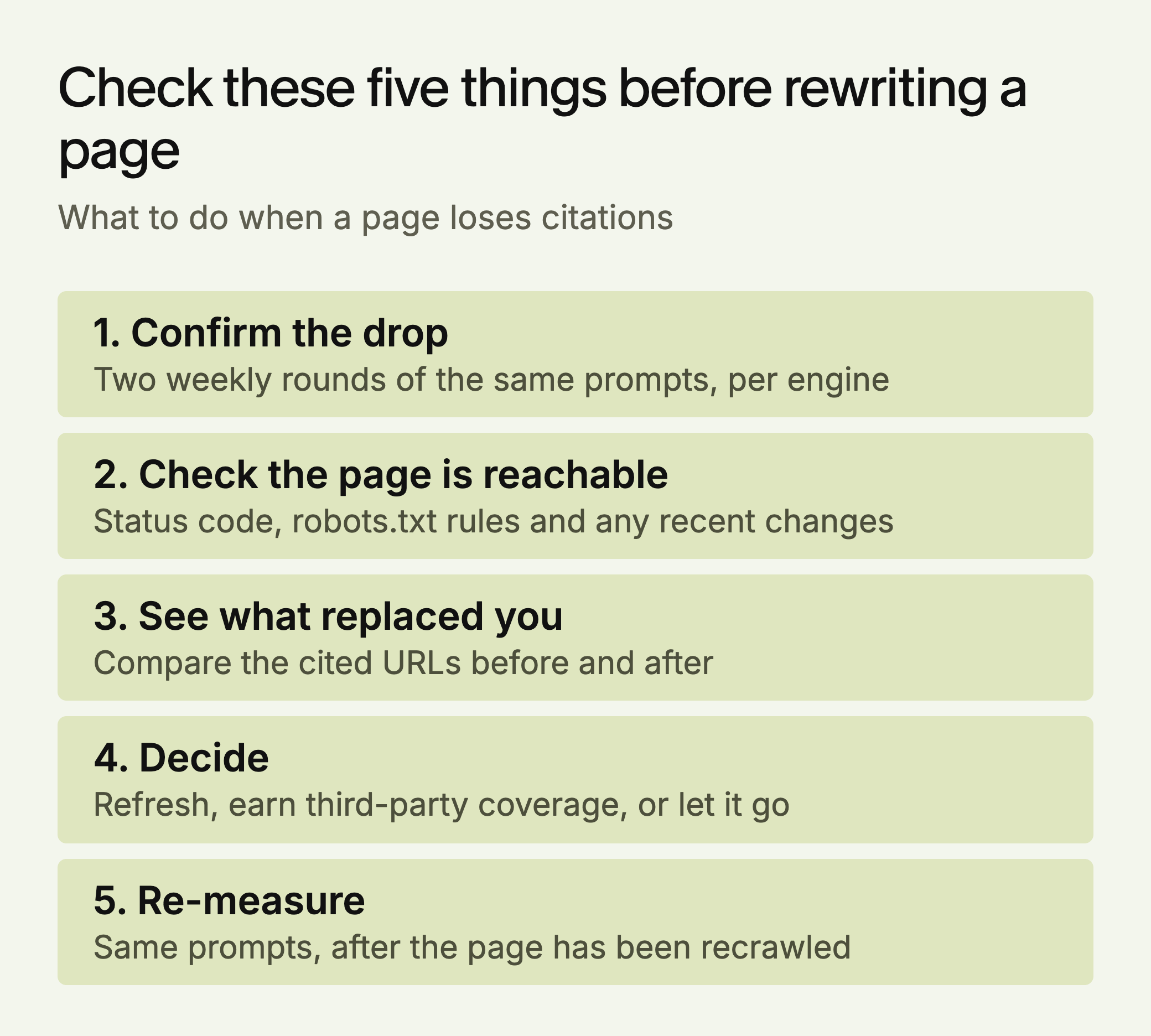
What you do at step four depends on the page. These are our recommendations, using Profound’s content groups.
| Page type | What to do when citations fall |
|---|---|
| Comparison, listicle, review | Update prices, options and criteria on each review. These pages held longest, so they repay upkeep. |
| How-to, docs, reference | Match them to the current product. Fix screenshots, steps and version names first. |
| Product, pricing, company | Change them when the facts change, and never leave an old price live. |
| News, announcements, research | Don’t keep rewriting them. Publish a follow-up and link it from the original. |
A Worked Example: Reading a Decline
The company and figures below are made up for illustration. Quillon tracks 12 prompts, five runs each, on three engines, so each cell is out of 60 responses.
| Week | ChatGPT | Perplexity | Google AI Mode |
|---|---|---|---|
| 1 | 24 (40%) | 18 (30%) | 15 (25%) |
| 2 | 21 (35%) | 20 (33%) | 14 (23%) |
| 3 | 13 (22%) | 17 (28%) | 16 (27%) |
| 4 | 11 (18%) | 19 (32%) | 15 (25%) |
Perplexity and AI Mode move two to five points from week to week. Take that as the noise. ChatGPT falls 13 points in week three, far more than that, and stays down in week four, so this is a real drop on one engine.
The cited URLs explain it. Quillon’s pricing comparison, last updated in March, has been replaced by a competitor’s page with October prices. That is source turnover with a staleness cause, so a refresh is the right move: new prices, the two plans launched since March and a dated note on what changed. Quillon leaves its other pages alone, then re-runs the same prompts three weeks later.
If ChatGPT recovers, that’s encouraging but not proof, since there’s no control page. Comparing with a similar page left untouched would make the result stronger.
Common Mistakes
Changing the date and nothing else. It looks like maintenance and adds nothing a reader or an engine can use. Keep dateModified for real changes.
Reacting to a single missing answer. With more than half of dropped brands returning within two runs, one absence is the normal state of things.
Trying to beat the 11-day figure. That median is dominated by single-event spikes, and nobody has shown that updating on that schedule helps. It would burn your whole content budget on rewrites.
Refreshing everything at once. You lose any chance of learning what worked. Change a few pages, leave similar ones alone and compare them.
How to Audit Your Citation Stability
- Define 10 to 15 target prompts that have a real answer and matter to your business.
- Run each prompt several times in ChatGPT, Perplexity and Google AI Mode, and record whether your domain is cited. SparkToro’s authors suggest at least 60 to 100 runs, averaged. A handful of manual runs will only show rough stability.
- Repeat weekly for four weeks. Calculate how often you appear out of all runs, per engine.
- Check your key pages for the date of their last substantive update, the presence of sourced data, and readability. Refresh the oldest high-value pages first.
LLMagnet measures AI visibility across seven engines and has an agent that prepares fixes for approval, so this tracking doesn’t have to stay manual. You can start with the free AI visibility audit.




 Gemini


 30-day free trial · no credit card