

 Perplexity
Most of the sources AI engines cite in a brand’s category are pages the brand doesn’t own, though the share swings widely by industry. In DeltaV Digital’s 2026 citation study, own-domain citations ran from 0% for a B2B technology services brand to 74.7% for a higher education brand, and seven of the eight brands were under 20%.
DeltaV is an agency, and this is vendor data from eight of its clients: 21,075 responses from ChatGPT, Perplexity, Gemini, Google AI Overviews and AI Mode, collected from April 14 to July 13, 2026. It covers each brand’s top-cited URLs and domains, so treat it as a close look at a few brands and not as a market average.
Yext’s analysis of 6.8 million citations (published October 2025, also vendor data) gives a different split: websites 44%, listings 42%, reviews and social 8%, news, forums and other 6%. The studies differ because they count different things. Yext sells listings management and groups listings with sources a brand controls. DeltaV counts only the brand’s own domain. Even in Yext’s data, 56% of citations sit off the brand’s website.
These are the six off-site channels worth working on, what’s measured about each, and where the evidence stops.
Contents
- Why the Studies Disagree
- 1. YouTube
- 2. Reddit
- 3. LinkedIn
- 4. Wikipedia and Wikidata
- 5. Directories and Review Platforms
- 6. News and Trade Publications
- Which Channels to Start With
- A Worked Example: From Prompts to a Work Plan
- How to Measure Your Third-Party Coverage
- Common Mistakes
- Your Own Site Still Counts
Why the Studies Disagree
Four different measures get quoted on this topic, and each answers a separate question. Mixing them is how a 44% and a 7% end up in the same argument.
| Measure | Source | What it counts | Use it to |
|---|---|---|---|
| Own-domain share | DeltaV | Citations to the brand’s own domain, within its top 30 cited domains | See how much a brand depends on other sites |
| Control buckets | Yext | 6.8 million citations from over 1.6 million responses on Gemini, OpenAI and Perplexity, sorted by how much a brand controls each source | See how much of the record you can edit |
| Mention share | Ahrefs | A domain’s citations as a share of those earned by the top 50 sources, across all topics | See which platforms are large overall |
| Citation rate | DeltaV | Citations earned per retrieval, where retrieval means the engine pulled the page while researching | See whether a source gets used once it’s found |
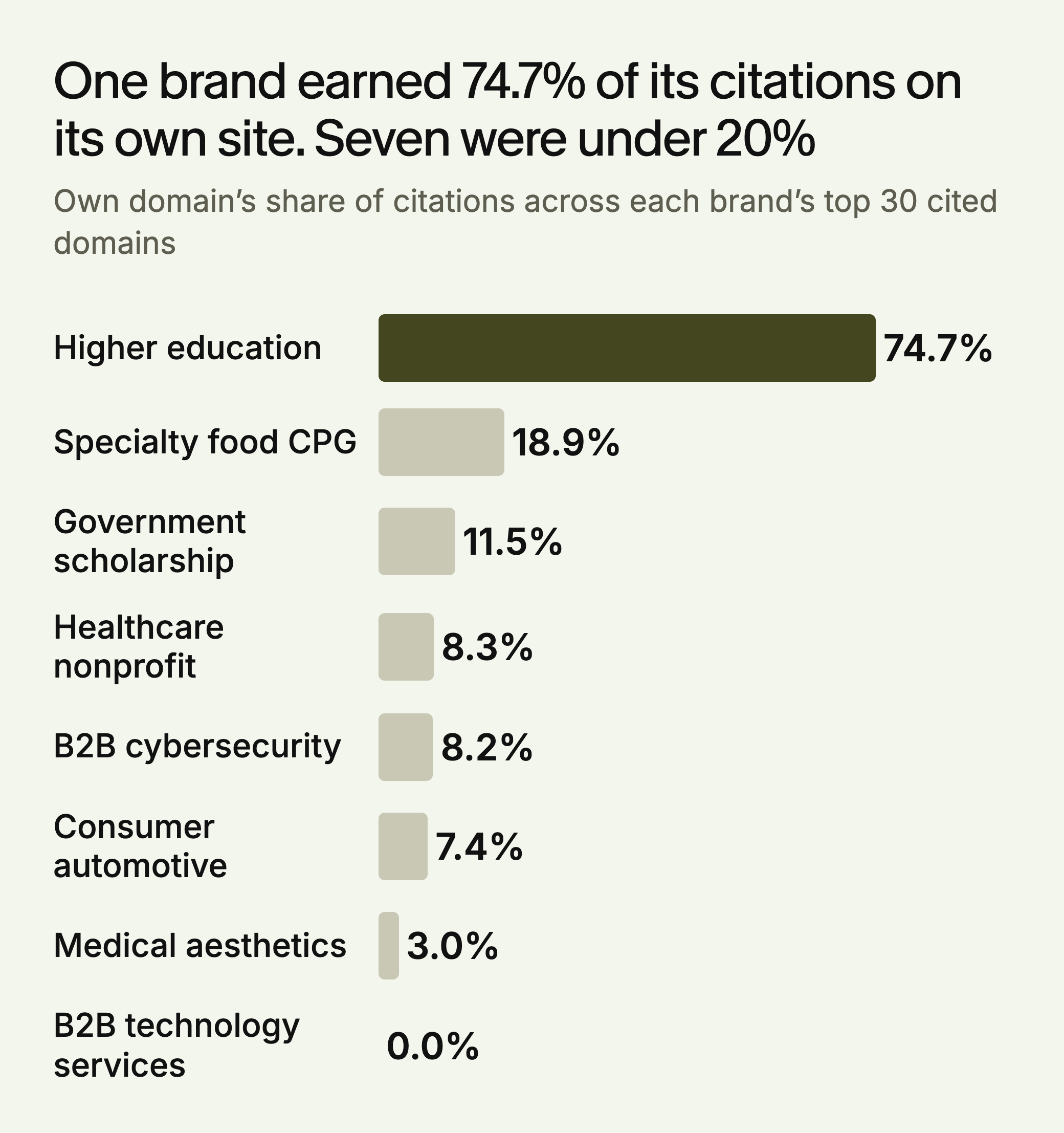
The two ends of this chart behave differently. Program pages were the top format for the higher education brand, at 53% of citations among its top-cited URLs. DeltaV’s explanation is that official pages win when queries are program-specific. The B2B technology services brand got none of its citations from its own site. Listicles on other sites earned 61% of the citations among its top-cited URLs. DeltaV notes two limits: the top 30 cut misses the long tail, and the prompt sets lean commercial.
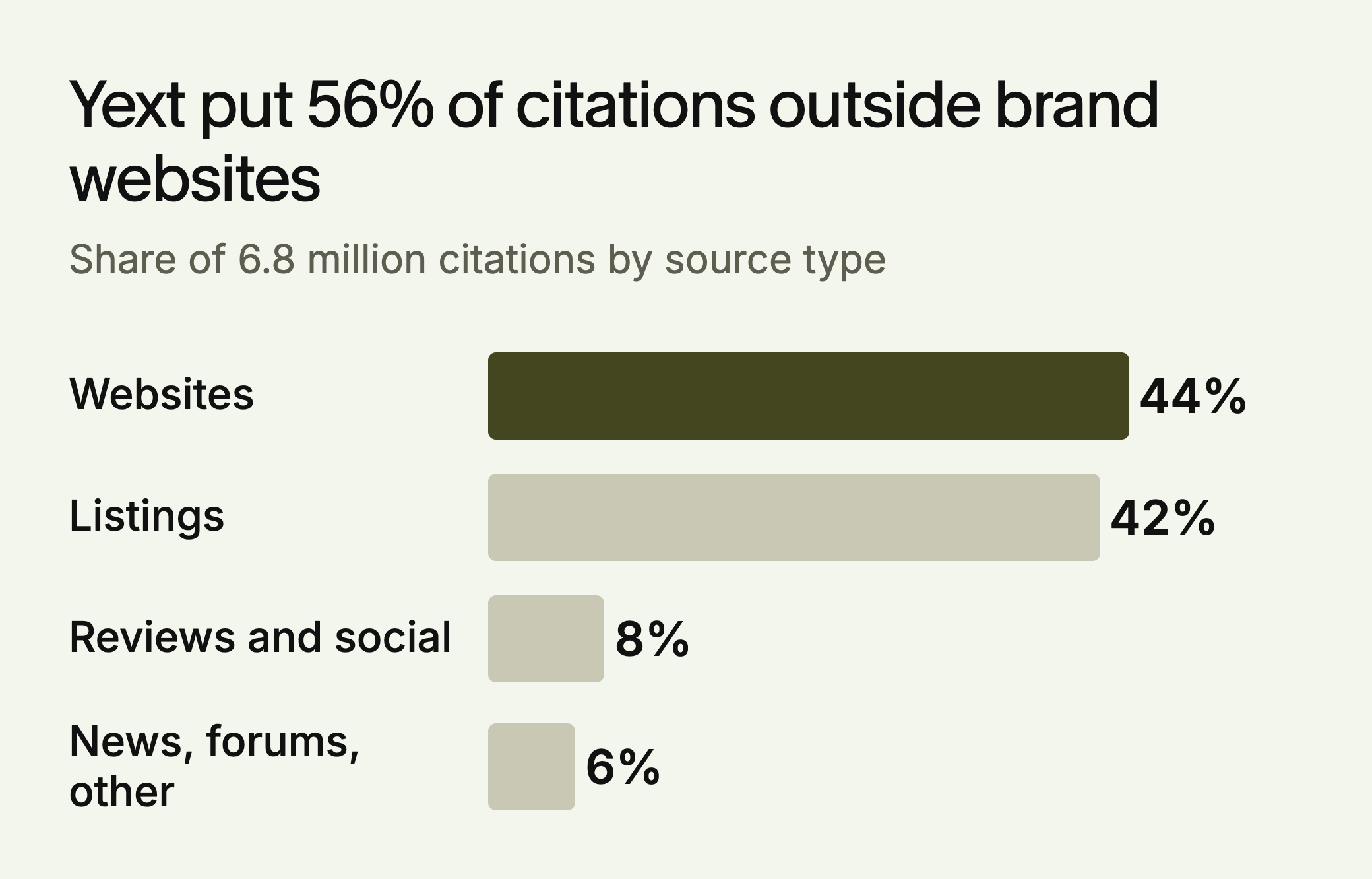
Yext’s headline of 86% “brand-managed” adds websites and listings together. That framing suits a listings vendor, but it holds a useful point: a listing is off your domain and still under your control. Yext also counts every query type, including local ones, which likely lifts listings compared with DeltaV’s commercial prompts.
1. YouTube
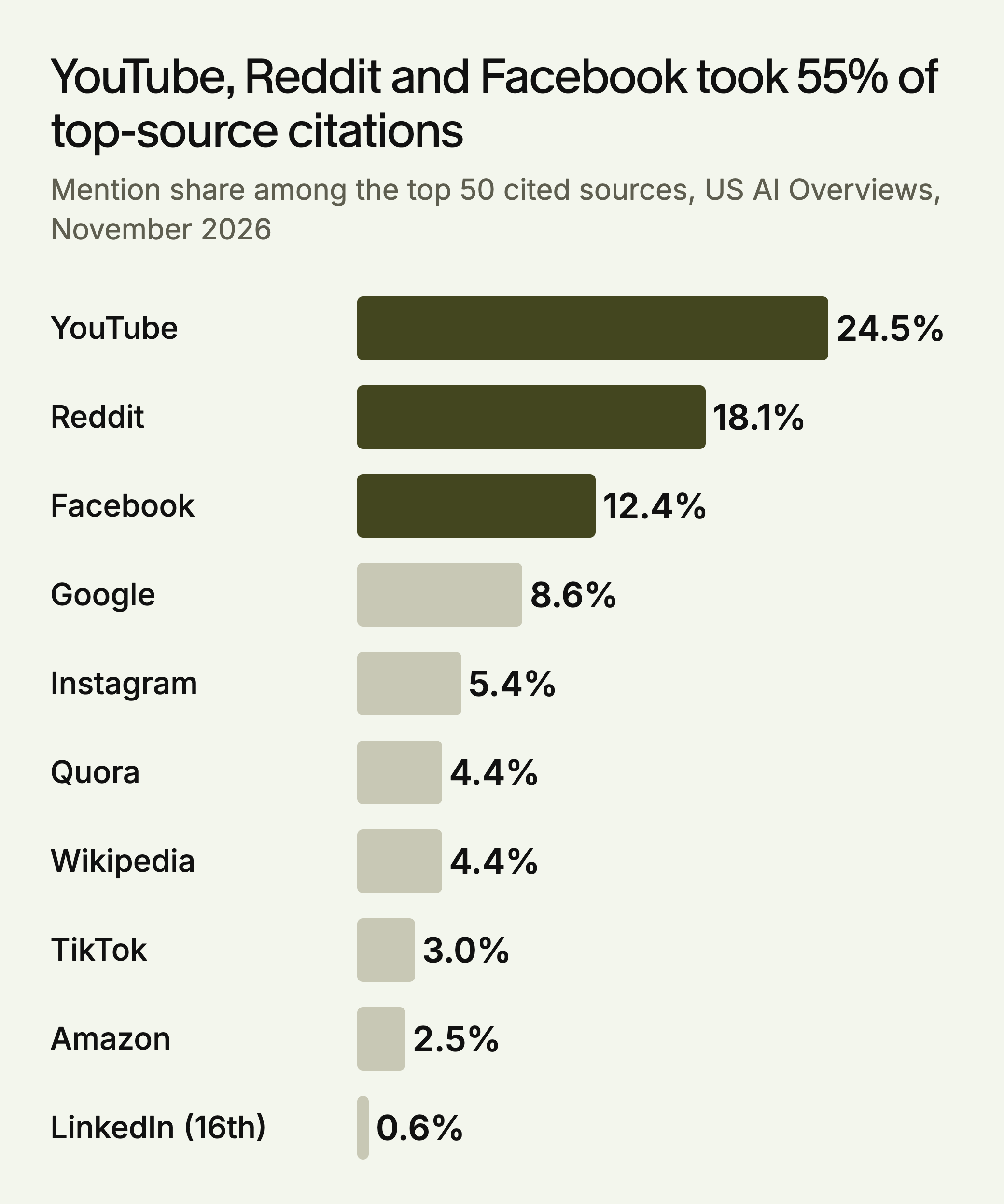
YouTube is the most-cited domain in Google AI Overviews. Ahrefs’ November 2026 ranking, built on more than 3 million US queries, gives it a 24.5% mention share, meaning its share of all citations earned by the top 50 sources. The number of answers citing it fell 11% from the month before, so expect the share to move.
The picture varies by brand. In the DeltaV study, YouTube was the most-retrieved domain for the consumer automotive brand, with a citation rate of 1.33, against 0.27 for higher education.
Other people’s videos count too. In Ahrefs’ December 2025 correlation study of 75,000 brands (vendor data), YouTube mentions had the strongest link with AI visibility, at about 0.737 across ChatGPT, AI Mode and AI Overviews. A mention meant the brand name appearing in any video’s title, transcript or description. That’s a correlation, and well-known brands get talked about on video more often, so it can’t show that one new video lifts citations.
Facebook and Instagram sit third and fifth in the chart above. They’re outside this list of six, but if you run a local or consumer brand, check whether they turn up for your prompts.
What to do this week: List the five questions buyers ask most in your category. Check who ranks on YouTube for them. Make one video per question with the question as the title, and correct the auto-captions, since captions are the text version of what you said. Then ask two or three reviewers or educators in your category to cover a specific use case, with the relationship disclosed.
2. Reddit
Reddit was among the top-cited domains for seven of DeltaV’s eight brands, and Ahrefs ranks it second in AI Overviews with an 18.1% mention share. It is also an unstable source. Ahrefs shows the number of AI Overview answers citing it down 21% in a month, and Semrush reports that Promptwatch data had Reddit’s share of ChatGPT citations falling from 3.8% to 0.5% in August 2026. Promptwatch calls that drop provisional and can’t rule out a problem in its own data collection.
This isn’t the first swing, and other trackers see the same direction. Semrush says its study of more than 230,000 prompts showed ChatGPT’s Reddit citations falling from about 60% of responses in early August 2025 to roughly 10% by mid-September. Kevin Indig attributed that drop to Google removing its “num=100” search parameter. Ahrefs’ US ChatGPT data shows Reddit going from about 1 in 5 answers in March 2026 to about 1 in 43 in September. These are different measures, so the numbers don’t line up, but each one shows how quickly this channel can lose citations.
What to do this week: Find the subreddits where buyers ask about your category. Have an employee answer questions where your product is a fair answer, with their affiliation stated, and reply to criticism directly. Don’t buy mentions or run undisclosed accounts. Treat Reddit as one channel among several, because its citation share can change in a week.
3. LinkedIn
LinkedIn looks most useful in B2B, though the evidence is one brand. It was the most-cited domain for DeltaV’s B2B technology services brand, with 736 citations. Across all US AI Overviews it is much smaller: Ahrefs ranks it 16th with a 0.6% mention share. If you sell to consumers, this one can wait.
The same B2B brand had arXiv as its third most-cited domain, so its buyers’ questions were being answered from technical and professional sources. DeltaV’s advice for B2B services firms is to move budget from blogging toward third-party placements such as “top 10” roundups, LinkedIn and community mentions. Remember that it’s an agency recommending the kind of work agencies sell, and that the evidence is one brand.
What to do this week: Have one named expert publish a LinkedIn article that answers a specific buyer question with real figures from your own work. In the Princeton GEO study, adding statistics raised visibility about 31% on its Position-Adjusted Word Count measure. That was a benchmark test, not proof for live engines or for LinkedIn, but specific numbers also make a post worth reading.
4. Wikipedia and Wikidata
Wikipedia is a smaller citation source than YouTube or Reddit: Ahrefs puts en.wikipedia.org seventh in AI Overviews with a 4.4% mention share. It’s often said that a Wikipedia page helps engines recognize a brand as an entity. We found no study that isolates that effect, so treat it as plausible and unproven.
Wikipedia can also move quickly. Ahrefs’ US ChatGPT data shows it going from 1 in 7 answers in March 2026 to 1 in 35 in September. So a Wikipedia page is a slow, rule-bound project with an uncertain payoff, and it shouldn’t be the first thing you try.
Be careful how you approach it. Wikipedia’s notability guideline asks for significant coverage in reliable sources independent of you, and sets no fixed number of sources. Its conflict of interest guideline strongly discourages editing articles about your own company. Paid editors must disclose who pays them. New articles should go through Articles for Creation.
What to do this week: Collect the independent coverage you have. If it’s thin, stop here and work on item 6. If a page exists, check it for errors and request fixes on its talk page using the edit request template. Check that your Wikidata entry has the correct website, founding date and headquarters.
5. Directories and Review Platforms
In Yext’s data, listings made up 42% of citations, and reviews and social another 8%. Remember that Yext sells listings management. The practical lesson still holds: for businesses with physical locations, structured listings are a large and fixable part of what engines can find about you.
The mix changes by industry and engine. Listings made up 52.6% of citations in Yext’s healthcare data and 41.6% in food service, where reviews and social reached 13.3%, the highest of any industry. Retail and finance leaned on brand websites, at 47.6% and 48.2%. Yext describes engine tendencies without percentages: Gemini favors first-party websites, OpenAI relies heavily on third-party listings, and Perplexity spreads citations across review platforms and local pages.
We found no study measuring how review count or recency changes citations, so we won’t give you a target number.
What to do this week: Run your top category prompts through ChatGPT, Perplexity and Google, and note which directories they cite. Complete those profiles first. Describe your product in the words buyers use, correct old details, and ask recent customers for reviews in a way each platform’s rules allow.
6. News and Trade Publications
Press has the thinnest direct evidence here. News, forums and other sources together were only 6% of citations in Yext’s data. The stronger argument is about mentions. Ahrefs’ May 2025 study of 75,000 brands found branded web mentions correlated with AI Overview brand visibility at 0.664, against 0.218 for backlinks. That’s a correlation in a sample of higher-authority domains. It doesn’t prove that coverage causes citations, because famous brands get both.
DeltaV gives a more practical signal. Editorial domains earned 1.43 citations per retrieval, the highest of any site type a brand doesn’t own. Across its top-cited URLs, listicles took 19.6% of citations and articles 23.7%. Comparison pages had the highest rate of any format, at 1.87 against an average of 1.29.
Publisher size doesn’t guarantee use in trust-sensitive topics. In DeltaV’s healthcare data, the CDC, Mayo Clinic and NIH earned 1.85, 1.79 and 1.66 citations per retrieval, against 0.55 for Healthline, 0.33 for WebMD and 0.24 for Medical News Today. If you work in health or finance, aim for institutional sources and named experts, not only high-traffic publishers.
What to do this week: Pick three trade publications your buyers read. Pitch each one a specific finding from your own data, with your brand tied to the capability you want to be known for. Bylined articles and original data give a publication something to cite. Generic announcements rarely do.
Which Channels to Start With
You won’t do all six at once. This table turns the study findings into a starting point by type of business. The last two columns are our judgment, and each DeltaV row is one brand, so test them against your own prompts.
| Business | What the data showed | Start with | Can wait |
|---|---|---|---|
| B2B technology services | 0% own-domain share, LinkedIn first, listicles 61% | LinkedIn, trade roundups | YouTube, Wikipedia |
| B2B security or compliance | 8.2% own-domain share, articles 38%, how-to guides 13% | Trade publications, expert bylines | Consumer review sites |
| Local services | 3.0% own-domain share, homepages 55% | A complete homepage, listings, reviews | LinkedIn, Wikipedia |
| Consumer products | 7.4% own-domain share for automotive, YouTube rate 1.33, articles and listicles 64% | YouTube, roundups, Reddit | |
| Healthcare | Institutions cited far more per retrieval than publishers, listings 52.6% in Yext | Listings, institutional partners | Reddit, which wasn’t a top domain for the healthcare nonprofit |
| Higher education | 74.7% own-domain share, program pages 53% | Your own program pages | Third-party roundups |
A Worked Example: From Prompts to a Work Plan
The company and figures below are made up for illustration. Corvane sells expense software to mid-size finance teams. It ran 40 buyer prompts on three engines, three times each, which gave 360 answers. It then listed the sources cited most often and checked each one.
| Source | Answers citing it | Is Corvane there? | Next step |
|---|---|---|---|
| Software review directory | 96 | Yes, but the profile is two years old | Update the profile this week |
| Finance subreddit | 61 | Two old threads, one critical | An employee answers in the open, with affiliation stated |
| “Best expense tools” roundup | 48 | No | Pitch the editor with customer data |
| Trade newsletter | 27 | No | Offer a bylined article with original figures |
| Competitor’s comparison page | 22 | Described inaccurately | Publish an honest comparison on your own site |
Corvane starts with the directory because it’s the most-cited source and the fix is entirely in its hands. The roundup comes next: it’s cited less than Reddit, but one placement there could change many answers. After 60 days, Corvane reruns the same 360 answers and compares two numbers: the share of answers naming it, and the share of answers citing a page where it appears.
How to Measure Your Third-Party Coverage
Write 50 to 100 prompts your buyers would really ask. Run them on a schedule on each engine, and record whether you’re named and which domains are cited. Track each engine separately. Writesonic’s study of 161,286 prompts (May and June 2026, vendor data) found ChatGPT and Perplexity shared only about 13% of cited domains on a Jaccard overlap measure.
Writesonic’s closest pair was Perplexity and AI Overviews, at 0.237. The furthest was ChatGPT and Gemini, at 0.119. It also found that 72 to 73% of cited domains appeared on exactly one engine and 3.8% on all four, so a single blended list of sources will mislead you.
Run each prompt several times before you trust a result. In a SparkToro study of 2,961 runs from 600 volunteers, there was less than a 1 in 100 chance that ChatGPT or Google’s AI would give the same list of brands twice.
Track four numbers per engine each month: the share of answers naming you, the share citing a page you own, the share citing a third-party page that mentions you, and how accurate those pages are. The third number is the one this whole channel plan is meant to move.
The list of cited domains is your work plan. If a competitor shows up through a directory or subreddit you’ve ignored, start there.
LLMagnet measures AI visibility across seven engines, and its agent prepares fixes for you to approve. To see where you stand first, run the free audit at ai-visibility.llmagnet.com.
Common Mistakes
- Using a global top-domain list as your plan. LinkedIn is 16th across US AI Overviews and was first for a B2B brand. The overall ranking covers all topics, so your own prompts matter more.
- Calling a channel dead after one bad month. Reddit’s numbers have swung sharply more than once, and part of that movement may be collection problems or changes in how queries are written. Wait for two or three readings.
- Counting appearances and ignoring what they say. A citation to a page that describes you wrongly can do harm. Read the page.
- Buying shortcuts. Undisclosed paid editing breaks Wikipedia’s rules, and a removed page or post takes its citation with it.
- Spending evenly across six channels. Pick the two where your buyers’ prompts already send engines, and finish them first.
Your Own Site Still Counts
None of this makes your website optional. It was 74.7% of citations for DeltaV’s higher education brand and 44% in Yext’s data. Google says AI features need no special markup or files: the page just has to be indexed and eligible for a snippet.
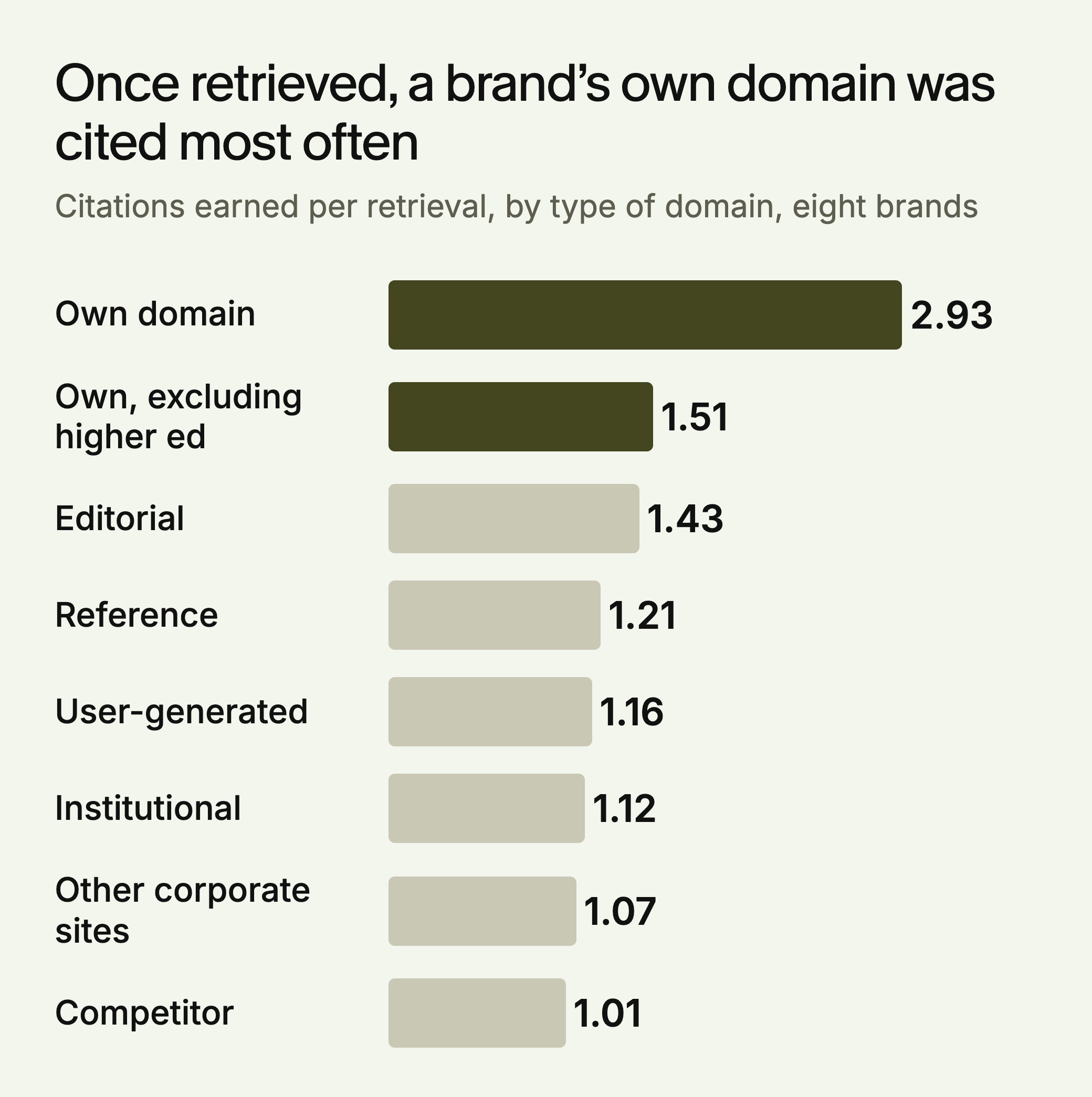
The chart shows why off-site work and your own pages are separate jobs. A brand’s own domain gets used well once it’s retrieved, at 2.93 citations per retrieval, or 1.51 without the higher education outlier. Our reading is that third-party coverage helps you get found in the first place, and that your own pages win when they contain what the engine went looking for. Comparison pages are a good first build, in our view: one comparison page for a cybersecurity brand earned 4.09 citations per retrieval, more than double the 1.87 average for that format. That’s one page, and the format earned only 4.1% of citation share.
Don’t expect shortcuts on-site. SE Ranking’s study of about 300,000 domains found no measurable link between llms.txt and citations. It didn’t test agents, and the file may still give them a useful map. Schema evidence is mixed: in Ahrefs’ controlled test of 1,885 pages that added JSON-LD, citations didn’t rise overall, though those pages were already heavily cited. Fix what’s wrong on your site, then put the next hour into the channels above.



 Gemini



 30-day free trial · no credit card