

 Perplexity
Named people earned most LinkedIn citations in AI answers, and long-form articles earned more per URL than posts in OtterlyAI’s 2026 study, but the per-URL gaps are only about 1.4 to 1.5 times and other data disagrees on format. Publish under named experts, test both articles and posts, and check what engines cite for your own prompts. In OtterlyAI’s vendor data, LinkedIn was 11.7% of social media citations in AI search in May 2026, up from 7.8% in January.
OtterlyAI, which sells AI visibility tracking, analyzed 1,310,455 citations of 161,440 unique LinkedIn content URLs across ChatGPT, Google AI Overviews, Google AI Mode, Perplexity, Microsoft Copilot and Gemini, from January 1 to June 1, 2026. The dataset contains only URLs that were already cited. It can show which cited pages were cited again, but not what makes a page eligible in the first place, and OtterlyAI notes that its correlations don’t prove cause.
Contents
- Articles vs. Posts: The Gap in OtterlyAI’s Data
- Other Studies Disagree on Format
- What Cited Articles Have in Common
- A Worked Example: One Buyer Question
- Named Authors vs. Company Pages
- Likes and Comments Did Not Track Citations
- Which Engines Cite LinkedIn
- Citations Concentrate in a Few URLs
- When LinkedIn Is Worth the Time
- Common Mistakes
- What to Publish This Month
- FAQ
Articles vs. Posts: The Gap in OtterlyAI’s Data
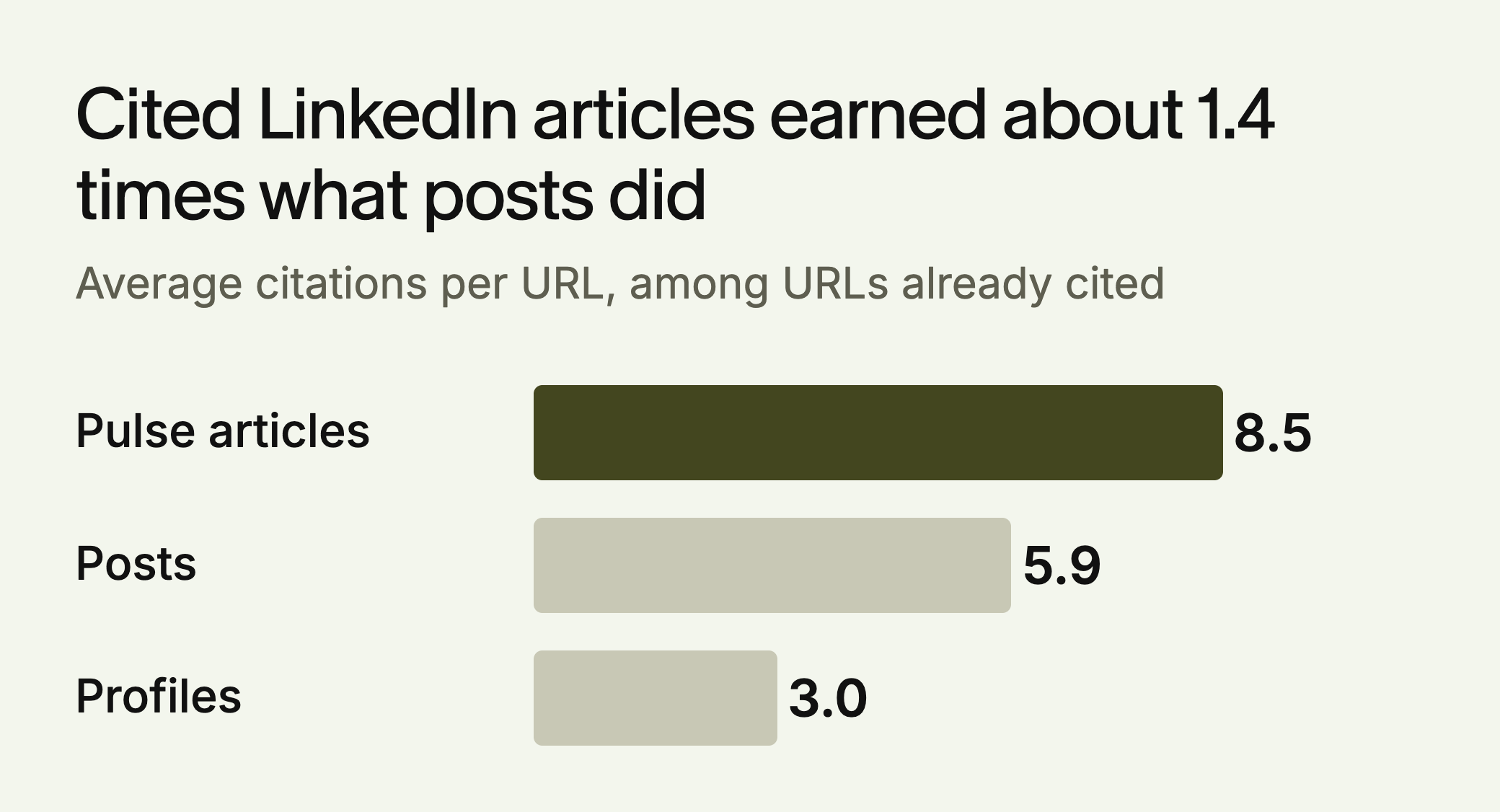
Pulse articles, LinkedIn’s long-form format, made up 63.0% of cited URLs and 72.2% of citations. A cited article averaged 8.5 citations, against 5.9 for a post and 3.0 for a profile. That makes an article worth about 1.4 times a post in this dataset, among pages that were cited at all.
Articles led on every engine with a usable sample: 90.2% of Copilot’s LinkedIn citations, 73.8% of ChatGPT’s, 72.1% of AI Overviews’, 71.3% of AI Mode’s and 70.1% of Perplexity’s.
Length alone doesn’t explain it. Cited articles had a median of 1,021 words and cited posts 185, but word count and citations correlated at only r = 0.03 across all content. OtterlyAI credits structure and crawl access (Pulse articles are public by default), which its data can’t isolate. Don’t pad an article to reach a word count.
Other Studies Disagree on Format
Two other datasets point elsewhere, so treat OtterlyAI’s split as true of its period and prompts.
- Meltwater (vendor data, published May 2026, 9.5 million citations from B2B prompts, 0.53% of them LinkedIn) found text posts were 72% of cited LinkedIn content, articles 12% and video 11%.
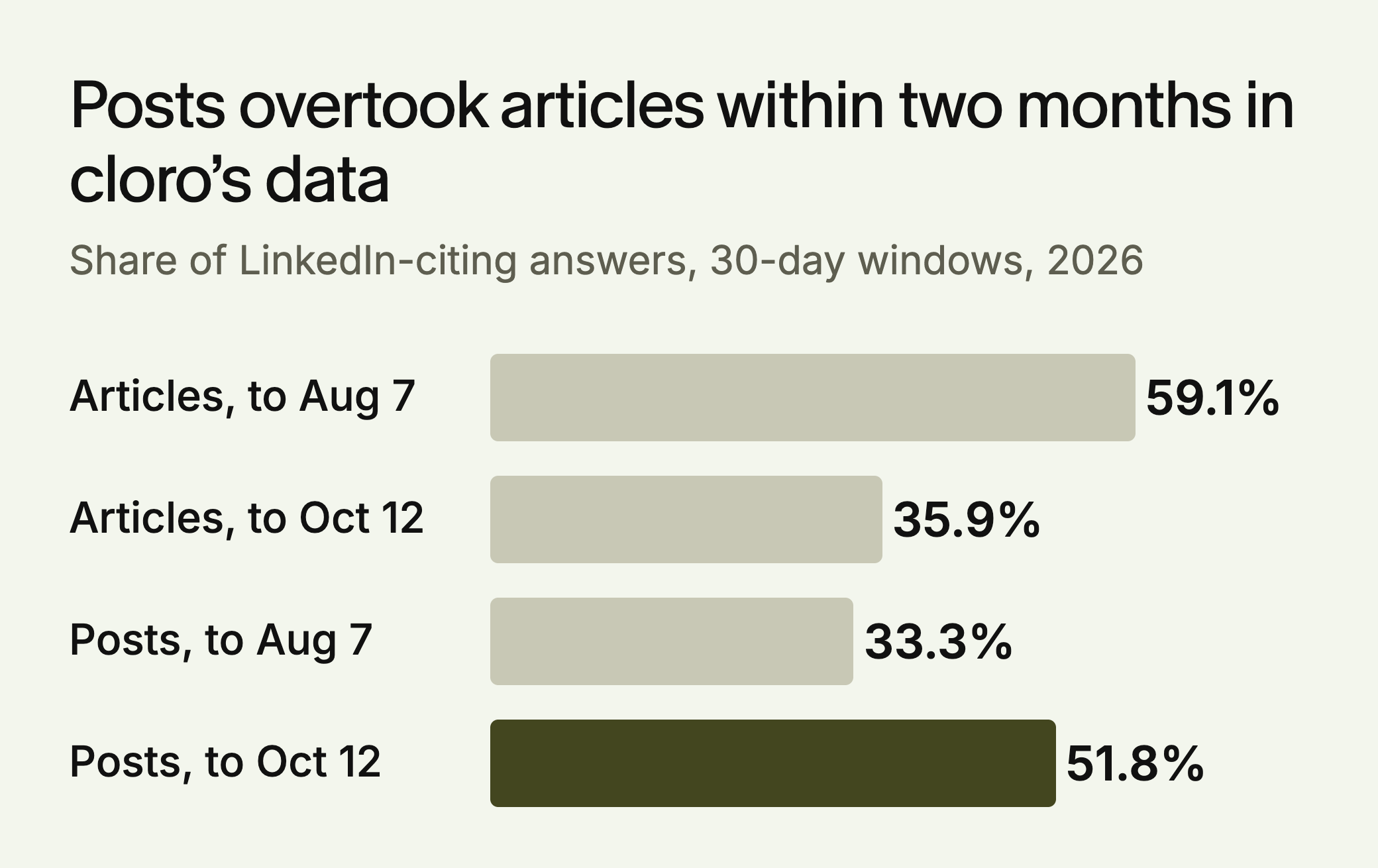
- cloro (vendor data) found articles in 59.1% of LinkedIn-citing answers and posts in 33.3% in the 30 days to August 7, 2026. In the 30 days to October 12, posts led at 51.8% and articles fell to 35.9%.
These studies differ in engines, prompts, dates and unit. OtterlyAI counts citations, Meltwater cited content, and cloro the share of answers containing a page type. cloro’s prompts lean toward retail, travel, consumer goods and software, and it says a B2B set would likely place LinkedIn higher.
Engine mix matters too. In cloro’s October window, ChatGPT cited feed posts in 1.12% of answers and articles in 0.28%, the opposite of OtterlyAI’s 73.8% article share on ChatGPT. Copilot is where the two agree: 212 of its 232 LinkedIn-citing answers cited an article, in line with OtterlyAI’s 90.2%. Microsoft owns both products, though cloro says it can’t confirm that explains the pattern. If Copilot matters to your buyers, favor articles. On ChatGPT the data conflicts, so test both.
LinkedIn’s overall share may also be moving. On 116 prompts tracked for six months, cloro saw LinkedIn fall from 13.80% of answers in February 2026 to 4.83% in July. That is one vendor’s prompt set, but it is reason enough not to plan around a single month’s figure.
What Cited Articles Have in Common
Meltwater read the 24 most-cited LinkedIn articles in its data. All of them used bullets or numbered items, 92% had clear H2 or H3 headings, 75% named specific companies or tools, 67% included hard numbers and 50% had a comparison or evaluation framework. Separately, “Best X” listicles appeared in 54% of top-cited content, against 8% for thought leadership with data.
That’s 24 articles and no comparison group, so it can’t show these traits cause citation. It does describe what the winners look like: reference pages that name options and compare them.
Meltwater also found 51% of cited creators had fewer than 10,000 followers, so a small expert account can compete. And 48% of cited content was under three months old, against 12% over a year old, so plan to keep publishing.
A Worked Example: One Buyer Question
The company, person and details below are made up for illustration.
| Weak | Stronger |
|---|---|
| Title: “Why finance leaders must rethink contractor payments.” Opens with a founder’s story and five lessons. Names no tools and gives no numbers. Published from the company page. | Title: “How to choose contractor payroll software for a team under 100.” Opens: “Choose on three things: country coverage, payout currency and who holds the tax forms.” Compares six named tools in a table, with prices checked in October 2026. Written by Ines Duarte, payroll lead at Quillon, who says Quillon is one of the six. |
The stronger version answers the question in its first sentence, names the alternatives, gives criteria a reader can apply and discloses the author’s stake. A short text post can then make the single most useful point and link to the article, which gives you both formats on the same prompts.
Named Authors vs. Company Pages
In OtterlyAI’s data, named individuals accounted for 87.8% of cited URLs and 91.7% of citations, averaging 8.5 citations per URL. Company pages and unattributed content accounted for 12.2% of URLs and 8.3% of citations, averaging 5.5. That is about 1.5 times the citations per URL. Author type was inferred from names, and OtterlyAI calls the result directional.
Meltwater points the same way, with about 75% of LinkedIn citations from individual members and 25% from Company Pages. Most cited LinkedIn content comes from people, so a plan that runs only through the company page covers the smaller share. Neither study shows why, or that moving a post from a company page to a person would raise its citations.
OtterlyAI didn’t report job title or seniority. Meltwater advises giving topics to people with hands-on experience rather than relying only on seniority. That’s advice, not a finding.
Likes and Comments Did Not Track Citations
Among cited articles and posts, engagement had almost no relationship with citation counts. OtterlyAI reports a Pearson correlation of -0.06 for likes, -0.04 for comments and -0.02 for both emojis and hashtags.
Content with video averaged 5.85 citations against 7.87 without, and content with an image 7.14 against 8.23 without. OtterlyAI attributes part of that gap to articles, which are often text-led and make up more of the no-media groups, so this is no reason to strip images out.
Among content that gets cited, engagement doesn’t separate high from low. It doesn’t show that engagement has no effect on whether a post is found at all.
Which Engines Cite LinkedIn
OtterlyAI’s share of LinkedIn citations by engine:
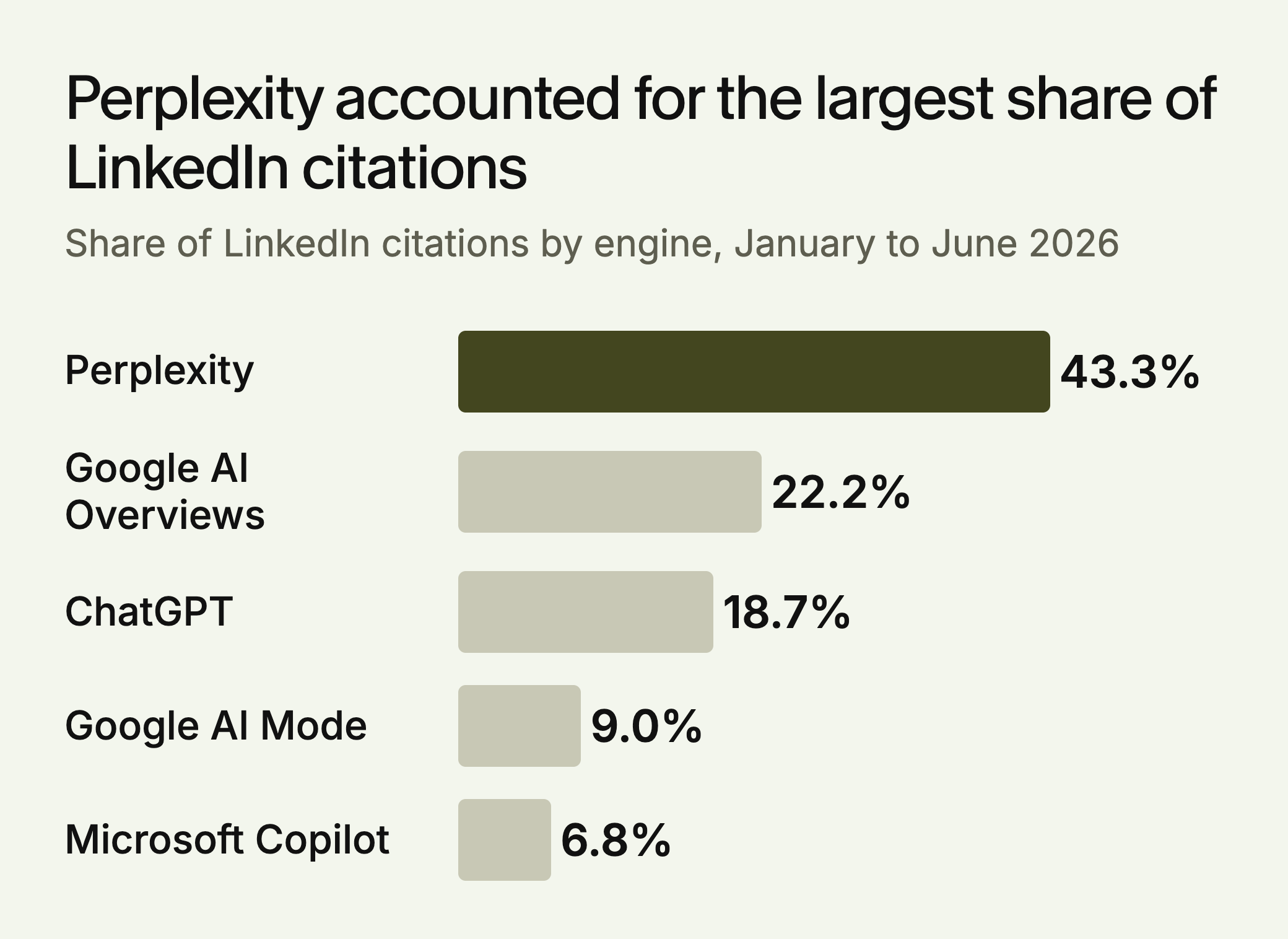
OtterlyAI calls Gemini a non-factor, with 38 citations in total.
Most URLs reached only one engine: 87.4% of cited URLs appeared on a single platform. The 2.6% cited on three or more platforms took 24.0% of all citations. Check each engine separately, because being cited on Perplexity says little about ChatGPT.
The order can change quickly. In cloro’s prompt set, Google AI Mode cited LinkedIn in 6.20% of answers in the August window and 1.96% in October, while Perplexity went from 2.29% to 3.91%. cloro notes AI Mode cut its sources per answer in late August, which lowers every domain’s share. Re-check your engines before you commit a quarter to one of them.
Citations Concentrate in a Few URLs
The top 1% of URLs took 30.2% of citations and the top 10% took 66.8%. The median cited URL was cited twice. Our reading: since most cited pieces earn very little, a few well-sourced pieces on questions buyers actually ask are a better bet than a daily posting schedule.
Meltwater recommends two to three posts a week per expert, which pulls the other way. Neither study tested frequency, so let your own results decide.
When LinkedIn Is Worth the Time
Category changes how much LinkedIn matters. Meltwater ranked LinkedIn among the top five cited domains in 14 B2B categories: first in AI and data science and in marketing and advertising, second in sales and in financial services, fifth in energy and sustainability. cloro’s consumer-leaning prompts put linkedin.com 14th, at 1.61% of answers in the 30 days to August 7.
| Your situation | What to do |
|---|---|
| B2B, with buyers who research vendors and roles | Run the test below. LinkedIn is a likely source for your prompts. |
| Consumer retail, travel or local | Run your prompts first, and continue only if LinkedIn URLs appear. |
| No expert willing to write | Interview one and publish under their name with their approval. Don’t default to the company page. |
Common Mistakes
Comparing formats on different prompts. An article that wins one question and a post that loses another tell you about the questions. Compare both on the same prompts, engines and dates.
Counting every LinkedIn URL as content. OtterlyAI excluded job posts, company pages and advice pages, 21% of its LinkedIn total, from its analysis. If your audit includes them, you’ll overstate what your publishing earned.
What to Publish This Month
These steps are our judgment from the data above, not findings from a study.
- Pick three buyer questions and run them in the engines you care about. Note every LinkedIn URL cited, and whether it is an article or a post.
- Give each question to a named expert with a complete profile, not the company page.
- Publish one article of about 1,000 words per question. Answer in the first paragraph, use subheadings, and include at least one sourced figure.
- Publish a short text post making the same point, so you can compare the two formats on your own prompts.
- Re-run the prompts after 30 days and keep the format that shows up.
Call a format the winner only if it appears on more of your prompts in two re-runs a few weeks apart. OtterlyAI’s median cited URL was cited twice, so one appearance proves little.
LLMagnet measures AI visibility across seven engines and has an agent that prepares fixes for approval, which helps if you want this check on a schedule. You can start with the free AI visibility audit.





 Gemini


 30-day free trial · no credit card