

The median enterprise B2B brand is cited in 3% of the AI Overviews relevant to it, according to Walker Sands’ 2026 benchmark. The likely fixes are plain ones: answer buyer questions directly, publish your best data outside the form, and make sure Google and AI search crawlers can reach it.
Walker Sands is a marketing agency that sells this kind of work, so treat the benchmark as vendor data. It covers 828 enterprise B2B companies in 14 technology industries and more than 45 million keywords. AI Overviews appeared on nearly half of the results pages where these brands ranked: the median company ranked for about 9,700 keywords, and about 4,500 of those triggered an AI Overview. Only 4.6% of the companies were never cited, so most are present somewhere, just rarely.
Walker Sands’ post doesn’t detail its methodology, and it calls the 3% both a “median” and an “average”. Read it as a rough baseline. It also reports no conversion or revenue data, which matters for the section on value below.
Contents
- B2B Buyers Already Use AI, Even If Your Analytics Don’t Show It
- Check How Much AI Overviews Touch Your Category
- Three Likely Reasons B2B Brands Are Rarely Cited
- What the Value Data Does and Doesn’t Show
- A Worked Example: Sizing the Opportunity
- Content Formats to Start With
- How to Audit Your Current AI Overview Presence
- Five Fixes to Start This Month
- Mistakes to Avoid
- Where to Start
- FAQ
B2B Buyers Already Use AI, Even If Your Analytics Don’t Show It
Forrester’s Buyers’ Journey Survey of nearly 18,000 global business buyers found that 94% report using AI during their buying process. That covers AI use in general, not only AI search, and Forrester also reports that buyers don’t fully trust what these tools tell them.
Analytics will undercount this. A buyer who reads an AI answer and then types your name into a browser shows up as direct traffic, or as a branded search. Treat your AI referral numbers as a minimum.
Check How Much AI Overviews Touch Your Category
The 3% hides a wide spread. Walker Sands found AI Overviews on nearly 60% of keywords in cybersecurity and below 30% in distribution and logistics. Ranking alone doesn’t get you there: some companies rank for tens of thousands of keywords and are rarely cited.
Measure your own exposure before you set a budget. Take 50 non-branded keywords and count how many show an AI Overview. Our rule of thumb: near half, treat AI Overviews as a main channel. Well below 30%, put the first effort into ChatGPT and Perplexity. If you’re a small company with a few hundred keywords, ignore the percentage and work from buyer questions, since 3% of 200 keywords is about six queries.
Three Likely Reasons B2B Brands Are Rarely Cited
The benchmark measures how often brands are cited, not why. It links citation with topical authority, clear structured explanations and consistent coverage across related pages. These three causes are what we’d check first.
1. Content written for awareness, not answers. Thought leadership and brand stories rarely answer a specific question. A buyer asks how a category of software handles a specific use case. If no page on your site answers that in plain terms, there’s nothing to cite.
2. Gated content. Crawlers can’t fill in forms. Your white papers and benchmark reports may be your most citable material, and they’re the pages nobody can read without a form. You don’t need to remove every gate. Publish the key findings in open HTML.
3. Crawler access rules. The right rule depends on the product. AI Overviews draw on Google Search, so Googlebot has to be able to reach the page. Google says Google-Extended doesn’t affect inclusion or ranking in Google Search, so changing it won’t fix an AI Overview problem. For ChatGPT search, OpenAI says the crawler that matters is OAI-SearchBot.
What the Value Data Does and Doesn’t Show
It’s tempting to combine two figures into a claim that B2B brands cited in AI Overviews convert 23x better. No study we found shows that. They measure different things.
The 23x figure is one company’s site. Ahrefs reported in June 2025 that AI search made up 0.5% of its visits over 30 days and 12.1% of its signups, a conversion rate 23x that of traditional organic search. Most of those signups came from ChatGPT, not AI Overviews. The author says he’s not sure the advantage would scale and expects it wouldn’t stay that high.
The same post estimates that people using AI search click links about 75% less than people using traditional search. A high conversion rate can sit on top of very few visits.
The click lift is a correlation. Seer Interactive’s study of 42 client organizations found that in Q3 2025, on informational queries with AI Overviews, brands cited in the Overview had a 35% higher organic CTR (0.70% against 0.52%) and a 91% higher paid CTR (7.89% against 4.14%). Seer says this doesn’t prove citation causes the lift, since stronger brands may simply be more likely to be cited. Another section of Seer’s post lists 1.2% and 11.05% for cited queries with no period given, so we use the figures it labels Q3.
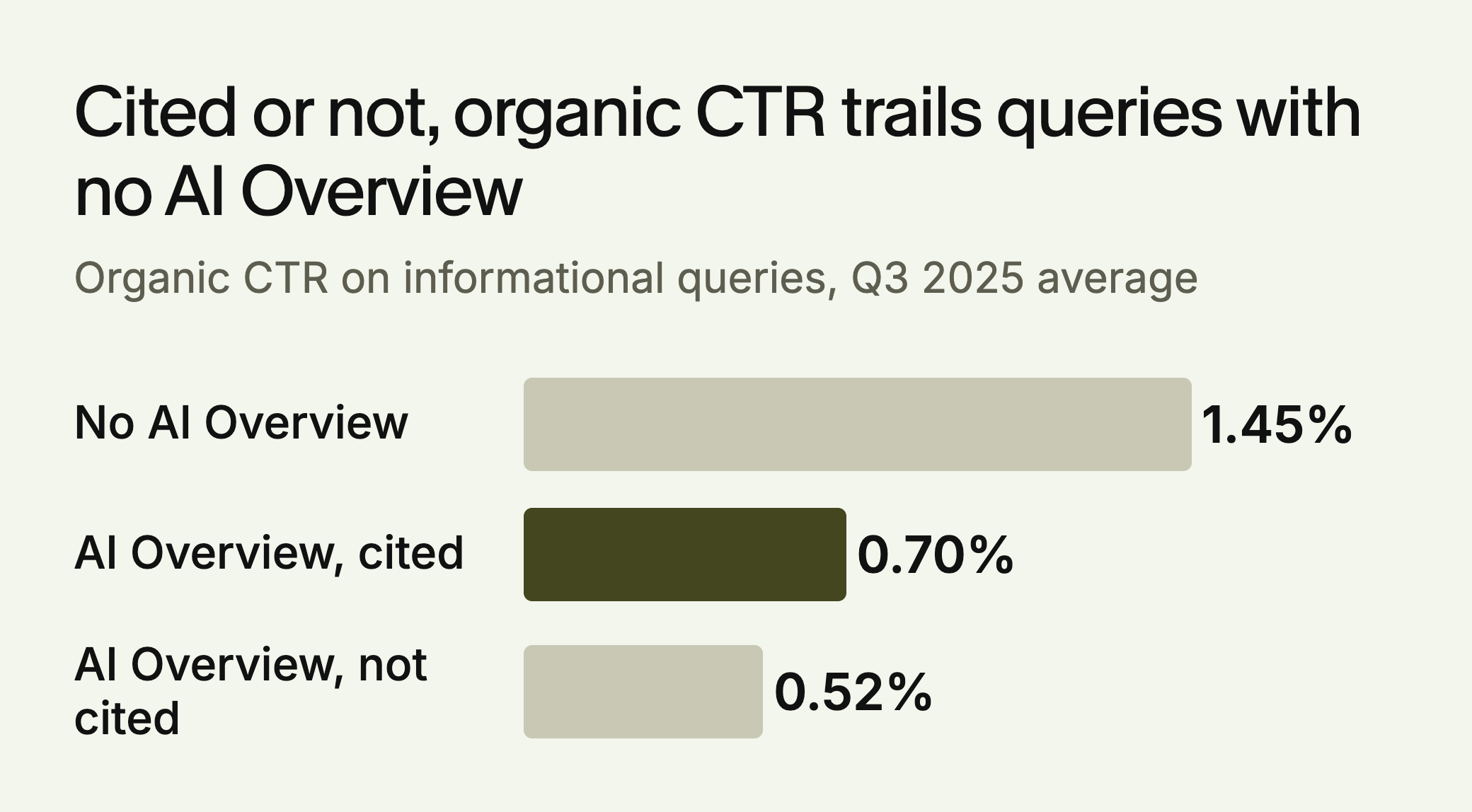
Queries with no AI Overview had a 1.45% organic CTR in the same period, about twice the cited rate. These are different queries, grouped by whether they showed an Overview in September 2025, so this isn’t a causal comparison. Seer also warns that its paid sample is much smaller, at 1.1 million impressions against 25.1 million organic.
The same study found organic CTR on those queries fell from 1.76% to 0.61% between June 2024 and September 2025. So being cited looks more like losing less than like a windfall. Measure your own conversion rate from AI referrers before you build a budget on anyone else’s number.
A Worked Example: Sizing the Opportunity
The company and figures below are made up for illustration. Ardmoor, a 60-person compliance software vendor, pulled 90 days of data from its analytics and CRM.
| Channel | Sessions | Demo requests | Rate |
|---|---|---|---|
| Organic search | 48,000 | 288 | 0.6% |
| AI referrers | 900 | 18 | 2.0% |
AI referrers convert at more than three times the organic rate, but they produced 18 demos against 288. The rate alone suggests moving budget. The volume suggests a small test. Ardmoor then added “How did you hear about us?” to its demo form and found 31 more buyers naming ChatGPT or Perplexity, whom analytics had logged as direct. Its working range for AI search became 18 to 49 demos a quarter.
Content Formats to Start With
Walker Sands’ post doesn’t break results down by format, and we haven’t found solid B2B data that does. This order is our judgment, based on the questions buyers ask at each stage.
Comparisons and alternatives. Buyers ask for these directly. Cover specific differences, public pricing and which product suits which use case.
Category definitions. When a buyer asks what a category is, a clear and current definition has a chance of being used.
Original data. A benchmark published in open HTML gives other people a reason to quote you, and gives AI systems something that exists nowhere else.
Implementation detail. Late-stage buyers want real timelines, required resources and integration steps.
How to Audit Your Current AI Overview Presence
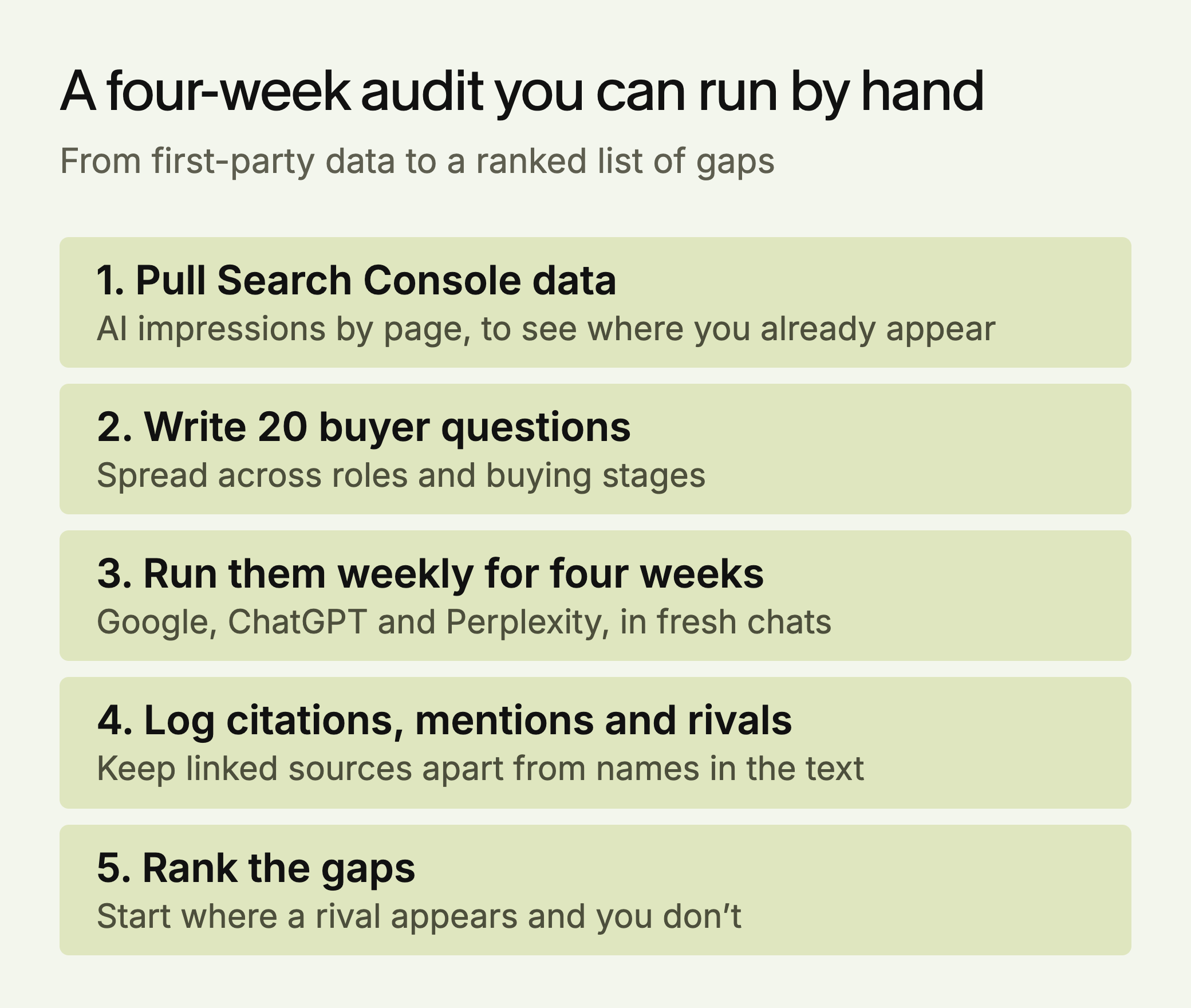
Start with Google’s own data. Search Console’s generative AI report now shows impressions in AI features by page, country, date and device. It doesn’t show clicks or queries, so pair it with a manual check.
List the 20 questions a buyer would ask during vendor evaluation, and split them by role. Forrester reports that 13 internal stakeholders and nine external participants influence the average purchase, and a CFO won’t ask what a security lead asks. Run each through Google, ChatGPT and Perplexity, once a week for four weeks, since answers vary from run to run. For each query, record:
- Citation rate: how often your site appears as a source
- Mention rate: how often your brand is named in the answer text, which is not the same as being linked
- Platform spread: whether you appear on one engine or several
- Competitors: who appears instead of you, and how they’re described
Five Fixes to Start This Month
These are sensible first moves, not proven levers. No study we’ve found shows a set lift from any of them.
1. Check crawler access. Confirm Googlebot can reach your key pages and that robots.txt doesn’t block OAI-SearchBot, PerplexityBot or ClaudeBot, unless you mean to block them. Check CDN and firewall rules too.
2. Open up your best research. Take your three most-downloaded gated assets and publish an HTML summary of each, with the question, the method and sample, the top five findings with their numbers, and one chart. A summary that teases findings without stating them gives an engine nothing to quote. Keep the form on the full report, the data tables or the workbook.
3. Build comparison pages for your top three matchups. Use one heading per comparison point and specific numbers you can back up. Review them every quarter.
4. Make the answer readable as plain text. Google’s guide recommends content “organized by paragraphs and sections”. It also says there’s no special schema you need to add for generative AI search, so don’t spend this week on markup. Schema can still help with rich results.
5. Rewrite your category definition page. Update the facts and say how the category differs from its neighbors. Add your own point of view, since Google notes that a distinct perspective can help.
Mistakes to Avoid
- Treating 3% as a target. It’s a median across 14 industries, so it may be high or low for yours.
- Writing comparison pages that never concede anything. A buyer asking which product suits a use case wants a real answer, and a page that always picks you doesn’t give one.
- Mass-producing pages for query variants. Google’s guide warns this can breach its scaled content abuse policy.
- Changing everything at once. Ship the fixes on separate sets of pages, or you won’t know which one moved the number.
Where to Start
A 3% median leaves room to improve, but no one has shown what closing that gap is worth to a B2B company. Run the audit, make the fixes, and track three things every month: citation rate on your 20 questions, AI impressions by page in Search Console, and demo requests by referrer and by what buyers say on the form.
To see how your brand appears across AI engines, try the free LLMagnet audit. LLMagnet measures AI visibility across seven engines, and its agent prepares fixes for you to approve.







 30-day free trial · no credit card