


ChatGPT showed an ad on 25.94% of 50,006 US commercial prompts in SE Ranking’s July 2026 study, in a sponsored card below the answer and not inside it. So ads aren’t taking citation slots today, and buying one doesn’t appear to earn you a citation: the advertiser’s domain was among the cited sources in only 3.63% of placements.
Contents
- What the 26% Measures
- What Ads Change for Organic Citations
- Who Is Buying, and Whether to Test
- What the Evidence Says About Organic Citations
- Engines Cite Different Sources
- What to Do This Quarter
- How to Measure Your Footprint
What the 26% Measures
SE Ranking is a vendor, and this is one snapshot: prompts collected on July 23, 2026, across 20 niches, all commercial, in the US. ChatGPT ads appear only to Free and Go users. On the same study design, Google’s AI Mode showed ads on 29.45% of prompts.
Other trackers get very different numbers because they sample differently. Cloro found ads in 51.0% of US responses in the week ending July 3, 2026, on a prompt set it says leans toward commercial queries, and 12.2% across all countries. Treat 26% as one study’s rate and not as a platform figure.
| Detail | SE Ranking | Cloro |
|---|---|---|
| Sample | 50,006 commercial prompts, about 2,500 in each of 20 US niches | 15,304 responses from its own monitoring data, across countries |
| Prompt mix | Commercial by design | Skews to brand, comparison, recommendation and B2B software queries |
| Date | One day, July 23, 2026 | Seven days ending July 3, 2026 |
| Result | 25.94% | 51.0% US, 53.6% Canada, 49.8% Australia, 18.8% Japan, 3.6% Netherlands |
Timing matters as much as the sample, because the rate was moving fast. Cloro’s overall rate went from 0.7% in the week of June 10 to about 19% in the first days of July. Independent readings can still agree on a like-for-like day: Cloro cites Writesonic’s 47.7% for the US on May 26, against its own 49.1%.
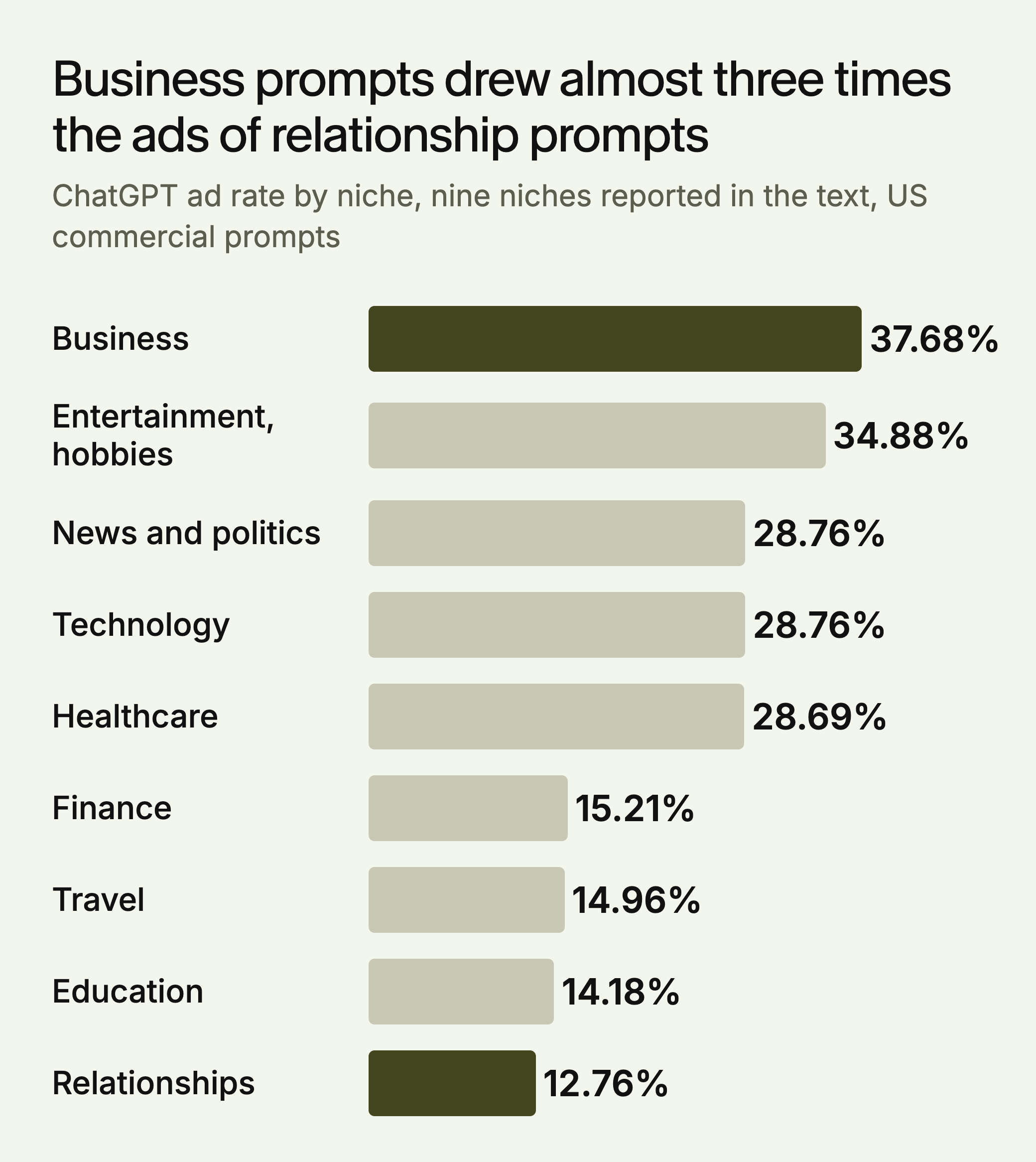
The average hides large differences, and the two platforms sell different things. The niches where ChatGPT shows ads least are often the ones where AI Mode shows them most:
| Niche | ChatGPT | AI Mode |
|---|---|---|
| Healthcare | 28.69% | 2.64% |
| News and politics | 28.76% | 6.8% |
| Technology | 28.76% | 29.4% |
| Business | 37.68% | 39.1% |
| Entertainment and hobbies | 34.88% | 59.6% |
| Finance | 15.21% | 44.7% |
| Travel | 14.96% | 50.4% |
| Education | 14.18% | 50.0% |
| Relationships | 12.76% | 29.8% |
The healthcare and politics rates are worth a second look. Cloro says OpenAI excludes ads near health, mental health and political topics, yet SE Ranking found ads on more than a quarter of those prompts. Commercial prompts in those niches, such as shopping for a health product, may simply fall outside the exclusion. We can’t confirm that from either study.
The ad business is growing fast. OpenAI began testing ads in the US on February 9, 2026. PPC Land reports that self-serve buying with cost-per-click bidding opened to US businesses on May 5, and that ads had reached more than 60 countries by September.
What Ads Change for Organic Citations
So far, ads and citations look like separate systems. In SE Ranking’s data, each placement was one sponsored offer in a card below the response. The advertiser’s domain was cited in 3.63% of placements and its brand was mentioned in 4.44%. OpenAI has said ads don’t influence ChatGPT’s answers, as ForkLog reported. We can’t verify that from outside.
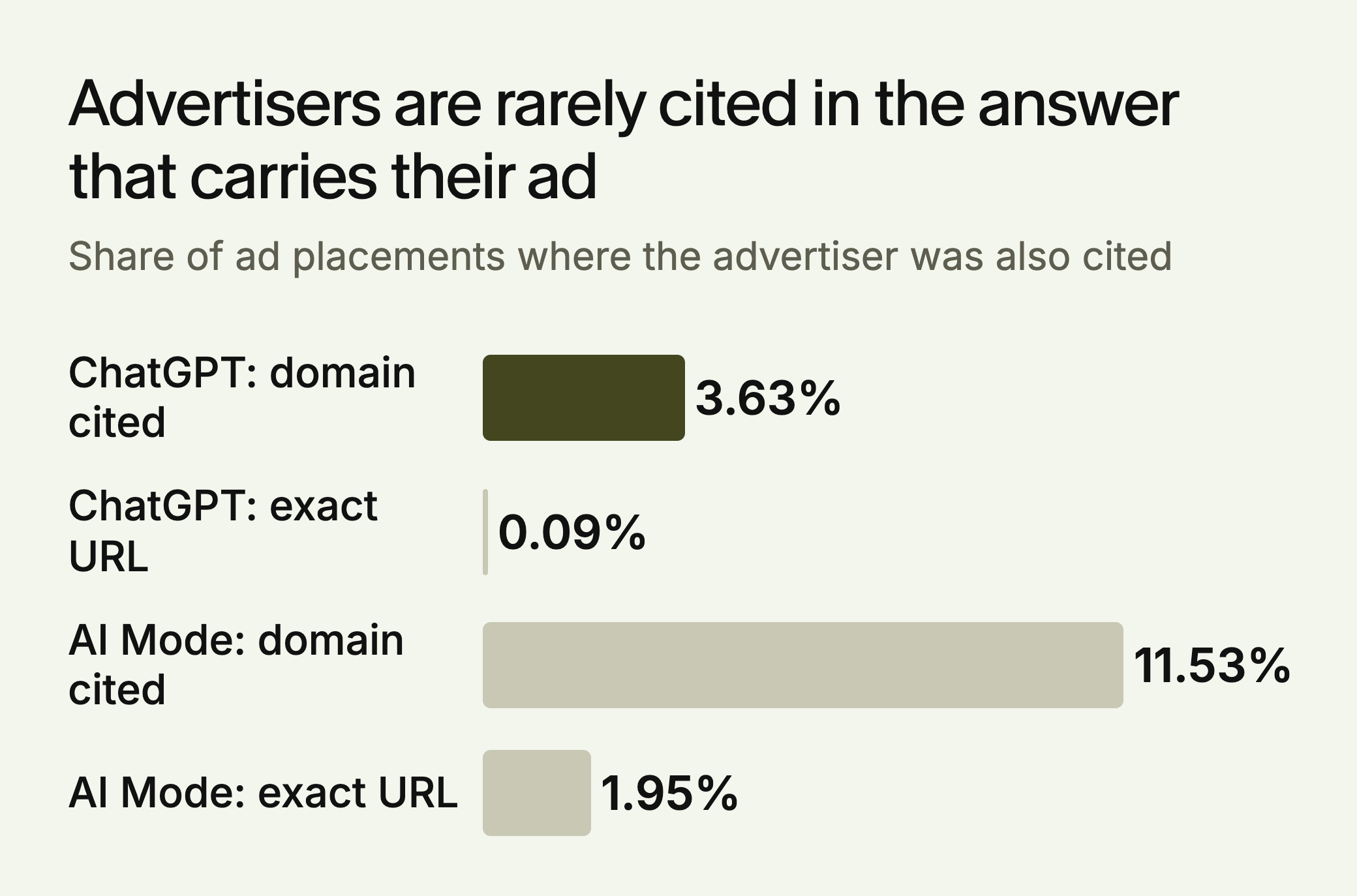
The exact advertised page was cited in just 12 ChatGPT placements. The higher AI Mode figure doesn’t show that ads buy citations there either. Big advertisers tend to be well-known brands that engines cite anyway, and this data can’t separate the two. The formats differ too: ChatGPT shows one offer per answer, while 71.1% of AI Mode placements had two ads side by side.
Two practical points follow:
- Ads don’t replace organic visibility. A paid card appears only while you pay, and the data shows it rarely comes with a citation.
- Organic citations aren’t protected from ads either. A competitor’s card can sit directly under an answer that recommends you. We found no published data on how much attention that takes away.
Relevance is also a problem for advertisers: SE Ranking found 14.35% of ad impressions were no more related to the query than a random pairing. If you test ChatGPT ads, review where they actually appear. The mismatch rate ranged from 2.6% in Pets and 4% in Travel to 51.1% in Relationships and 54.2% in News and Politics, and SE Ranking says the true rate is likely higher, since manual review found more weak matches.
Who Is Buying, and Whether to Test
Some niches are already crowded by a few buyers. SE Ranking counted 1,159 advertisers. BestMoney alone had 13.56% of all ChatGPT ads. Hungryroot had 79.92% of Food and Beverage ads, Booking.com 62.57% of Travel, Robinhood 52.24% of Finance and TickPick 51.03% of Entertainment and Hobbies. In a niche like those, a small test budget will be competing against one dominant buyer.
| Test now if | Wait if |
|---|---|
| Your buyers ask ChatGPT commercial questions and you can sell to them in a served country | Ads aren’t running in your main countries |
| You can measure a landing page conversion on its own | You’d judge success by citations or brand mentions |
| Your page answers the exact question behind the prompt | Your category is prone to mismatched placements |
| You already earn organic mentions on the sources engines cite | Competitors are named in answers and you aren’t: fix that first |
For a rough reference, SE Ranking ran its own test for about two weeks: 3 campaigns, 8 ad groups and 48 ads in the US, Canada, Australia and New Zealand. It got more than 97,000 impressions, 1,263 clicks and a 1.30% click-through rate. The campaigns produced very few sign-ups, and SE Ranking stopped them. That’s one advertiser promoting itself, so it’s a single data point.
One technical check before you start: OpenAI’s documentation says OAI-AdsBot visits landing pages of submitted ads to check policy compliance and help decide when to show the ad. Make sure your robots.txt and firewall don’t block it.
What the Evidence Says About Organic Citations
The research is uneven. Three findings are worth knowing, each with limits:
Mentions across the web correlate with visibility. Ahrefs’ May 2025 study of 75,000 brands found branded web mentions correlated with AI Overview brand visibility at 0.664, against 0.218 for backlinks. It’s a correlation for Google AI Overviews, and it doesn’t show that mentions cause citations.
Citing sources helped on a benchmark, mostly for lower-ranked pages. In the Princeton GEO study, Cite Sources raised visibility about 28% on Position-Adjusted Word Count. The effect was +115.1% for pages at rank 5 and -30.3% at rank 1. These are tests on a benchmark, not proof for live engines.
Structure may help. A March 2026 preprint reported a 17.3% citation improvement from changing content structure across six generative engines. Treat it as early work: the abstract doesn’t say how the engines were tested.
Engines Cite Different Sources
Don’t assume that a win on one engine carries over. Writesonic’s study of 161,286 prompts (May and June 2026, vendor data) found ChatGPT and Perplexity shared about 13% of cited domains on a Jaccard measure at domain level, and exact URLs would overlap less.
The sources themselves also shift. Semrush reported Promptwatch data showing Reddit’s share of ChatGPT citations falling from 3.8% to 0.5% in August 2026, a drop Promptwatch calls provisional.
Ads are also not evenly spread. Perplexity stopped running ads, citing concerns about user trust, so paid pressure on ChatGPT and Google doesn’t carry over there.
What to Do This Quarter
- Find the sources engines already cite in your category. Run 25 buyer prompts on each engine and list the cited domains. Those are your targets, and they beat any general list.
- Earn mentions on those sites. Bylined articles, listings, reviews and honest community answers all count. If you consider Wikipedia, read its conflict of interest guideline first, because it strongly discourages editing about your own company.
- Publish original data. A survey or customer analysis gives other sites a reason to mention you, and competitors can’t copy it.
- Test ads as a separate experiment. Judge them on their own results, and don’t expect them to improve your citations. Keep the same tracked prompt set running during the test, so you can see for yourself whether organic mentions move.
How to Measure Your Footprint
Search Console won’t show you this. Pick 25 to 50 prompts your buyers would really ask, run them on a schedule on each engine, and record:
- Presence: whether you’re named, and whether the description is accurate.
- Sources: which domains were cited for each answer.
- Share of voice: how often you appear against named competitors on the same prompts.
- Ads: whether a competitor’s card appears under answers that mention you, using a Free or Go account.
The last item gives you a number no published study has: how often your organic mentions sit directly above a competitor’s ad. The company and figures below are made up for illustration. Brightloom, a mattress brand, runs 30 prompts three times each on a Free account, for 90 answers. It’s named in 34 of them, and a competitor’s card appears under 11 of those 34. That’s 32% ad exposure, which is high enough to read those 11 answers closely. If the ad competes for the same purchase, Brightloom has a reason to test ads on those prompts or strengthen the recommendation itself. If the cards are off-topic, it can ignore them.
LLMagnet measures AI visibility across seven engines, and its agent prepares fixes for you to approve. To get a first read, run the free audit at ai-visibility.llmagnet.com.

 Gemini



 30-day free trial · no credit card